Introduction
Your website often makes the first sales pitch before you get the chance. People check it before they call, email or visit, so the agency behind it matters more than most suppliers you will hire.
The difficulty is that the UK has thousands of studios, freelancers and “full-service” agencies. Most show the same polished portfolio and promise the same results. This guide covers the factors to consider before choosing a web design agency in UK market, and it built to help you decide, not just browse. You will get 10 criteria, the questions that expose weak agencies, realistic costs, red flags and a scorecard for comparing your shortlist.
Quick answer: how to choose a web design agency in five steps
- Write a short brief with your goals and a budget range.
- Shortlist three to five agencies that can show results, not just screenshots.
- Ask about process, code ownership, SEO, accessibility and AI use.
- Compare itemised proposals like for like.
- Check the contract for support terms and who owns what.
Before You Contact Any Agency: Get Clear on What You Need
Most weak agency relationships start before the first call. If you have not defined the job, a confident salesperson will define it for you.
Start With the Outcome, Not the Website
“We need a new website” describes a deliverable. A goal describes what changes for your business. If you run a plumbing firm, the goal might be “double the number of emergency call-out enquiries from Google”. If you run an online shop, it might be “raise the checkout completion rate”.
Pick one to three measurable outcomes. Good agencies will ask for them. Agencies that never do are telling you how they will judge their own work.
Write on One-Page Brief
A brief doesn’t need 40 pages. It needs enough detail that two agencies would quote for the same project. Before you send anything, tick off:
- Who your customers are and what they need from the site.
- What your current site fails to do (or why you need a first one).
- Must-have features, such as booking, payments, or CRM integration.
- Two or three sites you like and one you dislike.
- Fixed deadlines, such as a product launch or event.
- Your budget range.
The brief also becomes your yardstick. When proposals arrive, you can see which agencies read it and which pasted in a template.
Share Your Budget Range
Many buyers hide their budget in case agencies quote up to it. The usual result is the opposite. Without a figure, agencies guess, and you receive quotes that cannot be compared.
Here is a simple illustration. You tell three agencies you have “£8,000 to £12,000”. One proposes a focused lead-generation site. Another suggests a smaller build now and a second phase later. The third tells you honestly that your feature list needs more than that. All three answers help you decide. A blank budget would have produced three unrelated quotes.
Agency, Freelancers, or Website Builder?
Before you short-list agencies, check that an agency is the right route at all. For some projects, it isn’t.
| Factor | Web design agency | Freelancer | DIY website builder |
|---|---|---|---|
| Best for | Complex sites, growth-focused projects, eCommerce, rebrands | Smaller projects with a clearly defined scope | Simple sites, tight budgets, quick launches |
| Skills on offer | Multi-disciplinary team: strategy, design, development, SEO, QA | One person, often strong in one area | Templates and drag-and-drop tools, with no professional input |
| Cost | Highest | Mid-range | Lowest upfront |
| Capacity and continuity | Strong, since the work doesn’t depend on one person | Risk if they’re unavailable or move on | You’re fully responsible |
| Strategy and long-term support | Usually included or available | Varies widely | None |
| Main risk | Paying for a process you don’t need | Single point of failure, limited range of skills | Limited flexibility, harder to scale or differentiate |
10 Factors to Consider Before Choosing a Web Design Agency in the UK
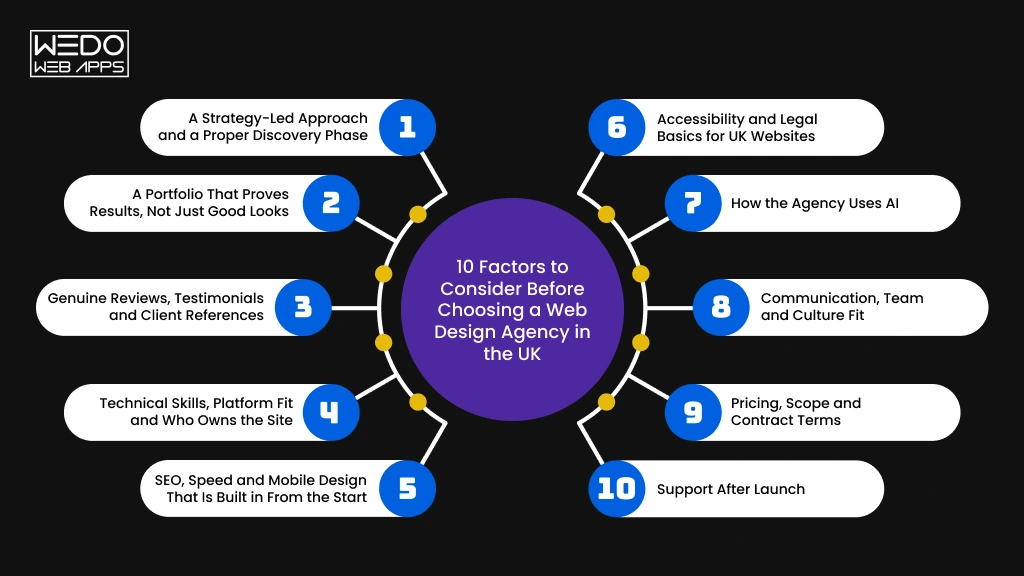
Once you know that an agency is the right fit, the next question is what to look for in a web design agency. These 10 factors are the practical web design agency selection tips that separate good partners from persuasive ones. Each one includes something you can change yourself, so you aren’t relying on the agency’s word.
1. A Strategy-Led Approach and a Proper Discovery Phase
Strong agencies spend time understanding your business before they open a design tool. This stage is usually called discovery. It typically covers your analytics, your competitors, your customers' journey and the structure of the site, all before any visual design begins.
Here is why it matters. A solicitor’s firm may think it needs a fresh look. Discovery shows that most visitors land on a service page with no clear next step. The fix is structure and copy, not a new colour palette. Skip discovery and you pay to redesign the wrong thing.
You can spot the difference in the first call:
| In the first call | Strong sign | Weak sign |
|---|---|---|
| Opening questions | Asks about your customers and what isn’t working | Asks which colours and styles you prefer |
| Proposed first step | A defined discovery stage | Homepage mockups |
| How success is judged | Agrees measures like enquiries or conversion rate | Talks about “modern” and “clean” design |
| Reaction to your brief | Challenges parts of it | Agrees with everything |
2. A Portfolio That Proves Results, Not Just Good Looks
A portfolio shows what an agency makes. It doesn’t show whether it works. Your own site won’t be in there either, so use it to judge how they solve problems, not whether you like their style.
Run through these five checks:
- Ask what changed after launch. A useful answer sounds like: “Contract form enquiries rose after we rebuilt the service pages and cut load time”. Treat any percentage as a claim until a client confirms it.
- Test live sites yourself. Run two or three client sites through Google PageSpeed Insights and note the Core Web Vitals results. Then open them on your phone and try the menu and forms.
- Visit older projects. A site built two years ago that still looks sharp and loads quickly says more than a fresh launch.
- Look for range. If every site shares the same layout with different logos, you can buy a template.
- Look for a similar problem, not the same sector. An agency that has solved a complex booking flow for a hotel can handle one for a clinic.
3. Genuine Reviews, Testimonials and Client References
The testimonials on an agency’s own website are selected by the agency. Use them to find client names, then check elsewhere. Google reviews, Trustpilot and Clutch all give you independent feedback.
Read for detail. Compare these two:
“Great team, would recommend.”
“They flagged in week three that our product import would take longer than planned, priced the extra work clearly and still launched before our sale.”
The second tells you how the agency behaves when something goes wrong, which is what you need to know. When you read reviews, start with the three-star ones. They are usually the most honest, and the agency’s reply shows how it handles disagreement.
Before you sign, ask for two client references you can call. Three questions are enough:
- Did the project hit its deadline, and what happened when it didn’t?
- How did they handle changes to the scope?
- Would you hire them again for a larger project?
An agency that is confident in its work will arrange these quickly.
4. Technical Skills, Platform Fit and Who Owns the Site
A good design only helps if it can be built well and run by your team later. Many buyers skip this part of choosing a web design agency UK wide, and it is where long-term problems start.
Here is a simple example. A bakery owner pays for a fully custom site. It looks great. But now every price change needs a developer and a bill. A Shopify store would have let her do it herself in two minutes.
The platform should match how you will use the site, not what the agency likes to build. As a rule of thumb:
- If you update content often, look at WordPress or a similar CMS.
- If you sell products online, look at Shopify or WooCommerce.
- If you need a polished marketing site with full visual control, Webflow is worth a look.
- If your needs are unusual, a custom build may be right, but it costs more to run.
Be careful with an agency that suggests the same platform to every client.
Ownership matters just as much. It is one of the most important things to check when you think about what to look for in a web design agency. Before you sign, make sure you can tick all of these:
- The domain is registered in your name.
- The hosting account is in your name.
- You can access the code.
- No licence or plugin is tied to the agency’s account.
If an agency hesitates on any of these, treat it as a warning sign.
5. SEO, Speed and Mobile Design That Is Built in From the Start
Many new sites look great and still bring in no visitors. Adding SEO after launch costs more, because the structure is already fixed. These web design agency selection tips take about 10 minutes and don’t need any technical skill.
Try this before you shortlist anyone:
- Open two of the agency’s client sites on your phone. Notice how long it takes before you can read the page and tap a button.
- Paste the same site into Google PageSpeed Insights. Look at the Core Web Vitals results. Google counts a site as good when the main content loads in 2.5 seconds or less, the page reacts to a tap in under 200 milliseconds, and the layout doesn’t jump around while loading,
- Ask what happens to your old pages when the new site goes live.
That last question matters more than it sounds. Imagine your old page for “emergency electrician in Leeds” brings in calls every week. The new site uses a different web address, and nobody sets up a redirect. The page drops out of Google and the calls stop. A good agency will talk about a URL map, 301 redirects and checks before and after launch.
Also ask whether the basics are part of the build: page titles, heading structure, schema markup and a sitemap. If not, find out who will do them and what it will cost.
“Is on-page SEO part of your standard build, or an extra?”
The answer tells you a lot.
Search is also changing. More people now read an AI summary before they click anything. No agency can promise you a spot in those summaries. Be wary of any that do. What they can do is build the site so it is easy to read and understand: clear headings, structured data, fast pages and answers placed right where people look for them. That is good SEO with a sharper focus on clarity, not a separate service.
6. Accessibility and Legal Basics for UK Websites
Cheap proposals often cut corners here. The risk then falls on you, not the agency, so it is worth checking when hiring a web design company UK businesses rely on for their main offline presence.
Accessibility
Under the Equality Act 2010, UK service providers must make reasonable adjustments for disabled people. A site that people can’t use with a keyboard or a screen reader may not meet that standard. Most agencies build to WCAG 2.2 level AA. Public sector bodies have extra legal duties.
Ask: “Do you test with a keyboard and a screen reader, or only with an automated scanner?”
Scanners catch only some of the problems, so a “yes” to the first part is the better answer.
Cookies and Privacy
The rule changed this year. The Data (Use and Access) Act came into force on 5 February 2026. It added a few narrow exceptions, such as for some low-risk analytics. Consent is still the default for most tracking. The penalties are also bigger: fines under PECR can reach £17.5 million or 4% of global turnover.
Ask: “How do you set up our cookie banner so tracking tags don’t run before someone says yes?”
Who does what
A fair split looks like this. The agency builds and tests the site, sets up consent properly and flags any third-party scripts that collect data. You approve the privacy and cookie wording, choose which tracking tools to use and keep your consent records. If you handle sensitive data, ask a solicitor to review the setup.
An agency that says “compliance is your job” and stops there is giving you very little. One that explains what it covers and what it leaves to you is doing the work properly. Together with the points above, this completes the technical factors to consider before choosing a web design agency in UK projects. Next come the factors about the agency itself: how it uses AI, how it communicates, what it charges and how it supports you afterwards.
7. How the Agency Uses AI
Most agencies now use AI somewhere in their work, for ideas, code help, testing or copy drafts. That is not a problem. What matters is whether a person checks the result and whether your data stays safe. This is one of the newer factors to consider before choosing a web design agency in UK buyers often forget to ask about.
Ask three plain questions and listen for specific answers:
- “Where do you use AI?” A good answer names real tasks, such as “first drafts of page structure, then a designer rewords them.” “We use AI for everything” is a weak answer, and so is “we never touch it”.
- “Who checks the output?” You want a named role, like a senior developer who reviews all AI-assisted code before it goes live.
- “Does our content or customer data go into public AI tools?” The answer should be no. If you share product details or client information, this protects you under UK GDPR.
Also ask where any time saved goes. Faster work should mean better testing or a lower bill, not just more profit for the agency.
8. Communication, Team and Culture Fit
You will work with these people for months, so the way they talk to you matters as much as what they build. Part of knowing how to choose a web design agency is seeing how it behaves before you sign.
Watch for these during the sales process:
- Who turns up. If a senior person pitches and a junior one builds, ask to meet the team doing the work.
- How fast they reply. Slow answers now will not get faster once they have your deposit.
- How they handle disagreement. Say you doubt one of their ideas. A good agency explains its reasoning. A poor one agrees with you, then does what it planned.
Also ask which tool they use for updates and how often you will hear from them. A weekly update you can read in two minutes beats a monthly call that runs for an hour.
9. Pricing, Scope and Contract Terms
A low quote is not always a good deal. Here is a made-up example to show why.
| Feature | Quote A: £6,000 | Quote B: £9,000 |
|---|---|---|
| Discovery and strategy | Not included | Included |
| Revision rounds | 1 | 3 |
| SEO setup and redirects | Extra | Included |
| Training for your team | Extra | Included |
| 30-day post-launch fixes | Included | Not included |
Add the extra to Quote A and the gap shrinks fast. Always ask for itemised quotes so you can compare like with like.
Before you sign, check that the contract covers who owns the design and code, what counts as a change to scope and what it costs, payment stages tied to milestones, and how either side can end the agreement. Be careful with any agency that asks for most of the money upfront.
10. Support After Launch
Your site is not finished on launch day. Updates break things, people make mistakes and you will want new pages. Test the agency with three everyday situations:
- The site goes down at 9 am on a Monday. Who do you call, and how fast will they reply? Look for a stated response time in writing.
- An update breaks your contact form. Is fixing it covered by a maintenance plan, or billed by the hour?
- You want a new service page next quarter. Will you pay a fixed rate, a retainer or a new quote each time?
Ask for the support terms before the project starts, not after. A clear maintenance plan with set hours and response times is one of the best web design agency UK factors to look at, because it shows the agency plans to stay once the invoice is paid.
How Much Does a Web Design Agency Cost in the UK?
Price is where most people start and where most comparisons go wrong. Figures vary by source, so use these as a guide when hiring a web design company UK wide, not as a fixed price list.
Typical Price Ranges
- Small business site (5 to 10 pages): a small agency will usually charge £2,500 to £10,000.
- Online shop on Shopify or WooCommerce: most UK agencies charge £5,000 to £15,000, and complex customer work can run from £12,000 to £40,000.
- Hourly rates: small agencies charge roughly £50 to £150 an hour, and large agencies £75 to £200 or more.
Why Two Quotes Can Be Thousands Apart
Every quote is hours multiplied by rate. The gap usually comes from the hours. Here is a simple illustration:
- Agency A: 60 hours at £60 = £3,600. Starts from a template and skips discovery.
- Agency B: 140 hours at £90 = £12,600. Includes research, custom design, SEO setup and testing.
Neither is wrong. They are selling different jobs. One of the most useful web design agency selection tips is to ask every agency for its estimated hours and which roles will work on your site.
A Quick Value Check
Before you decide whether a quote is cheap or expensive, ask yourself:
- What am I getting here that a website builder could not give me?
- Does the price include SEO setup, training and support, or will I pay for those later?
- Could I explain to a colleague exactly what this quote covers?
If you can’t answer the third one, ask the agency to break the quote down further.
Questions to Ask a Web Design Agency and How to Read the Answers
You have already seen questions on AI, ownership, pricing and support in the factors above. This section covers the rest, and they work best on a first call. The best way to learn how to learn how to choose a web design agency is to ask things a sales script can’t answer.
Question About Process and Timeline
Ask these four in order:
1. What happens in the first four weeks?
Listen for: named steps, such as research, site structure and first designs. Vague answers like “we get started on the look and feel” suggest no set process.
2. What do you need from us, and by when?
Listen for: dates. Late client content is a common cause of delays, so a good agency will say something like “copy by week four, or launch moves back.”
3. How many revision rounds are included, and what happens after that?
Listen for: a clear number and a clear picture for extra rounds.
4. Who writes the copy and sources the images?
Listen for: a direct answer. This is a hidden cost in many projects, and it often adds weeks.
The Question That Reveals the Most
“What would you change in our brief?”
It shows whether the agency has read your brief and is willing to challenge it. Compare two replies:
- Strong: “Your brief lists 12 pages, but your analytics show most visitors only use three. We would build those first and test the rest.”
- Weak: “Nothing, it looks great”.
You are paying for judgment as well as skill, so choose the agency that gives you something to think about.
Red Flags to Watch for When Hiring a Web Design Company
Some warning signs appear before you have seen a price. When choosing a web design agency UK buyers often notice them and talk themselves out of it. Here are the ones to catch, beyond the points we have already covered.
In the Sales Process
The countdown discount. “This price is only good until Friday” is a pressure tactic. Real quotes stay valid for weeks. Ask for the offer in writing and take your time to compare.
The guaranteed ranking. Anyone who promises you the top spot on Google is guessing. Nobody controls search results. A better answer describes what they will do and how they will measure progress.
In the Proposal and Contract
The “free” website. A free or very cheap build often comes with a long hosting deal. Suppose it costs £99 a month for 36 months. That is £3,546 for hosting alone, and you may not own the site at the end. Always add up the full term before you say yes.
The impossible timeline. A custom site in seven days means skipped research, skipped testing or both. Ask for a schedule with dates for each stage and a clear owner for each task.
In the Portfolio and Reviews
Screenshots with no links. If you can’t visit a project, you can’t test how it loads or works on your phone. Ask for the live address, and if one has gone offline, ask why.
Review that looks too tidy. A batch of five-star reviews posted in the same week, all praising the “great team” in similar words, tells you little. Check the dates, look for names you can find on LinkedIn and read the reviews that include detail.
Pause or Walk Away?
Not every flag means you should leave. Use this quick rule:
- Pause and ask more questions if the agency is vague, a bit slow to reply or can’t show results yet.
- Walk away if it guarantees rankings, won’t put terms in writing or won’t let you own your site.
How to Shortlist, Compare and Decide
By now you know what to look for. This section turns it into a decision you can defend to your team, your boss or yourself.
Local or National Agency?
Neither is better by default. It depends on how you like to work.
- Choose local if you want face-to-face workshops, a team that knows your area and easy catch-ups over coffee. This suits independent shops, clinics and trades.
- Choose national if you need a wider range of skills, such as eCommerce, integrations or multi-location rollout. Most national agencies work well over video calls, so distance matters less than it used to.
A good test is simple. Ask yourself whether you will actually use the in-person meetings. If the honest answer is no, widen your search.
Build a Shortlist of Three to Five
More than five becomes hard to compare. Fewer than three leaves you with no leverage. Here is a quick way to get there:
- Ask for referrals from business owners in your network. They will tell you things a website never will.
- Read independent reviews on Google and Clutch, starting with the three-star ones.
- Check Companies House. It is free. Look at how long the company has existed, whether its accounts are filed on time and who the directors are.
- Send each agency the same brief. Their replies show who listens.
Compare Proposals Like for Like
Put the proposal side by side under the same headings: scope, estimated hours, timeline, revision rounds, ownership terms, support and the total cost for the first year. Where a proposal leaves a heading blank, ask for it. A missing line is usually either an extra charge or an agency that did not think about it.
Score Your Shortlist
Numbers help you stay fair when one agency is simply more charming. The table below lists the best web design agency UK factors from this guide, with suggested weights that add up to 100. Change the weights to suit your project. A shop owner might raise SEO and speed, for example.
| Factor | Weight |
|---|---|
| Strategy and discovery process | 15 |
| Portfolio results | 15 |
| Technical skills and ownership | 15 |
| Price and contract clarity | 15 |
| SEO and speed | 10 |
| Accessibility and compliance | 10 |
| Communication and team | 10 |
| AI use and data handling | 5 |
| Post-launch support | 5 |
Score each agency from 1 to 5 on every row. Then divide the score by 5 and multiply by the weight. For example, a 4 strategy gives 4/5 x 15 = 12 points. Add up the points for a total out of 100.
If two agencies finish within five points of each other, let the references and the “what would you change in our brief?” The answer is decided.
Final Checklist Before You Sign
Run through this once the contract is on your desk. If you can tick every box, you are in a strong position.
About the agency
- ☐ I have seen live results, not only screenshots.
- ☐ I have spoken to at least two past clients.
- ☐ I have met the people who will actually do the work.
About the project
- ☐ The scope, timeline and number of revision rounds are in writing.
- ☐ The quote is itemised and includes the first-year running costs.
- ☐ SEO setup, redirects and accessibility testing are part of the build.
About ownership and support
- ☐ The domain, hosting and code are in my name or fully accessible to me.
- ☐ Support teams and response times are written down.
- ☐ I know how the agency uses AI and where my data goes.
Final Thoughts
A good decision comes down to evidence. The best agency for you is the one that understands your goals, shows proof of past results, explains its prices clearly and puts the important terms in writing. Looks matter, but they should not be the deciding factor.
If you remember one thing about what to look for in a web development agency, make it this: ask for the thing that can’t be faked. That could be a client you can call, a live site you can test or an honest answer to “what would you change in our brief?”