Introduction
Thinking about making your own Uber Eats app? You may already have the business idea, but the bigger questions are often where to start, what features you need, how much development will cost, and how to turn the concept into a scalable food delivery platform.
To create an app like Uber Eats, you need more than a customer-facing ordering app. An Uber Eats-type platform is a multi-sided marketplace connecting customers with restaurants and delivery partners, and administrators manage the operations behind the platform. Each side needs its own workflows, features, and success through the right information.
Your planning therefore needs to cover the business model, revenue streams, MVP features, restaurant and delivery workflows, technology, payments, and many more. You also need to decide which capabilities should be included at launch and which can be added as your platform grows.
AI can add value to specific areas of Uber Eats like app development, including food recommendations, demand forecasting, delivery assignment, ETA prediction, and customer support.
In this guide, you will learn how to build a food delivery app like Uber Eats, from choosing the right business model and defining features to understanding the development process, AI opportunities, cost, timeline, development approach, and launch strategy.
What Is an Uber Eats Like App?
An Uber Eats like app is an on-demand food delivery platform that connects customers with restaurants and delivery partners. Customers can find nearby restaurants, browse menus, place orders, make payments, and track deliveries from one platform.
Unlike a basic food ordering app, this model works as a multi-sided marketplace. Restaurants manage menus and orders, delivery partners handle pickups and deliveries, and administrators oversee users, payments, commissions, and platform operations.
When you build a food delivery app like Uber Eats, these different user groups need to work through connected systems so that an order can move smoothly from the restaurants to the customer.
How Does a Food Delivery App Like Uber Eats Work?
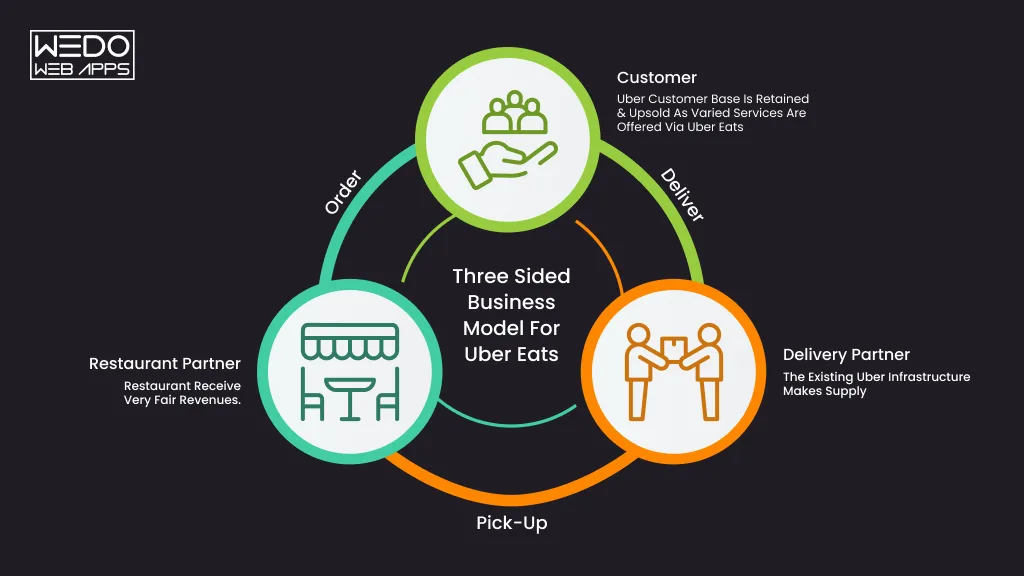
The process generally follows six stages:
Restaurant discovery -> Order placement -> Restaurant confirmation -> Food preparation -> Delivery assignment -> Order delivery
For example, a customer selects a restaurant and places an order. The restaurant confirms and prepares it. A delivery partner then receives the delivery request, picks up the order, and delivers it to the customer. The platform manages notifications, payments, order status, and tracking throughout the process.
Who Uses an Uber Eats Like Platform?
An Uber Eats clone app typically serves four user groups:
| User | Main Function |
|---|---|
| Customer | Searches restaurants, orders food, pays, and tracks deliveries |
| Restaurant | Manages menus, orders, availability, and sales |
| Delivery Partner | Accepts deliveries, handles pickups, and completes orders |
| Admin | Manages users, restaurants, orders, payments, and operations |
This multi-user structure is one of the first things to define when planning on-demand food delivery app development.
Choose the Right Business Model Before You Build Your Food Delivery App
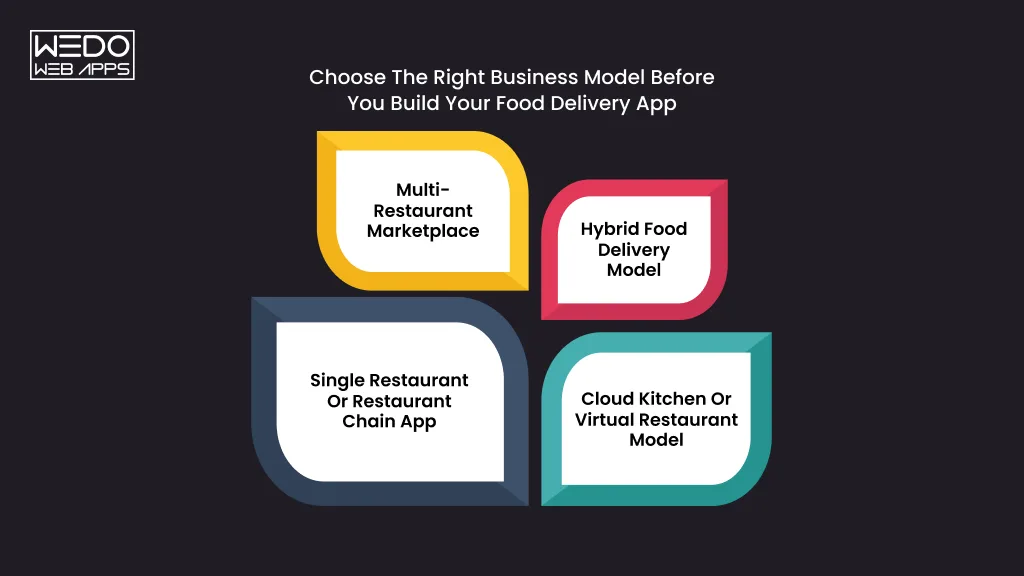
Before you create an app like Uber Eats, decide how your platform will operate. Your business model affects who you serve, how restaurants join the platform, who handles deliveries, and how you generate revenue.
Multi-Restaurant Marketplace
This model connects multiple restaurants with customers through one platform. Restaurants manage their menus and orders, while your platform coordinates the customer experience and delivery process.
Best suited for: Startups and businesses building a local or regional food delivery marketplace.
Single Restaurant or Restaurant Chain App
A restaurant or chain can build its own ordering app to manage direct orders, deliveries, pickup, and customer relationships.
Best suited for: Restaurant brands that want greater control over their ordering operations.
Cloud Kitchen or Virtual Restaurant Model
A cloud kitchen can use a delivery platform to manage orders from one or multiple food brands without operating traditional dine-in locations.
Best suited for: Food businesses focused primarily on delivery and takeaway.
Hybrid Food Delivery Model
You can combine different approaches based on your market. For example, your platform could support multiple restaurants while also offering pickup, scheduled delivery, or a dedicated delivery network.
The right model depends on your target market, restaurant supply, delivery strategy, and available resources. Define these decisions before starting Uber Eats like app development so your product scope supports the business model from the beginning.
How Does an App Like Uber Eats Make Money?
When you build a food delivery app, choosing the right revenue streams is as important as defining its features. You can combine multiple models based on your market, restaurant, and delivery structure.
| Revenue Stream | How It Works |
|---|---|
| Restaurant Commission | Restaurants pay a percentage of eligible orders generated through the platform. |
| Delivery Fees | Customers pay a delivery charge based on factors such as distance, demand, or order value. |
| Service Fees | A separate fee may be added to eligible customer orders. |
| Sponsored Listings | Restaurants pay to promote their listings within selected areas or search results. |
| Subscriptions | Customers pay a recurring fee for benefits such as delivery savings or member offers. |
For example, a new food delivery app like Uber Eats could initially earn through restaurant commissions and delivery fees. As the platform gains restaurant traffic, sponsored placements and subscriptions can provide additional revenue.
Features You Need to Create an App Like Uber Eats
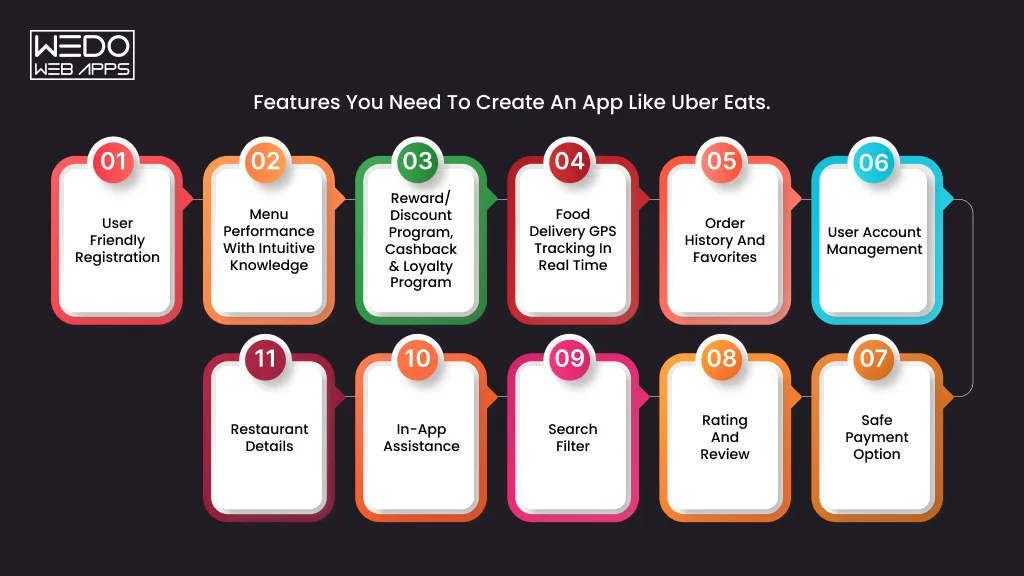
When you create an app like Uber Eats, each participant needs features designed around their specific tasks. The customer discovers and orders food, the restaurant manages orders, the delivery partner handles fulfillment, and the admin controls the platform.
Customer App Features
The customer experience should cover the complete ordering journey, from finding a restaurant to receiving the food.
- Account access: Registration and login with secure authentication.
- Restaurant discovery: Location detection, restaurant listings, search filters, and restaurant profiles.
- Menu and ordering: Digital menus, food customization, favorites, cart, promo codes, and reordering.
- Checkout: Multiple payment options and scheduled orders.
- Delivery tracking: Real-time order tracking, delivery ETA, and push notifications.
- Post-order support: Order history, ratings, reviews, and customer support.
For example, a customer can search for nearby restaurants, filter options by cuisine or rating, customize a meal, schedule the order, and track its delivery from the same app.
Restaurant App or Dashboard Features
Restaurants need tools to manage their storefront and process orders without depending on the platform operator for routine updates.
- Restaurant management: Registration, profile, menu, pricing, and availability management.
- Order management: Order acceptance, preparation status, and order tracking.
- Inventory control: Food availability and inventory updates.
- Promotion tools: Discounts, offers, and promotional campaigns.
- Business insights: Sales reports, revenue analytics, and customer feedback.
This gives restaurants control over information that changes frequently, such as menu items, prices, preparation times, and availability.
Delivery Partner App Features
The delivery partner app should make each delivery easy to accept, navigate, and complete.
- Partner onboarding: Registration and verification.
- Availability: Online and offline status management.
- Delivery management: Order assignment, acceptance, and pickup information.
- Navigation: Route guidance and live location sharing.
- Delivery updates: Pickup and delivery status management.
- Earnings: Earnings dashboards, wallet, payouts, and delivery history.
- Support: Access to assistance for delivery-related issues.
Admin Panel Features
The admin panel provides centralized control over the food delivery app and its marketplace operations.
- User management: Customers, restaurants, and delivery partners.
- Order management: Order monitoring, cancellations, and issue resolution.
- Financial controls: Commissions, payments, refunds, and settlements.
- Delivery management: Delivery zones and partner operations.
- Marketing: Promotions and platform offers.
- Analytics: Reports and business performance data.
- Platform settings: Operational configurations and administrative controls.
These features provide the core functionality for an Uber Eats clone app. Your MVP does not need every advanced capability at launch. Prioritize the features required to complete the ordering and delivery cycle, then expand based on actual user and business requirements.
Advanced Features That Can Make Your Food Delivery App Stand Out
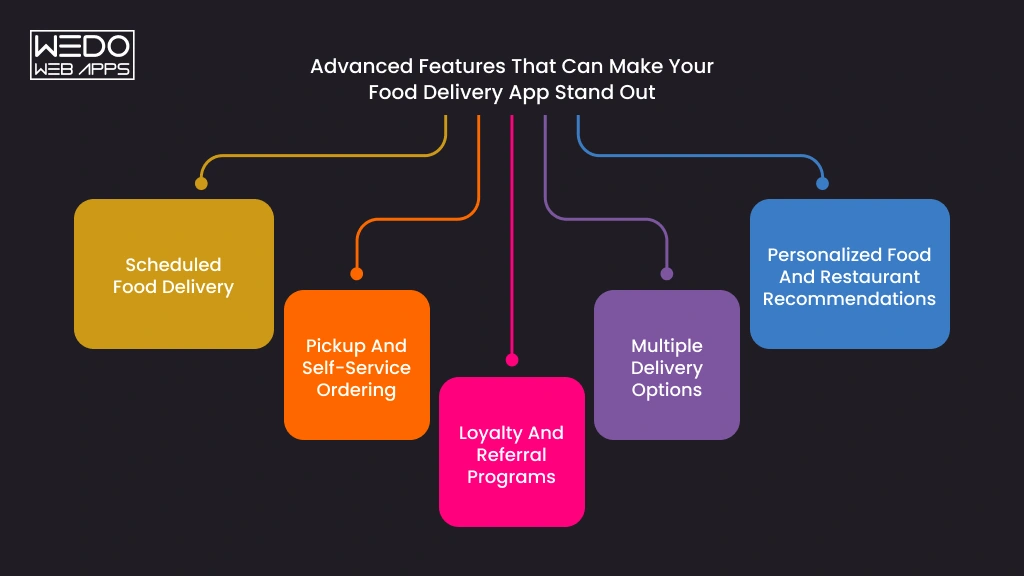
Once the core ordering and delivery journey is covered, advanced features can give customers more flexibility and help your platform encourage repeat orders.
Scheduled Food Delivery
Allow customers to select a preferred delivery time instead of ordering only for immediate delivery. This can be useful for planned meals and group orders.
Useful capabilities include:
- Select a preferred delivery date and time.
- Set preparation and delivery windows.
- Send reminders before scheduled orders.
- Allow restaurants to manage scheduled order capacity.
Pickup and Self-Service Ordering
Not every customer needs delivery. A pickup option lets users place their order through the app and collect it directly from the restaurant.
This can help restaurants handle more orders without adding delivery requirements to every transaction.
Loyalty and Referral Programs
Reward customers for repeat purchases and referrals to encourage continued use of the platform.
You can offer:
- Reward points on eligible orders.
- Discounts for repeat customers.
- Referral rewards.
- Membership-based benefits.
Multiple Delivery Options
Give customers more control over delivery based on their preferred cost and speed.
Possible options include:
- Standard delivery
- Priority delivery
- Scheduled delivery
- Pickup
The options you provide should match your delivery capacity and operating model.
Personalized Food and Restaurant Recommendations
Personalized recommendations can help customers find relevant restaurants and dishes without searching through every available option.
Recommendations can consider:
- Previous orders
- Preferred cuisines
- Location
- Browsing behavior
- Ordering frequency
AI can support this feature by identifying patterns in customer and order data. For example, a customer who regularly orders vegetarian food could receive more relevant restaurant and dish suggestions during their usual ordering times.
How AI Can Improve an Uber Eats Like App?
AI is becoming a valuable addition to on-demand food delivery app development, particularly for personalization, prediction, and operational automation. When you create an app like Uber Eats, AI can help your platform make better use of customer, restaurant, order, and delivery data.
AI-Based Food Recommendations
A food delivery app like Uber Eats can use AI to recommend restaurants and dishes based on individual customer behavior.
Recommendations can consider:
- Previous orders
- Preferred cuisines
- Browsing activity
- Location
- Ordering patterns
For example, a customer who frequently orders vegetarian meals could receive more relevant restaurant and dish suggestions.
Demand Forecasting
During Uber Eats like app development, AI integration services can be used to analyze historical ordering patterns and predict demand across different locations and time periods.
This can help businesses plan:
- Delivery partner availability
- Restaurant staffing
- Inventory requirements
- Peak hour capacity
Smarter Delivery Assignment
AI can support delivery assignments by analyzing factors such as delivery partner location, availability, current workload, restaurant preparation time, and estimated travel time.
This can help an on-demand food delivery app make more suitable delivery assignments as conditions change.
Dynamic ETA Prediction
Delivery estimates can change because of traffic, preparation delays, or order volume.
AI models can use historical and real-time data to provide more accurate ETAs and keep customers better informed throughout the delivery process.
AI Customer Support
AI-powered assistants can handle common questions related to order status, payments, delivery updates, cancellations, and account issues.
Complex cases can still be transferred to human support agents.
Personalized Offers
AI can identify patterns in customer behavior and help provide more relevant promotions.
For example, customers who regularly order a specific cuisine could receive offers from relevant restaurants instead of receiving the same promotions as every other user.
You do not need to implement every AI capability when you first build a food delivery app. Start with use cases that address clear business requirements, then add more as your platform collects the data needed to support them.
How to Build an App Like Uber Eats: Step by Step
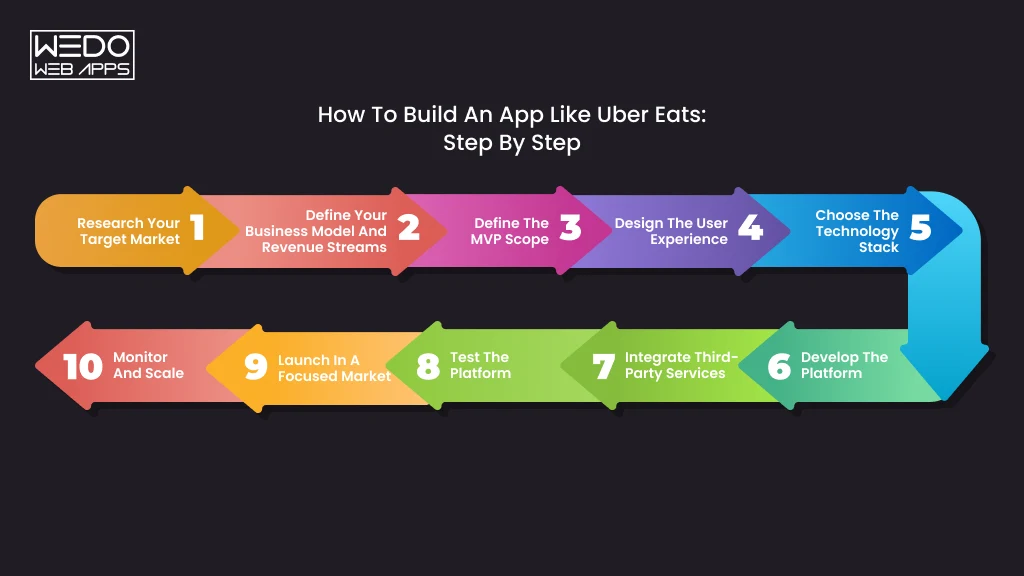
Building a food delivery platform involves more than developing a mobile application. You need to validate the market, define the operating model, plan the product, develop connected systems, and test the complete ordering journey.
Step 1: Research Your Target Market
Before you build a food delivery app, identify the customers and businesses you want to serve. Study the market where you plan to launch and understand what existing platforms offer.
Focus your research on:
- Target customer preferences
- Restaurant availability and requirements
- Competitor offerings and pricing
- Geographic coverage
- Expected delivery times
- Common customer pain points
For example, if customers in your target area frequently face limited late-night delivery options, that gap could influence your restaurant acquisition and operating strategy.
Step 2: Define Your Business Model and Revenue Streams
Decide how your marketplace will operate and who will pay for each service.
You may generate revenue through restaurant commissions, delivery fees, service fees, sponsored listings, or subscriptions.
Your business model should also define how restaurants are charged, how delivery partners are paid, and how customer fees are calculated.
Step 3: Define the MVP Scope
Your first version does not need every feature found in an established platform. Identify the functionality required to complete the core order cycle.
MVP priorities can include:
- Customer registration and restaurant discovery
- Menu browsing and cart
- Checkout and payments
- Restaurant order management
- Delivery assignment
- Order tracking
- Notifications
- Admin controls
Features such as advanced loyalty programs, AI recommendations, and complex analytics can be added after you validate the initial product.
Step 4: Design the User Experience
Map the complete user journey before development starts. Each participant needs an interface suited to their responsibilities.
Design flows for:
- Customers placing and tracking orders
- Restaurants managing menus and orders
- Delivery partners accepting and completing deliveries
- Administrators managing platform operations
Start with wireframes and user flows before moving to detailed interface design. This helps identify usability issues before development work begins.
Step 5: Choose the Technology Stack
The technology stack should support the features, integrations, expected traffic, and future growth of your platform.
Your food delivery app development stack may include:
| Layer | Technology Requirements |
|---|---|
| Mobile | Native iOS and Android or cross-platform development |
| Backend | APIs, authentication, order management, and business logic |
| Database | Users, restaurants, menus, orders, payments, and other platform data |
| Payments | Payment gateway and transaction processing |
| Maps | Location, routes, distance, and delivery tracking |
| Notifications | Push notifications, SMS, and email |
| Analytics | User, order, revenue, and operational data |
| Cloud | Hosting, storage, monitoring, backups, and deployment |
Choose technologies based on your actual product requirements rather than selecting tools simply because they are popular.
Step 6: Develop the Platform
Development brings the separate parts of your platform together. This includes the customer application, restaurant platform, delivery partner app, admin panel, backend, and APIs.
The backend connects these systems so that an action in one interface can trigger the appropriate update elsewhere.
For example, when a restaurant accepts an order, the customer should receive the updated status while the delivery system can prepare for the next fulfillment stage.
Step 7: Integrate Third-Party Services
Third-party services can provide functions that would otherwise require additional development.
Depending on your requirements, you may integrate:
- Payment gateways
- Maps and geolocation services
- Route calculation APIs
- Push notification services
- SMS and OTP providers
- Analytics platforms
- Cloud services
- AI APIs
Choose integrations based on your target market and required functionality. You do not need to integrate every available service from the beginning.
Step 8: Test the Platform
Testing should cover the complete order journey rather than individual screens alone.
Your testing process should include:
- Functional testing
- Payment and transaction testing
- API testing
- Location and tracking testing
- Security testing
- Performance testing
- Device and operating system testing
Run realistic scenarios such as placing an order, cancelling it, processing a refund, assigning a delivery partner, and handling a location or payment failure.
Step 9: Launch in a Focused Market
Launching in one defined geographic area can make an initial on-demand food delivery app development strategy easier to manage.
You can focus on building enough restaurant supply, delivery capacity, and customer demand within that area before expanding.
A smaller launch also gives you an opportunity to identify operational issues and collect real user feedback with fewer variables.
Step 10: Monitor and Scale
After launch, track how customers, restaurants, and delivery partners use the platform.
Monitor metrics such as:
- Order volume and completion rate
- Customer retention and repeat orders
- Cancellation rate
- Average delivery time
- Restaurant retention
- Delivery partner utilization
- Average order value
- Revenue per order
Use these results to decide which features, operational improvements, and new markets should receive further investment. This allows your Uber Eats like app development strategy to evolve according to actual platform performance.
How Much Does It Cost to Build an App Like Uber Eats?
The cost to create an app like Uber Eats depends on what you plan to build. A basic MVP with core ordering features will require a different budget than a full marketplace with separate customer and delivery apps, advanced logistics, analytics, and AI.
There is no single development price that applies to every food delivery app like Uber Eats. Your feature scope, technology choices, integrations, development teams, and post-launch requirements all affect the final estimate.
What Affects the Cost of an Uber Eats Clone App?
The main cost factors include:
| Factor | How It Affects Cost |
|---|---|
| Number of Platforms | iOS, Android, web, or cross-platform requirements change development effort. |
| Feature Complexity | Advanced ordering, loyalty, scheduling, and marketplace features require more development. |
| UI/UX Requirements | Custom interfaces and complex user journeys increase design effort. |
| Backend Complexity | Orders, payments, delivery logic, APIs, and marketplace workflows require substantial backend work. |
| Real-Time Tracking | Live location, delivery status, and ETA features require real-time data processing. |
| Payment Integrations | Multiple payment methods and transaction workflows add integration and testing requirements. |
| Third-Party APIs | Maps, SMS, notifications, analytics, and other services can add development and usage costs. |
| AI Functionality | Recommendations, forecasting, ETA prediction, and other AI features require additional data and infrastructure. |
| Admin Requirements | More operational controls, reports, roles, and dashboards increase development scope. |
| Security | Authentication, payment protection, data security, and access controls require dedicated work. |
| Testing | Larger platforms need broader functional, performance, security, and device testing. |
| Development | Team expertise, location, and engagement model affect development rates. |
| Post-Launch Support | Maintenance, monitoring, updates, bug fixes, and new features add ongoing costs. |
For example, adding live delivery tracking is not simply a map feature. It requires location updates, route services, backend processing, delivery partner integration, and customer-facing status updates.
Uber Eats App Development Cost by Development Approach
Your development approach can also affect the initial investment, level of customization, and long-term control.
| Approach | Initial Cost | Customization | Suitable For |
|---|---|---|---|
| Custom Development | Higher | High | Businesses building a unique marketplace |
| Ready-Made Solution | Lower | Limited to moderate | Businesses testing a standard food delivery model |
| Hybrid Approach | Moderate | Moderate to high | Businesses combining existing services with custom functionality |
Custom development gives you control over the product architecture, workflows, branding, integrations, and future expansion. It is generally suitable when your Uber Eats clone app needs features that standard solutions cannot provide.
Ready-made solutions can reduce initial development work because common food delivery functions are already available. However, customization and control may be more limited.
A hybrid approach can combine both. For example, you could use established services for payments and maps while developing your own customer experience, marketplace logic, and business-specific features.
How Much Does It Cost to Add AI to a Food Delivery App?
AI does not have one fixed development cost. The investment depends on what you want the AI system to accomplish and how much data is available to support it.
Key cost factors include:
- AI capability: Recommendations, demand forecasting, ETA prediction, or customer support have different requirements.
- Data requirements: Existing structured data can reduce preparation work, while new systems may require data collection and processing.
- Model approach: You may use an AI API, an existing model, fine-tuning, or custom model development.
- API usage: Third-party AI services can create ongoing costs based on usage.
- Infrastructure: AI features may require additional storage, processing, model hosting, and monitoring.
For example, adding an AI chatbot through an existing API can require less development than building a custom demand forecasting model using your platform's historical order data.
When planning on-demand food delivery app development, treat AI as a specific product capability rather than a separate fixed cost. Start with use cases that have a measurable business purpose and expand them as your platform collects the required data.
How Long Does It Take to Build a Food Delivery App Like Uber Eats?
The time required to create an app like Uber Eats depends on the scope, number of platforms, feature complexity, integrations, and development approach. A focused MVP can be developed faster than a complete marketplace with advanced logistics and AI capabilities.
A typical Uber Eats like app development project involves these stages:
| Development Stage | What It Covers |
|---|---|
| Planning | Market research, requirements, business model, and technical planning |
| UI/UX Design | User flows, wireframes, and interface design |
| MVP Development | Customer, restaurant, delivery, and admin functionality |
| Integrations | Payments, maps, notifications, analytics, and other services |
| Testing | Functional, security, performance, API, and device testing |
| Deployment | Production setup and app store release |
| Post-Launch | Monitoring, maintenance, fixes, and feature updates |
A platform with a single mobile app and basic ordering functionality will have a shorter development cycle than one requiring separate customer and delivery applications, a restaurant dashboard, complex dispatch logic, live tracking, and AI features.
The development timeline should therefore be estimated after defining the MVP and technical requirements rather than using a fixed number of weeks for every food delivery app development project.
Custom Development vs Uber Eats Clone Solution: Which Should You Choose?
When planning an Uber Eats clone app, you can choose between building the platform from scratch, using a ready-made solution, or combining existing components with custom development. The right option depends on your requirements, launch plans, budget, and need for customization.
| Approach | Best For | Customization | Time | Cost |
|---|---|---|---|---|
| Custom Development | Businesses with unique requirements | High | Longer | Higher |
| Ready-Made Solution | Faster market entry | Moderate | Shorter | Lower |
| Hybrid Approach | Businesses wanting speed plus custom features | High | Moderate | Moderate |
When Custom Development Makes Sense
Choose custom development when your food delivery app like Uber Eats needs workflows or features that standard solutions cannot support.
It gives you greater control over:
- Product functionality
- User experience
- Business rules
- Third-party integrations
- Data and analytics
- AI capabilities
- Future product changes
This approach is generally better suited to businesses planning a differentiated platform or long-term expansion.
When a Ready-Made Solution Makes Sense
A ready-made solution can be useful when your priority is getting a standard food delivery platform to market faster.
It may suit businesses that want to:
- Test a food delivery concept.
- Start with common marketplace features.
- Reduce initial development work.
- Validate demand before large investment.
However, check the solution’s customization options, scalability, integrations, security, and ongoing support before choosing it.
When a Hybrid Approach Makes Sense
A hybrid approach combines ready-made components with custom development. You can use established services for standard requirements while building custom functionality where your business needs greater control.
For example, you could use existing payment and mapping services while developing your own marketplace workflows, customer experience, analytics, and AI features.
If you are planning on-demand food delivery app development for a unique business model, custom or hybrid development may provide more flexibility than relying entirely on a ready-made solution.
How to Launch and Grow Your Food Delivery App
Building a food delivery app like Uber Eats is only the first part of creating a functioning marketplace. You also need enough restaurants, delivery partners, and customers to make the platform useful from the start.
1. Start With a Focused Market
Launching in a specific city, neighborhood, or customer segment can make early operations easier to manage.
Focus on:
- A defined service area.
- Relevant restaurant categories.
- Sufficient delivery partner availability.
- Clear customer demand.
A focused launch also gives you useful data before expanding into additional markets.
2. Onboard Restaurants Before Launch
Restaurant availability directly affects the value customers get from your platform.
Prioritize restaurants that match your target audience and offer a useful mix of cuisines, price points, and locations.
Give restaurants simple tools to manage menus, availability, orders, and promotions so they can operate independently.
3. Build Delivery Capacity
Your platform needs enough delivery partners to handle expected order volume, particularly during peak periods.
Use your initial order forecasts to plan partner onboarding and coverage instead of recruiting without considering demand.
4. Run a Controlled Launch
Start with a limited customer group or geographic area before opening the platform more broadly.
Use this phase to identify problems with:
- Ordering
- Payments
- Restaurants acceptance
- Delivery assignment
- Tracking
- Notifications
- Customer support
5. Track Performance Before Expanding
Measure how the marketplace performs before moving into new locations.
| Metric | What It Indicates |
|---|---|
| Order completion rate | Reliability of the ordering process |
| Repeat order rate | Customer retention |
| Average order value | Revenue generated per order |
| Cancellation rate | Friction in ordering or delivery |
| Delivery time | Operational performance |
| Restaurant retention | Restaurant satisfaction |
| Delivery partner utilization | Efficiency of delivery capacity |
Use these results to identify what needs improvement and where expansion makes sense. This approach lets your Uber Eats like app development strategy evolve around actual customer and operational data.
Key Takeaways for Building an App Like Uber Eats
To create an app like Uber Eats, you need to plan both the technology and the marketplace behind it. Customers, restaurants, delivery partners, and administrators all need connected experiences that support the complete order cycle.
Start by defining your target market, business model, MVP scope, and core features. Then choose a suitable technology stack, develop the platform, integrate required third-party services, and test the complete ordering and delivery process.
AI can add practical value through recommendations, demand forecasting, ETA prediction, delivery assignment, and customer support. However, the right use cases depend on your business goals and available data.
Whether you choose custom development, a ready-made solution, a hybrid approach, or a dedicated mobile app developer, your decision should reflect your budget, customization needs, launch timeline, and long-term plans.
A focused launch can help you validate the concept before expanding. Once your platform starts generating real usage data, you can use customer behavior and operational metrics to prioritize new features and improvements.