Introduction
Dating apps have changed how people meet, but the basic swipe and match model is no longer enough to make a new platform stand out. Users now expect relevant recommendations, smooth communication, profile authenticity, privacy, and quick ways to report unwanted behaviour.
For businesses, this creates both an opportunity and a challenge. You can create a dating app around a specific audience, relationship goal, location, or matching approach. However, the product needs more than an attractive interface. You need to plan the matching logic, user flows, safety measures, technology, monetisation, and future scalability before development begins.
So, how to make a dating app that people actually want to use?
This guide walks you through the dating app development process, from defining your concept and selecting the right features to adding AI, choosing a technology stack, estimating dating app development cost, and planning a Tinder-style experience.
If you are planning to build a dating app, the following section can help you turn the initial idea into a practical development plan.
What Do You Need to Consider Before Building a Dating App?
Before you create a dating app, you need to define what makes it worth downloading. A swipe interface alone is not a strong product strategy. Established platforms are adding better verification, AI-powered matching, new discovery formats, and stronger safety controls. Tinder, for example, introduced AI-powered matching and new social formats in its 2026 product updates.
Your first decisions should therefore focus on who the app is for, what problem it solves, and how users will trust it.
Choose a Specific Dating App Niche
Start by identifying a clear audience rather than building a general dating platform for everyone.
You could focus on people looking for serious relationships, professionals in a specific age group, users in a particular region, or people who share a specific interest or lifestyle.
Example: Instead of creating another general swipe-based app, you could build a platform that helps people find compatible matches based on shared interests and relationship goals.
Define Your Target Users and Value Proposition
Once you know your niche, define what users should get from your app that they may not get elsewhere.
Consider these questions:
| Question | What you need to define |
|---|---|
| Who will use the app? | Age group, location, interests, relationship goals |
| What problem will it solve? | Poor matches, lack of trust, limited niche options |
| Why will users choose it? | Better matching, verification, community, personalisation |
| What will make them return? | Relevant recommendations, conversations, events, premium features |
This also helps you decide which features of dating apps belong in your MVP and which can wait for later releases.
Decide How the Dating App Will Make Money
Your monetisation model should be considered before development because it can affect the feature set and payment architecture.
A freemium model can offer basic matching for free while charging for advanced filters, boosts, unlimited likes, or other premium functions. Subscriptions can provide recurring access to exclusive features.
For example: A user might browse profiles and match for free but subscribe to see advanced preferences or receive enhanced recommendations.
At this stage, you do not need to finalise every paid feature. You need a clear direction that can guide the dating app development process.
Features of Dating Apps You Should Include
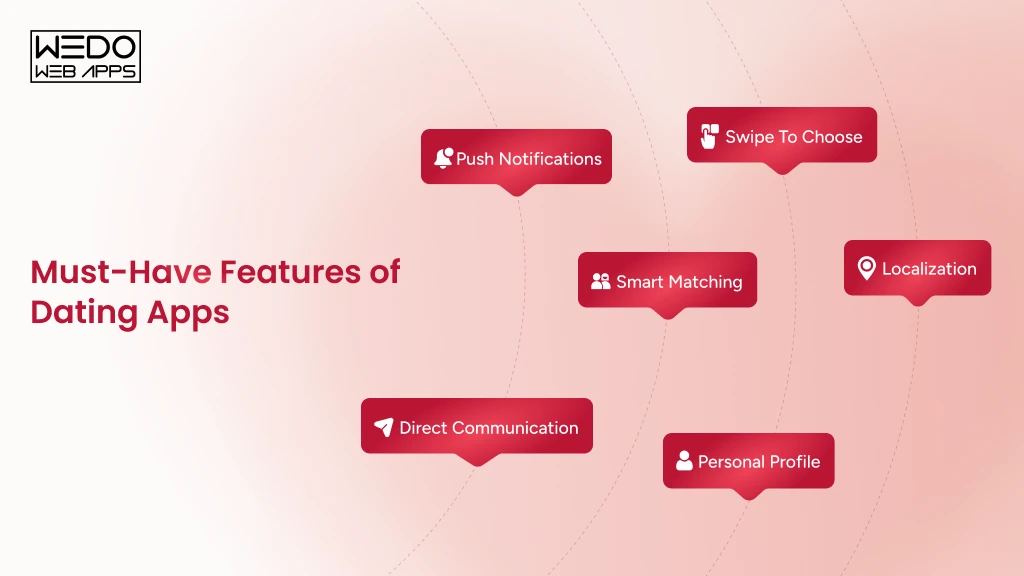
The right features determine how easily users can move from creating a profile to finding a relevant match and starting a conversation. When you build a dating app, the focus should not be on adding every feature available in competing platforms. Instead, prioritise functionality that supports discovery, communication, trust, and retention.
Current dating products also show that safety is becoming part of the core product experience. Tinder, for example, offers photo verification, blocking, reporting, unmatching, and other safety controls alongside its matching and messaging features.
User and Profile Features
Your app should make profile creation quick while giving users enough space to present themselves accurately.
Key features include:
- Email, phone, or social registration
- Profile creation and editing
- Photos and video uploads
- Age, location, interests, and relationship preferences
- Profile verification
- Privacy controls
For example, a user looking for a serious relationship may want to specify their relationship goals, interests, and preferred age range during onboarding. These details can later inform the matching system.
Matching and Discovery Features
Matching is the core interaction in most dating apps. Tinder uses location-based technology and user preferences to present profiles, while its mutual like system determines when two people can start chatting.
Your dating app can include:
- Swipe-based discovery
- Likes and phases
- Mutual matching
- Location-based recommendations
- Advanced filters
- Compatibility scores
- Personalised profile recommendations
The matching method should reflect your product concept. A niche dating app may rely more heavily on interests, values, or relationship goals than a simply proximity-based system.
Communication and Engagement Features
Once two users match, communication becomes the next priority.
Real-time messaging should be part of the core experience. Depending on your target audience and budget, you can also add voice calls, video calls, read receipts, GIFs, reactions, and conversation prompts.
Example: If users often struggle to start conversations, an icebreaker feature can suggest a question based on a shared interest instead of leaving the first message entirely to chance.
Safety and Admin Features
Safety cannot be treated as an optional add-on. Dating platforms handle personal information and interactions between strangers, so users need clear ways to control their experience.
Include:
| Feature | Purpose |
|---|---|
| Photo verification | Helps users confirm that a profile matches its photos |
| Block and unmatch | Gives users control over unwanted interactions |
| Report system | Lets users flag suspicious or inappropriate behaviour |
| Content moderation | Helps identify harmful or prohibited content |
| Admin dashboard | Gives your team control over users, reports, and content |
| Fraud detection | Helps identify suspicious accounts and behaviour |
Tinder has also introduced AI and LLM-based safety features that can identify potentially harmful messages and prompt users before or after inappropriate content is sent.
For your MVP, prioritise the features that support matching, communication, and user safety first. Advanced functionality can be added as your user base and product requirements grow.
How to Make a Dating App: Development Process
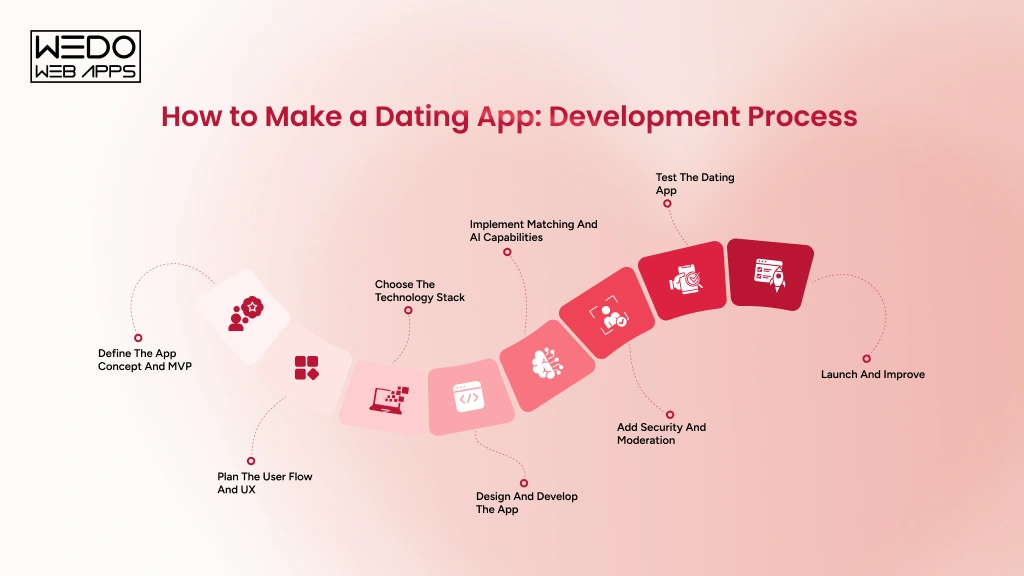
Knowing how to make a dating app starts with more than choosing a development team. You need to move from the product idea to a tested application through a structured process. Each stage should answer a specific product or technical requirement.
A practical dating app development process can be divided into eight stages.
Step 1: Define the App Concept and MVP
Start by deciding what your app will offer and who it will serve. Your niche, target audience, relationship goals, and core value proposition should guide the product scope.
Next, separate the features required for the first release from those that can come later.
For example, an MVP may include registration, profiles, preferences, discovery, matching, messaging, notifications, and reporting. Advanced video dating, AI recommendation, and profile boosts can be introduced after validating the core experience.
The objective is to test whether users can successfully move from creating a profile to finding and communicating with a relevant match.
Step 2: Plan the User Flow and UX
Once the MVP is defined, map how users will interact with the app.
A typical journey could follow:
Registration -> Profile -> Preferences -> Discovery -> Match -> Chat
Keep the initial experience focused. Users should understand what to do next without navigating through unnecessary screens.
Pay particular attention to onboarding. Asking for too much information during registration can increase friction. You can collect additional preferences later as users become more engaged with the app.
The matching interface also needs careful planning. Whether you use swipes, cards, search results, or another discovery format, users should be able to understand why profiles are being recommended.
Step 3: Choose the Technology Stack
Your technology choice should match the features, platforms, expected user volume, and development budget.
For the frontend, you can consider cross-platform frameworks such as Flutter or React Native, or choose native development for iOS and Android.
The backend will handle functions such as authentication, profiles, matching, messaging, subscriptions, notifications, and user management. You will also need a suitable database, cloud infrastructure, APIs, and third-party services.
Do not select technologies simply because they are popular. Choose components that your development team can maintain, and that can support the product as it grows.
Step 4: Design and Develop the App
With the user flows and technology decisions in place, development can begin.
The UI/UX design team creates the interface for key screens such as onboarding, profiles, discovery, matching, chat, settings, and payments.
Developers then build the frontend and backend while connecting the required APIs and services.
The backend needs to manage more than profile information. It should support matching logic, real-time messaging, notifications, media uploads, authentication, subscriptions, and administrative controls.
At this stage, your team should also establish how user data moves between different parts of the application.
Step 5: Implement Matching and AI Capabilities
Matching is the heart of a dating product, so the recommendation logic needs to reflect what your users actually value.
A basic system can begin with rules such as age range, location, interests, preferences, and relationship goals.
As the product collects sufficient behavioural data, AI and machine learning can help improve recommendations by identifying patterns in user preferences and interactions.
AI can also support profile personalisation, conversation suggestions, content moderation, and suspicious activity detection.
The important point is to introduce AI where it solves a measurable product problem. You do not need to make every part of the application AI-powered from the first release.
Step 6: Add Security and Moderation
Dating platform handles personal information and facilitates interactions between people who may not know each other. Security and moderation therefore need to be built into the product from the beginning.
Your implementation should include secure authentication, appropriate data protection, profile verification, reporting, blocking, unmatching, and access controls.
You should also establish processes for handling reported profiles and inappropriate content.
For example, automated moderation can flag suspicious activity for review, while users can immediately block or report an account they do not want to interact with.
Step 7: Test the Dating App
Before launch, test both the technical performance and the actual user experience.
A useful testing checklist includes:
| Testing Area | What to Check |
|---|---|
| Functional testing | Profiles, matching, chat, notifications, and core workflows |
| Usability testing | Navigation, onboarding, discovery, and overall ease of use |
| Security testing | Authentication, access controls, data protection, and vulnerabilities |
| Performance testing | Loading speed, response time, and concurrent users |
| Device testing | Different screen sizes, operating systems, and devices |
| Payment testing | Subscriptions, purchases, refunds, and transaction handling |
| Real-time testing | Message delivery, calls, notifications, and connection recovery |
Beta testing with a controlled group can also reveal usability issues that internal testing may miss.
Step 8: Launch and Improve
Once testing is complete, prepare the application for App Store and Google Play submission.
But launching the app is not the end of the dating app development process. The first release gives you real user data that can guide future development.
Track metrics such as profile completion, match rates, conversations started, retention, subscription conversions, user reports, and churn.
If users create profiles but rarely start conversations, for example, the issue may be the matching quality or discovery experience rather than the registration process.
Use these insights to fix problems, refine recommendations, improve safety measures, and decide which features should be developed next.
The best approach to build a dating app is to treat development as an ongoing product cycle. Start with a focused MVP, validate the experience, and use real user behaviour to guide the next release.
How Can AI Improve a Dating App?
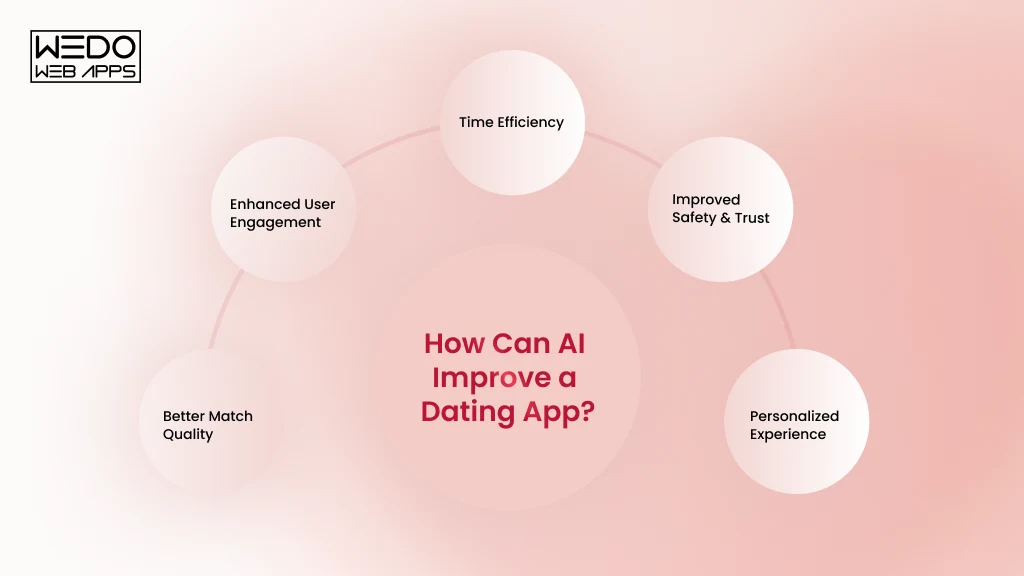
AI is becoming more useful in dating apps when it is applied to specific user problems rather than added as a label to existing features. The strongest opportunities are around match recommendations, personalisation, safety, and user assistance.
For a business planning to create a dating app, AI can be introduced gradually. You can start with a rule-based matching system and add machine learning once the app has enough interaction data to identify meaningful patterns.
AI-Based Match Recommendations
Traditional matching can rely on fixed conditions such as age, location, interests, and relationship preferences. AI can take this further by analysing how users interact with recommendations.
For example, if a user consistently likes profiles with certain interests or characteristics, a recommendation model can identify those patterns and adjust future suggestions.
This can make the matching experience more personalised over time.
AI Profile and Conversation Assistance
Creating a dating profile can be difficult for some users. AI can suggest improvements to profile descriptions, recommend prompts, or help users present their interests more clearly.
The same approach can support conversations.
An AI assistance could suggest an icebreaker based on a shared interest between two matched users. The feature should assist the user rather than generate every interaction automatically.
AI-Based Safety and Moderation
Safety is another practical application.
AI models can help identify spam, inappropriate content, suspicious behaviour, or potentially harmful messages. Flagged activity can then be reviewed according to the platform’s moderation policies.
For example, if an account sends the same promotional message to numerous users, an automated system could flag the behaviour for further review.
AI for Fake Profile and Fraud Detection
Fake accounts can damage trust and user retention. AI can examine patterns such as unusually logical behaviour, repeated profile information, suspicious messaging activity, or abnormal interaction patterns.
This does not mean AI should make the final decision in every case. A better approach is to use automated detection to identify potential risks and apply appropriate review or verification processes.
Should AI Be Included in the MVP?
Not necessarily.
If you are building your first version, a well-designed matching system based on explicit user preferences may be enough to validate the product. Advanced AI can then be introduced when you have sufficient data and a clear use case.
A sensible progression could look like this:
- MVP: Rule-based matching and basic recommendations.
- Growth stage: Behavioural recommendations and personalisation.
- Advanced stage: AI-based matching, moderation, fraud detection, and intelligent user assistance.
This approach keeps AI connected to actual product needs while giving you room to improve the experience as your dating app grows.
Technology Stack for Dating App Development
The technology stack you choose can affect development speed, app performance, scalability, and ongoing maintenance. There is no single stack that works for every dating product. Your choice should depend on the features you plan to launch, the platform you want to support, and the expected user volume.
Here is a practical stack you can consider when you build a dating app:
| Component | Suitable Technologies | Purpose |
|---|---|---|
| Mobile app | Flutter, React Native, Swift, Kotlin | Build iOS and Android applications |
| Backend | Node.js, Python, Java | Manage business logic, APIs, users, and matching |
| Database | PostgreSQL, MongoDB | Store profiles, preferences, matches, and other app data |
| Cloud | AWS, Google Cloud, Azure | Hosting, storage, scaling, and infrastructure |
| Real-time communication | WebSockets, WebRTC, communication APIs. | Chat, voice, and video functionality |
| Location services | Google Maps platforms or similar APIs | Location-based discovery and distance features |
| Payments | Stripe, Braintree, regional payment gateways | Subscriptions and in-app purchases |
| Notifications | Firebase Cloud Messaging, Apple Push Notification service | Match, message, and account notifications |
| AI and ML | Python, ML frameworks, AI APIs | Recommendations, personalisation, moderation, and fraud detection |
Choose Cross-Platform or Native Development
If you want to launch on both iOS and Android, cross-platform development can reduce duplicate development work. Flutter and React Native are common options for this approach.
Native development with Swift for iOS and Kotlin for Android can be suitable when your app requires platform-specific functionality or deeper control over device capabilities.
Select a Backend That Supports Growth
Your backend needs to handle more than user registration. It will manage profiles, matching logic, messages, notifications, subscriptions, media, moderation, and administrative operations.
For an app where real-time communication and frequent profile interactions are expected, the backend architecture should be designed to handle concurrent activity without slowing down the user experience.
Plan Third-Party Integrations Carefully
Dating apps often depend on external services for maps, payments, authentication, notifications, video calls, and AI capabilities.
Before selecting an API, check its pricing, usage limits, data handling practices, reliability, and regional availability. These services can also contribute to your ongoing operating costs after launch.
The technology stack should ultimately support the product you want to build rather than dictate it. A focused MVP can start with a relatively lean architecture and evolve as your user base, features, and technical requirements increase.
How Much Does It Cost to Build a Dating App?
The dating app development cost in the UK depends on the app’s complexity, platform choice, integrations, security requirements, and development team. A basic MVP will cost considerably less than an app with AI-powered recommendations, video dating, identity verification, and advanced moderation.
For initial planning, a dating app can range from around £20,000 to £100,000+. A focused MVP may sit toward the lower end, while a feature-rich platform with custom matching, AI, real-time communication, and advanced safety systems can move well beyond £100,000.
Dating App Development Cost by Complexity
| App Type | Estimated UK Cost | Suitable For |
|---|---|---|
| Basic MVP | £20,000 to £40,000 | Testing a niche and core concept |
| Mid-level app | £40,000 to £70,000 | Growing user base and monetisation |
| Advanced app | £70,000 to £100,000+ | AI, video, verification and advanced matching |
These are planning estimates rather than fixed quotes. Your final cost will depend on the features, technology choices, design requirements, and development team you select.
What Affects Dating App Development Cost?
The main cost drivers include:
- Platforms: Building for iOS and Android can require additional development and testing effort.
- Custom matching: Sophisticated compatibility rules and personalised recommendations require more backend development.
- AI capabilities: AI matching, profile assistance, moderation, and fraud detection add development and infrastructure costs.
- Safety features: Verification, reporting, moderation, and suspicious activity detection increase development requirements.
- Real-time features: Messaging, voice and video calling require additional backend and communication infrastructure.
- Third-party integrations: Payment gateways, maps, verification providers, cloud services, and AI APIs can add both development and ongoing costs.
- Testing and security: Dating apps handle sensitive user information, making security testing and quality assurance important parts of the budget.
How to Control Development Costs
Start with an MVP rather than building the complete product from day one. Focus your first release on the features needed to validate your dating concept, such as profiles, preferences, matching, messaging, notifications, and reporting.
Choose cross-platform development when it suits your requirements, use established third-party services where practical, and introduce advanced AI capabilities in phases.
This approach gives you room to learn from real users before investing heavily in complex features. Once you understand which features drive matches, conversation, retention, and paid conversions, you can expand the platform with greater confidence.
How to Build a Dating App Like Tinder?
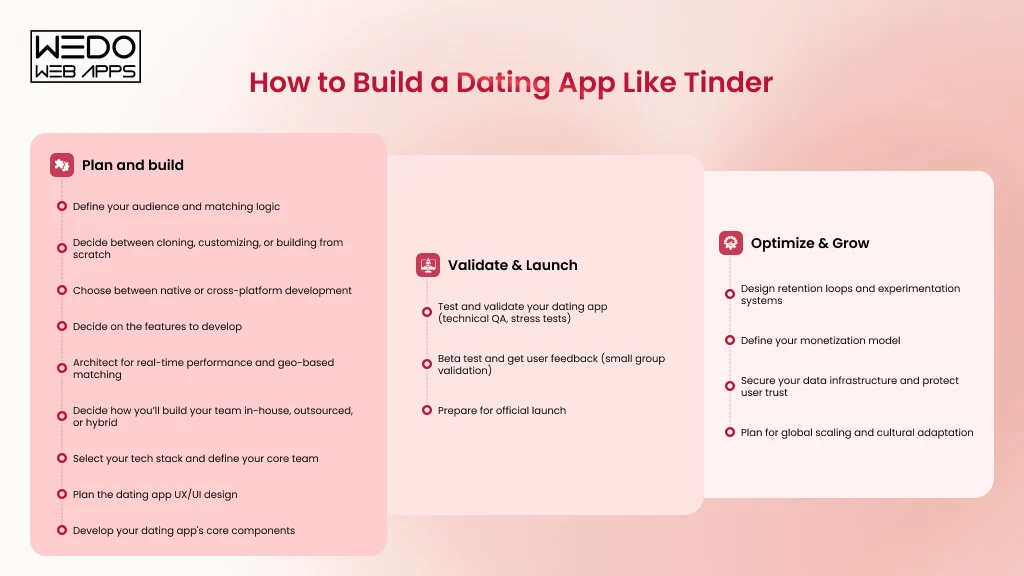
If you want to build a dating app like Tinder, copying the swipe interface is not enough. Tinder’s appeal comes from a simple discovery experience combined with matching, messaging, personalisation, safety tools, and paid features.
Your app can follow a similar product model while serving a different audience or solving a specific dating problem.
Core Tinder-Style Features
A Tinder-style dating app typically needs a fast discovery flow where users can review profiles, express interest, and get notified when there is a mutual match. The basic journey should remain simple:
Create profile -> Set preferences -> Discover profiles -> Like or reject -> Get a match -> Start chatting
You can then add features such as location-based discovery, profile verification, personalised recommendations, premium preferences, profile boosts, and in-app communication.
Tinder has also introduced AI-powered recommendations, verification, and safety features, showing how established dating platforms are moving beyond the basic swipe and match model.
How to Make Your App Different
The strongest opportunity is not to create another purpose-built dating app. Give users a clear reason to choose your platform instead.
For example, you could focus on:
- Serious relationships rather than casual dating
- Specific interests or communities
- Professional networking and dating
- Local dating within selected UK cities
- Compatibility based on values and lifestyle
- Verified profiles and stronger identity checks
- AI-assisted recommendations based on user behaviour.
Your interface can borrow familiar interaction partners, but your matching logic, audience, safety model, and value proposition should be your own.
Before development, define what users will get from your app that they cannot get from established platforms. That difference should guide your MVP, marketing strategy, and future feature roadmap.
Conclusion
Learning how to make a dating app is only the first step. Building a product that attracts users, creates meaningful matches, and keeps people coming back requires the right niche, user experience, matching logic, safety measures, technology, and monetisation strategy.
You do not need to launch every feature at once. Start with a focused MVP, validate your idea with real users, and expand the platform as your audience grows.
Whether you want to create a dating app for a specific UK audience or build a larger platform with AI-powered development and advanced features, the right development approach can turn your concept into a scalable product.