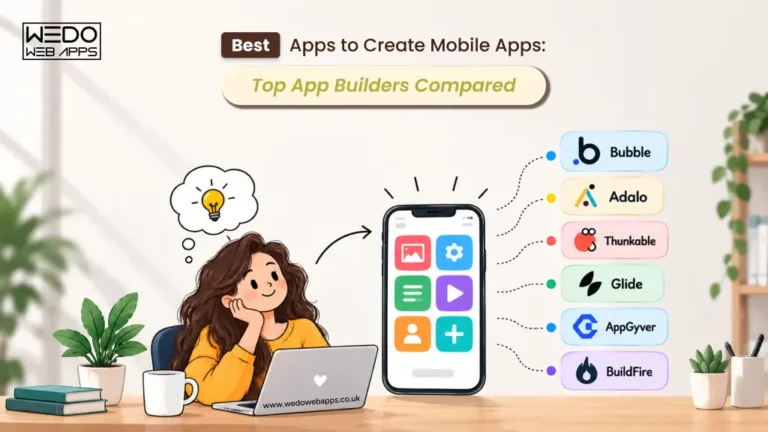
Introduction
You have an app idea. You may even know the features you want. The problem starts when you look at the development process and see the time, coding skills, and cost involved.
That is where apps to create mobile apps can make the starting point much easier. You can use visual builders, prebuilt components, integrations, and AI-assisted tools to turn an idea into a working app without building everything from scratch.
But choosing a platform is where things get complicated. Some no-code app builders work well for simple apps and prototypes. Others offer more flexibility through low-code app development platforms. AI-powered development adds another option by letting you generate parts of an app through prompts.
So, which platform actually fits your project?
This guide compares the best apps to create mobile apps, their features, pricing, AI capabilities, publishing options, and limitations. You will also learn what to check before choosing a mobile app builder platform and when custom development may make more sense.
What Are Apps to Create Mobile Apps?
Apps to create mobile apps are platforms that let you design, build, test, and sometimes publish mobile applications without developing every component from scratch. Depending on the platform, you can use visual editors, prebuilt components, databases, APIs, workflows, and custom logic to create an application.
For example, a restaurant owner could use a visual app builder to create a food ordering app with menus, customer accounts, payments, and order tracking. A startup could use the same type of platform to create an MVP and test its idea before investing in a larger development project.
Most app builders bring together three main parts:
| Part | What you can do |
|---|---|
| UI Layer | Create screens, forms, menus, buttons, and navigation |
| Logic Layer | Set up actions, workflows, authentication, and app behavior |
| Data Layer | Connect databases, APIs, and external services |
Platforms such as FlutterFlow provide visual tools for these UI, logic, and data layers, while also supporting APIs, databases, testing, and app deployment.
The level of control varies between platforms. No-code app builders are generally designed around visual development, while low-code platforms give you more room to add custom logic or code. Some newer platforms also use AI to generate screens, databases, or other parts of an application from natural language prompts.
So, when you search for tools to create mobile apps, you are not looking at one type of software. You are choosing between different approaches to app development, each suited to different project requirements.
What Should You Look for in a Mobile App Builder?
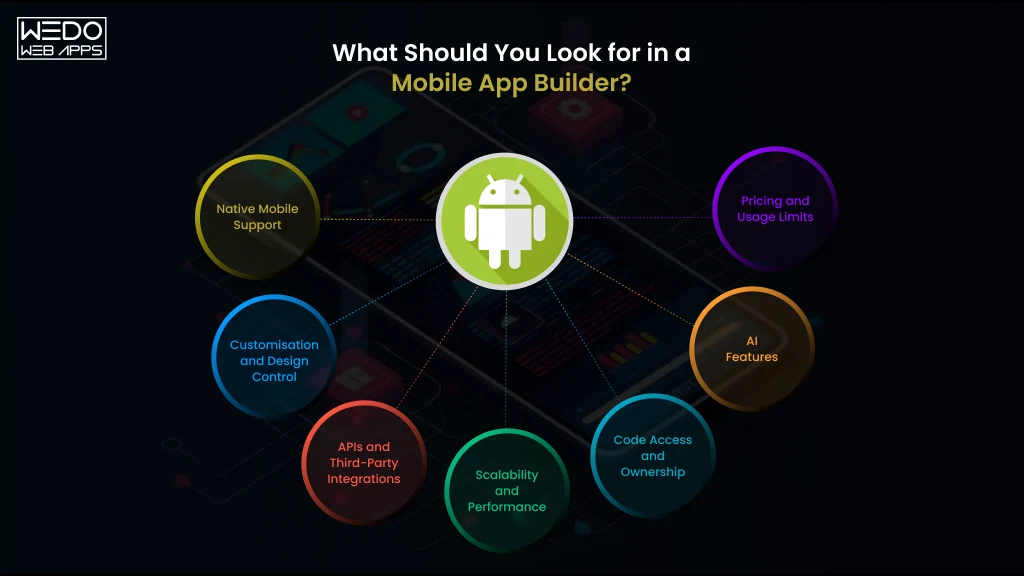
Choosing between different mobile app builder platforms becomes easier when you know what to check first. The right features depend on your app type, target users, budget, and future development plans.
Native Mobile Support
First, check where your app can run. If you want an app for both iOS and Android, look for platforms that support both operating systems and provide a clear path to App Store and Google Play publishing.
Customisation and Design Control
Templates can help you start quickly, but your app may need a design that matches your brand and user experience. Check whether you can customise layouts, navigation, components, animations, and interactive elements.
APIs and Third-Party Integrations
Your app may need to communicate with other systems. Look for support for:
- Payment gateways
- Maps and location services
- CRM platforms
- Authentication services
- Analytics tools
- REST APIs
- Business databases
For example, a delivery app may need maps for location tracking and a payment gateway for online orders.
Scalability and Performance
Think beyond your first version. Check user limits, database capacity, hosting, app performance, API usage, and available infrastructure.
A platform that works well for a small MVP may have different limitations when your user base grows.
Code Access and Ownership
Find out whether you can export your application code and access the underlying project. This gives you more options if you later need custom development or want to move away from the platform.
AI Features
AI is becoming part of many tools to create mobile apps. Depending on the platform, you may find prompt-based screen generation, AI-assisted workflows, database creation, or code generation.
Check what the AI actually produces. A generated screen can save development time, but your team may still need to review its logic, security, integrations, and performance.
Pricing and Usage Limits
Compare the complete cost rather than the starting subscription.
| Cost area | What to check |
|---|---|
| Platform plan | Monthly or annual subscription |
| Users | User or seat limits |
| Usage | API calls, database usage, or automation limits |
| Publishing | App Store and Google Play requirements |
| AI | Credits or usage limits |
| Integrations | Paid connectors or third-party services |
A useful rule is simple: choose based on your app's requirements first, then compare the platform's price and features against those requirements.
12 Best Apps Builders to Create Mobile Apps in 2026
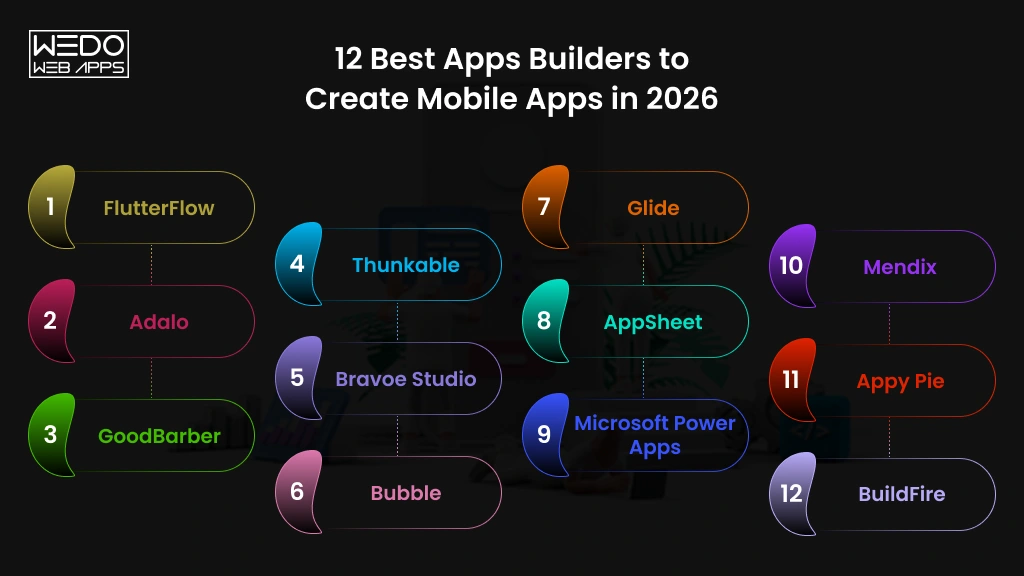
There is no single platform that fits every app project. A Founder validating an MVP may need speed and simplicity. A business launching a customer-facing app may care more about native publishing and integrations. A technical team may prioritise code access and customisation.
The table below gives you a quick starting point before looking at each platform in more detail.
| App Builder | Best suited for | Mobile output | Development approach |
|---|---|---|---|
| FlutterFlow | Custom mobile apps and developer handoff | iOS, Android, Web | Low code |
| Adalo | Simple mobile apps and MVPs | iOS, Android, Web | No code |
| GoodBarber | Content and commerce apps | iOS, Android, PWA | No code |
| Thunkable | Beginner-friendly mobile apps | iOS, Android | No code |
| Bravo Studio | Design-focused mobile apps | iOS, Android | No code |
| Bubble | Complex web applications | Web, mobile options | No-code and low-code |
| Glide | Internal and data-driven apps | Web and PWA | No code |
| AppSheet | Business process applications | Mobile and web | Low code |
| Microsoft Power Apps | Enterprise business applications | Mobile and web | Low code |
| Mendix | Enterprise application development | Mobile and web | Low code |
| Appy Pie | Template-based business apps | iOS, Android, Web | No code |
| BuildFire | Managed business and customer apps | iOS, Android | No code |
The output type matters here. For example, current comparisons identify FlutterFlow, Adalo, and Thunkable as platforms capable of producing native mobile applications, while tools such as Glide are more focused on web or PWA experiences.
1. FlutterFlow
Best for: Businesses that need visual development with greater technical control.
FlutterFlow uses a visual development approach for building applications across mobile and web. It is particularly useful when you want to move beyond basic templates and retain greater control over the application.
One notable advantage is code export. That gives your development team more flexibility if the project later requires custom development.
Consider it when: You want to build a serious mobile product and may involve developers as the project grows.
2. Adalo
Best for: Founders, small businesses, and teams building mobile MVPs without extensive coding.
Adalo provides a visual builder for creating mobile applications and supports native mobile publishing. Its approach is suited to projects such as booking platforms, marketplaces, directories, and customer-facing business apps. Current platform information also highlights AI-assisted app generation.
Consider it when: You want to validate an app idea quickly before committing to a larger development project.
3. GoodBarber
Best for: Content, eCommerce, community, and business applications.
GoodBarber focuses heavily on mobile publishing and provides features such as content management, push notifications, and commerce capabilities. Its current 2026 comparison also distinguishes it from AI-first tools that primarily generate web applications.
Consider it when: Your app depends heavily on content, customer engagement, or mobile commerce.
4. Thunkable
Best for: Beginners, educators, and teams learning visual app development.
Thunkable uses a visual block-based approach and supports mobile application development for iOS and Android. It can be a practical starting point when you want to create an app without learning a full programming language.
Consider it when: You need a relatively straightforward mobile application and prefer visual logic.
5. Bravo Studio
Best for: Design-focused teams working from Figma or Adobe XD designs.
Bravo Studio takes a different approach from traditional drag-and-drop builders. Your existing interface design can become the starting point for a mobile application.
Consider it when: Your UI/UX design team already has detailed screens and wants to turn them into a functional mobile product.
6. Bubble
Best for: Applications with complex workflows and business logic.
Bubble is widely used for web applications that require databases, workflows, integrations, and extensive business logic. It is better suited to web-first products than projects where native iOS and Android output is the primary requirement.
Consider it when: Your project needs sophisticated workflows and a web application is acceptable.
7. Glide
Best for: Internal tools and data-driven applications.
Glide is particularly useful when your application depends on structured business data. It can turn data sources into usable applications without requiring traditional development.
Keep its output in mind before choosing it for a consumer mobile app. Current comparisons classify Glide primarily around web and PWA output rather than traditional native app publishing.
Consider it when: Your goal is an internal business tool rather than a conventional App Store product.
8. Google AppSheet
Best for: Business applications connected to existing data and workflows.
AppSheet is suited to applications involving forms, records, approvals, field operations, and business processes. It can be particularly relevant when your organisation already works heavily with Google services.
Consider it when: You want employees to access business processes through a custom mobile interface.
9. Microsoft Power Apps
Best for: Organisations already using Microsoft’s business ecosystem.
Power Apps provide low-code development for business applications and can connect with services across the Microsoft ecosystem.
Consider it when: Your app needs to work closely with existing enterprise data, workflows, and Microsoft services.
10. Mendix
Best for: Enterprise teams with complex application requirements.
Mendix is positioned toward low-code development at an enterprise level. It gives technical and business teams more structured development options than basic no-code builders.
Consider it when: Governance, integrations, scalability, and mobile app developer involvement are significant requirements.
11. Appy Pie
Best for: Small businesses looking for template-based app development.
Appy Pie provides prebuilt components and visual tools that can simplify the initial development process. It also incorporates AI-assisted capabilities into its app-building experience.
Consider it when: You need a relatively straightforward business application without extensive custom functionality.
12. BuildFire
Best for: Businesses that want a managed approach to mobile app creation.
BuildFire focuses on native mobile applications and provides a combination of visual building tools and managed services. This can reduce the amount of technical work your internal team needs to handle.
Consider it when: You want mobile app development support alongside a builder rather than managing every technical detail yourself.
One thing to check before choosing any of these tools: confirm the actual output, publishing process, pricing limits, integrations, and ownership terms for your specific plan. A platform can look ideal on paper and still be unsuitable once your app requires a feature outside its supported capabilities.
Best Mobile App Builders by Use Case
The right app builder for mobile apps depends on what you are building, who will use it, and how much technical control you need. Use the comparison below as a quick filter before choosing a platform.
| Your requirements | Platforms to consider | What to prioritise |
|---|---|---|
| Mobil MVP | Adalo, FlutterFlow, Thunkable | Speed, core features, testing |
| Native iOS and Android app | FlutterFlow, Adalo, GoodBarber | Native output, device features, publishing |
| No coding experience | Adalo, Thunkable, GoodBarber | Templates, visual workflows, ease of use |
| Internal business app | AppSheet, Power Apps, Glide | Data, workflows, automation |
| AI-powered app | FlutterFlow, Bubble Adalo | AI integrations, APIs, custom workflows |
| Developer-led project | FlutterFlow, Mendix | Code access, APIs, custom logic |
| Enterprise mobile app | Power Apps, Mendix | Security, governance, integrations |
Best for Building a Mobile App
An MVP needs to prove whether your idea works before you invest heavily in development.
Look for:
- Fast visual development
- Database support
- User authentication
- API integrations
- Basic Analytics
- Testing and publishing options
Platforms to consider: Adalo, FlutterFlow, and Thunkable.
Example: A startup testing a fitness app could launch workout plans, user accounts, progress tracking, and basic subscriptions first. More advanced features can follow after collecting user feedback.
Best for Building a Native iOS and Android App
Your first check should be the platform’s actual mobile output. Some builders create native apps, while others focus on web applications or PWAs.
Check these capabilities before signing up:
| Requirement | Why it matters |
|---|---|
| iOS support | Required for Apple users |
| Android support | Required for Google Play users |
| App Store publishing | Determines how you distribute the app |
| Push notifications | Useful for user engagement |
| GPS and camera | Needed for many mobile-specific features |
| Offline functionality | Important for apps used without reliable internet connectivity |
Platforms to consider: FlutterFlow, Adalo, GoodBarber, and Thunable.
Best for Beginners With No Coding Experience
If you are building your first application, technical complexity can slow you down quickly.
Prioritise platforms with:
- Drag-and-drop interfaces
- Ready-made templates
- Visual workflows
- Built-in databases
- Guided publishing
- Clear documentation
Platforms to consider: Adalo, GoodBarber, Thunkable, and Appy Pie.
A simple test can help. Build one complete feature before committing to a paid plan. If you can create and modify it without constant technical help, the platform is likely easier for your team to manage.
Best for Businesses and Internal Apps
Internal applications usually need efficient workflows rather than elaborate consumer features.
Useful capabilities include:
- Forms: Collect employee, customer, or field data.
- Dashboards: Give teams access to real-time business information.
- Automation: Trigger approvals, notifications, or follow-up actions.
- Database connections: Keep business records accessible from mobile devices.
- Platforms to consider: Google AppSheet, Microsoft Power Apps, and Glide.
Example: A field services company could give technicians an app to view assigned jobs, upload site photos, update job status, and submit service reports.
Best for AI-Powered Apps
AI can now assist with both app creation and the features inside the application.
When comparing AI-enabled platforms, check whether they support:
- AI-generated screens and workflows
- AI model integrations
- API connections
- AI agents
- Automated content generation
- Custom AI workflows
Platforms to consider: FlutterFlow, Bubble, and Adalo, depending on the AI functionality and integrations your project requires.
Best for Developers and Technical Teams
A technical team usually needs more control than a basic no-code builder provider. This is where low-code app development platforms can fit.
| Capability | Why developers need it |
|---|---|
| API access | Connect external systems |
| Custom code | Handle specialised functionality |
| Code export | Continue development outside the platform |
| Database control | Manage application data |
| Authentication | Build secure user access |
| Custom backend logic | Support complex workflows |
Platforms to consider: FlutterFlow and Mendix
FlutterFlow, for example, combines visual development with code export, giving developers an option to continue working with the generated application outside the builder.
Best for Enterprise Mobile Apps
Enterprise applications need stronger controls around users' data, integrations, and deployment.
Enterprise checklist:
- Role-based access
- Enterprise authentication
- Security controls
- Compliance requirements
- API and system integrations
- Governance features
- Scalability
- Deployment controls
- Vendor support
Platform to consider: Microsoft Power Apps and Mendix.
For example, an organisation could use a low-code platform to connect an employee mobile application with existing business systems while controlling who can access specific data and workflows.
The key is to evaluate the platform against your actual business requirements. A tool that works well for an MVP may not provide the control, security, or customisation required for an enterprise application.
No-Code vs Low-Code vs AI App Builders
Also mention the current limitation: a prompt-generated web app is not automatically equivalent to a native mobile application. Current 2026 comparisons make this distinction clearly.
Choosing between no-code app builders, low-code platforms, and AI app builders depends on how much control you need during development. Each approach reduces some of the work involved in traditional coding, but they give you different levels of flexibility.
| Factor | No Code | Low Code | AI App Builder |
|---|---|---|---|
| Coding required | Little to none | Some | Varies by platform |
| Development method | Visual components | Visual tools plus code | Prompts plus visual or code tools |
| Customisation | Moderate | High | Varies |
| Speed | High | High | Very high for initial builds |
| Best suited for | Simple apps and MVPs | Complex business apps | Prototypes and AI assistant development |
| Developer involvement | Usually low | Often useful | Depends on complexity |
| Code access | Often limited | More common | Depends on platform |
When No Code Is Enough
Choose a no-code platform when your application can be built using its existing components, workflows, integrations, and templates.
A good fit could be:
- Appointment booking
- Restaurant ordering
- Employee forms
- Customer directions
- Basic marketplaces
For example, a small business could create an appointment booking app without building its authentication, forms, notifications, and database system from scratch.
When Low-Code Makes More Sense
A low-code platform becomes useful when your project needs functionality beyond standard visual components.
Choose low-code when you need:
- Custom business logic
- Advanced API integrations
- Specialised workflows
- Greater database control
- Custom code
- Developer access
This approach can work well when your internal team has developers but wants to reduce repetitive development work.
When AI App Builders Are Worth Considering
AI changes how you start an application. Instead of manually creating every screen, you can describe what you want and let the platform generate an initial structure.
For example:
Prompt: “Create a customer loyalty app with user registration, point tracking, rewards, and push notifications.”
An AI-enabled builder may generate parts of the interface and workflow from that description.
However, AI-generated code or screens still need review. You should verify authentication, data handling, integrations, business logic, security, and mobile performance before releasing the application.
Which Approach Fits Your Project?
Use this quick check:
- Choose no-code if speed and simplicity matter most.
- Choose low-code if you need more customisation and developer control
- Choose AI-assisted development if you want to accelerate ideation, prototyping, and parts of the development process.
If your application has highly specific functionality, complex integrations, strict security requirements, or long-term scalability needs, a custom development approach may provide greater control than any builder.
How AI Is Changing Mobile App Builders
AI is changing how you approach the first version of an application. Instead of manually setting up every screen and workflow, you can describe parts of your requirements and let AI generate a starting point.
The technology is useful at different stages of development.
Prompt to App Development
Some AI-powered mobile app builder platforms can interpret natural language prompts and generate initial screens, layouts, workflows, or database structures.
For example, you could describe a property rental app with:
User registration -> Property search -> Filters -> Property details -> Booking -> Payment
The AI may generate the initial application structure from that description. You can then adjust the screens and logic using the platform’s visual tools.
AI-Assisted UI and Feature Development
AI can also rescue the manual work involved in creating individual app components.
| AI capability | Potential use |
|---|---|
| Screen generation | Create initial app screens from prompts |
| UI suggestions | Generate layouts and interface components |
| Workflow generation | Set up common actions and processes |
| Database assistance | Suggest data structures and fields |
| Code generation | Produce code for supported custom functionality |
| Content generation | Create placeholder text or app content |
This can help you move from an idea to a working prototype faster. You still need to review the output against your actual requirements.
AI Features Inside Mobile Apps
AI is also becoming part of the applications being built.
You can integrate features such as:
- AI chat assistants
- Product recommendations
- Document summarisation
- Image analysis
- Personalised content
- AI agents
- Intelligent search
For example, an eCommerce app could use an AI assistant to help customers find products based on natural language requests rather than requiring them to search through multiple categories.
AI Does Not Remove the Need for Testing
A generated application can look complete while still containing technical problems.
Before releasing an AI-assisted app, check:
- Functionality: Do workflows behave as intended?
- Security: Is user and business data protected?
- Performance: Does the app remain responsive under realistic usage?
- Integrations: Are APIs and third-party services working correctly?
- Mobile compatibility: Does the application behave properly across supported devices?
AI can speed up the creation process, but production readiness still depends on proper testing, technical review, and ongoing maintenance.
How Much Do Mobile App Builders Cost?
The subscription price is only one part of the cost. Your final expense can change based on the number of users, app publishing requirements, integrations, storage, AI usage, and the features you need.
A free plan may be enough to test an idea. A production app can require a paid plan and additional services.
Free Plans vs Paid Plans
Most mobile app builder platforms use tiered pricing. Free plans often come with restrictions on features, branding, users, storage, or publishing.
| Plan type | Usually suitable for | Common limitations |
|---|---|---|
| Free | Learning and basic prototypes | Limited features and publishing |
| Starter | Small projects and MVPs | User or usage limits |
| Professional | Growing applications | Higher monthly cost |
| Enterprise | Large organisations | Custom pricing and contracts |
Costs You Should Check Before Choosing
Look beyond the advertising subscription and check these expenses:
- Platform subscription: Your main monthly or annual fee.
- App publishing: Developer accounts and platform-specific publishing requirements.
- User usage: Some platforms charge based on users, seats, or application activity.
- Storage and database: Higher data volumes can increase your costs.
- API usage: External services may charge based on requests or usage.
- AI credits: AI features may have separate usage limits or charges.
- Third-party services: Payments, maps, analytics, and other integrations may have their own fees.
- Development support: You may need professional help for custom features or technical issues.
How to Estimate Your Actual Cost
Before selecting a platform, calculate your expected usage rather than choosing the cheapest starting plan.
For example:
A small business building an internal employee app may need a limited number of users and basic workflows. A consumer app with thousands of users may require higher limits, more storage, additional integrations, and stronger infrastructure.
The better question is not “Which app builder is cheapest?”
Ask “Which platform can deliver the features I need at a predictable cost as usage grows?”
This gives you a more realistic basis for comparing tools to create mobile apps.
Final Thoughts on Choosing a Mobile App Builder
Choosing from the many apps to create mobile apps starts with your project requirements. Consider what you are building, who will maintain it, which devices it needs to support, and how much flexibility you may need as the product grows.
A no-code builder can be a practical choice for a simple app or early MVP. A low-code platform may suit projects that need custom logic and developer involvement. AI-assisted tools can speed up prototyping and help teams create parts of an application faster.
When your app requires complex features, custom integrations, strict security controls, or long-term scalability, a custom mobile app development approach can give you greater control over the product and its underlying technology.
The best choice is the one that fits your current requirements without creating unnecessary limitations for the next stage of your app.