
Introduction
Launching a website is still one of the fastest ways for startups and businesses to create a scalable digital asset. Whether the goal is generating leads, building a SaaS product, creating a marketplace, or launching a niche platform, the right website idea can evolve into a long-term revenue channel. The challenge is not building a website; it is choosing an idea that can realistically attract users, support monetization, and scale with business growth.
Many lists of ‘good website ideas’ focus on generic concepts without addressing feasibility, monetization, or development complexity. For business owners, those lists rarely help in making any strategic decisions. A viable website idea must align with business objectives, solve a specific problem, and support measurable returns.
This guide moves beyond simple idea lists and instead focuses on website ideas that can be launched, monetized, and promoted effectively. It also explains how to validate opportunities, choose the right web development approach, and identify monetization models that work in real-world scenarios.
Whether you are exploring a new product, building a digital platform, or expanding your service offerings, this article outlines the best website ideas along with practical guidance to turn them into scalable business assets.
How to Choose the Right Website Idea (Before You Build)
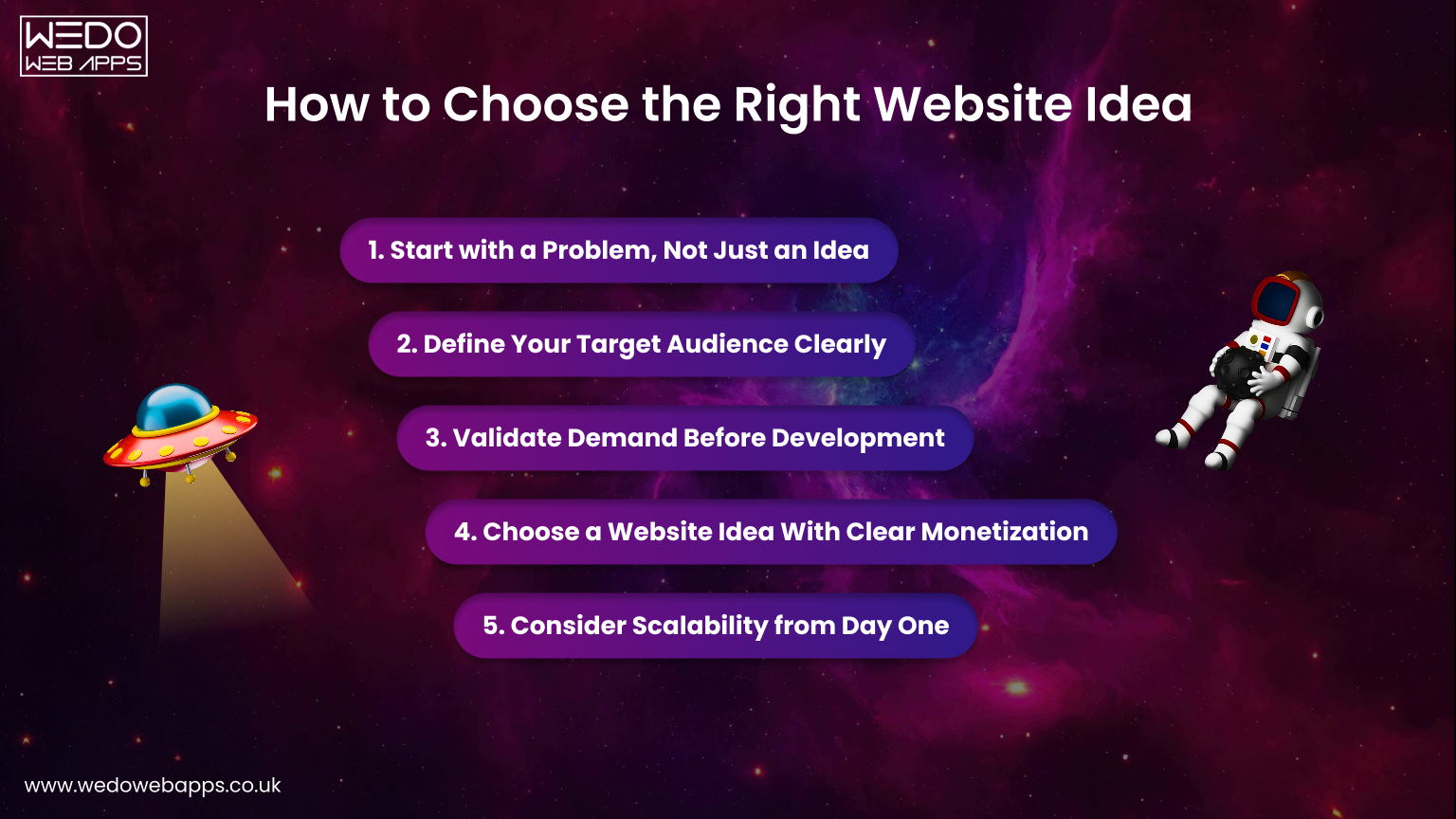
Choosing the right website idea is not about picking something trendy. For startups, enterprises, and decision-makers, the goal is to select an idea that can scale, generate revenue, and support long-term digital growth. The strongest website ideas solve a specific problem, serve a defined audience, and support clear monetization from the beginning.
Before investing in development, validate the opportunity strategically rather than jumping straight into design or features.
1. Start with a Problem, Not Just an Idea
Most successful websites originate from operational inefficiencies, market gaps, or unmet user needs. Instead of brainstorming random ideas, identify workflows that can be simplified, automated, or centralised. B2B problem-focused websites often perform better because they address measurable business pain points and allow premium monetization models.
For example, instead of launching a general marketplace, consider building a vendor comparison platform for a specific industry. Narrowing the scope increases relevance, improves SEO targeting, and accelerates early traction.

2. Define Your Target Audience Clearly
A website built for ‘everyone’ rarely succeeds. Decision-makers should define whether the platform targets startups, enterprises, agencies, consumers, or niche professionals. Each audience influences feature requirements, monetization models, and marketing channels.
B2B-focused website ideas often require dashboards, integrations, and automation features. Consumer-focused platforms may prioritize usability, engagement, and content. Identifying this early prevents costly rebuilds later.
3. Validate Demand Before Development
Before launching a website, confirm that users are actively searching for solutions in your category. Keyword demand, competitor traction, and existing tools all indicate market interest. A strong website idea typically sits in a space where demand exists, but execution is weak.
Look for gaps such as outdated platforms, fragmented solutions, or poor user experience. These opportunities allow new websites to compete effectively without needing massive marketing budgets.
4. Choose a Website Idea With Clear Monetization
Some website ideas attract traffic but struggle to generate revenue. Prioritize concepts that naturally support monetization models like subscriptions, commissions, premium listings, or lead generation. B2B websites often monetize faster because businesses are willing to pay for efficiency and measurable ROI.
If monetization feels forced, the idea may not be viable. The strongest website concepts integrate revenue into the core value proposition.
5. Consider Scalability from Day One
Many website ideas work initially but fail when traffic grows or features expand. Decision-makers should evaluate whether the idea can evolve into a platform, marketplace, or SaaS product over time. Scalable website ideas allow new features, user roles, automation, and integrations.
Planning for scalability early ensures the website can transition from MVPs to a full platform without major architectural changes.
This strategic approach helps businesses move beyond generic website ideas and focus on opportunities that can be launched, monetized, and scaled effectively. Once the idea is validated, the next step is identifying which types of website models offer the strongest growth potential.
25 Best Website Ideas to Launch and Monetize
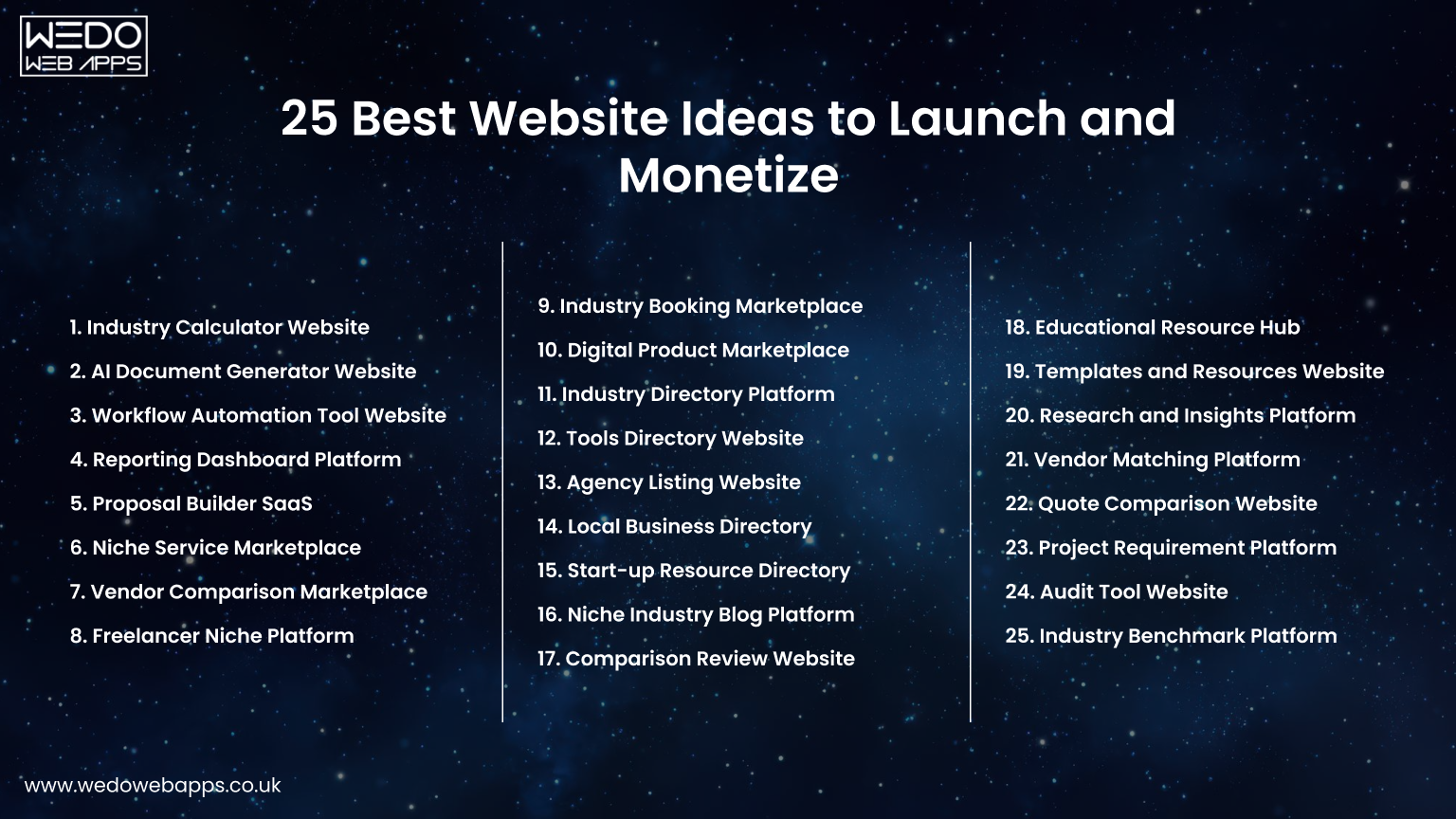
The best website ideas are those that solve real problems, support scalable monetization, and can evolve into platforms over time. Instead of generic concepts, the following website ideas are grouped by business model to help startups, founders, and decision-makers identify opportunities aligned with long-term growth.
We will start with SaaS and tool-based website ideas, which typically offer strong scalability and recurring revenue potential.
SaaS & Tool Website Ideas
1. Industry Calculator Website
An industry calculator website provides specialized calculation tools personalised to a specific niche. These platforms attract highly targeted users who need quick answers for decision-making. Because the value is immediate and practical, these websites often generate consistent organic traffic.
Examples include ROI calculators, pricing estimators, cost calculators, profit margin tools, or project estimation platforms. Businesses frequently use these tools during evaluation stages, making them strong lead generation opportunities.
These websites can start with a single calculator and expand into a full suite of tools. Over time, dashboards, saved reports, and integrations can transform the platform into a SaaS product.
Monetization Options:
- Lead generation
- Promium calculator access
- Subscription dashboards
- Embedded tool licensing
2. AI Document Generator Website
An AI document generator website helps users create structured documents automatically. These platforms solve repetitive tasks such as generating proposals, reports, contracts, or business documentation. With AI-driven workflows, users can produce outputs quickly without manual effort.
Examples include proposal generators, business plan creators, policy generators, and requirement documentation tools. These platforms are especially valuable for startups, agencies, and enterprises managing recurring documentation.
As usage grows, these websites can expand into full document automation platforms with templates, collaboration, and export features.
Monetization Options:
- Subscription plans
- Pay-per-document pricing
- Template marketplace
- Enterprise licensing
3. Workflow Automation Tool Website
Workflow automation websites help businesses streamline repetitive processes. These platforms connect steps, automate actions, and reduce manual work across teams. Companies increasingly look for niche automation tools personalised to their specific workflows.
Examples include onboarding automation, approval workflows, task routing, reporting automation, or data synchronization tools. Instead of competing with broad automation platforms, niche tools focused on a single use case often gain traction faster.
These websites typically require dashboards, rule builders, integrations, and notifications. Over time, automation libraries and API access can be introduced.
Monetization Options:
- Monthly subscriptions
- Usage-based pricing
- Automation credits
- Enterprise plans
4. Reporting Dashboard Platform
A reporting dashboard website centralises data and presents insights visually. Businesses use these platforms to track performance metrics, operational data, or marketing analytics. These websites provide ongoing value, making them ideal for subscription-based models.
Examples include marketing dashboards, sales tracking platforms, financial reporting tools, or project analytics websites. Many companies prefer lightweight dashboards personalised to their workflows instead of complex enterprise software,
These platforms typically include user roles, integrations, visualization tools, and export capabilities. As the product grows, automated insights and alerts can be added.
Monetization Options:
- Subscription tiers
- Data volume pricing
- Team-based pricing
- Enterprise plans
5. Proposal Builder SaaS
A proposal builder website helps businesses create structured proposals quickly. These platforms are useful for agencies, consultants, and service providers that frequently send project proposals. Instead of manually formatting documents, users generate professional proposals using templates and automation.
Features may include pricing tables, a section library, digital signatures, branding customization, and analytics. Over time, these platforms can expand into full sales enablement tools.
Proposal builder websites often gain traction because they directly impact conversion rates and operational efficiency.
Monetization Options:
- Monthly subscriptions
- Template marketplace
- Team pricing
- White-label access
Marketplace Website Ideas
Marketplace platforms connect two sides of a market and create value through discovery, comparison, and transactions. These websites are highly scalable because they benefit from network effects - more users attract more providers, which increases overall platform value. For startups and businesses, the marketplace website ideas can evolve into long-term revenue-generating platforms.
6. Niche Service Marketplace
A niche service marketplace connects users with specialised service providers within a specific industry. Instead of competing with broad platforms, these websites focus on a defined category, which improves relevance and conversion rates.
Examples include marketplaces for hiring AI developers, UX consultants, legal experts, SaaS implementation specialists, or marketing agencies. Narrowing the audience allows better filtering, clearer positioning, and higher-quality leads.
These platforms typically include provider profiles, search filters, service categories, messaging, and admin dashboards. Over time, reviews, ratings, and comparison features can improve user trust.
Monetization options
- Commission per project
- Vendor subscription
- Featured listings
- Lead generation fees
7. Vendor Comparison Marketplace
A vendor comparison marketplace helps businesses evaluate multiple service providers before making decisions. These websites focus on comparison and discovery rather than direct transactions, making them effective for B2B industries.
Examples include software development vendor comparison, CRM implementation providers, cloud service vendors, or automation agencies. These platforms often attract high-intent buyers looking to shortlist vendors.
Key features include comparison tables, filters, request forms, ratings, and recommendation logic. As traffic grows, automated vendor matching can be introduced.
Monetization options
- Paid vendor listings
- Featured placement
- Lead generation
- Subscription access
8. Freelancer Niche Platform
A freelancer niche platform focuses on a specific skill set instead of offering broad freelance categories. These websites help businesses find specialized talent quickly and reduce the noise found in general platforms.
Examples include platforms for hiring machine learning engineers, Shopify developers, UI designers, DevOps specialists, or data analysts. By narrowing the focus, these platforms attract more qualified users.
These websites typically include freelancer profiles, portfolios, availability status, messaging, and hiring workflows. Over time, escrow payments and contracts can be added.
Monetization options
- Commission on hiring
- Freelancer subscription
- Premium profiles
- Job posting fees
9. Industry Booking Marketplace
An industry booking marketplace allows users to book services, consultations, or appointments directly through the platform. These websites are useful for industries that rely on scheduling and availability.
Examples include consultation booking platforms, agency discovery with scheduling, coaching marketplaces, or technical consultation websites. These platforms simplify discovery and scheduling in one place.
Key features include calendars, booking management, provider dashboards, notifications, and payment integrations. As the platform grows, recurring bookings and packages can be added.
Monetization options
- Booking commission
- Subscription for providers
- Featured placement
- Transaction fees
10. Digital Product Marketplace
A digital product marketplace allows creators or businesses to sell downloadable or digital assets. These websites perform well because inventory is scalable and delivery is automated.
Examples include template marketplaces, UI kits, business documents, automation workflows, prompt libraries, or industry-specific resources. These platforms can start niche-focused and expand over time.
These websites require product listings, categories, payments, downloads, and seller dashboards. Additional features like bundles and licensing can increase revenue.
Monetization options
- Commission per sale
- Seller subscription
- Featured products
- Platform fees
Directory & Listing Website Ideas
Directory and listing websites organize businesses, tools, or resources within a specific niche. These platforms attract users who are actively searching for solutions, making them strong candidates for SEO-driven traffic. For startups and decision-makers, directory websites are often easier to launch and can evolve into comparison platforms, marketplaces, or lead generation systems.
11. Industry Directory Platform
An industry directory platform lists companies or service providers within a specific sector. These websites help users discover relevant vendors while giving businesses visibility within a targeted audience. When focused on a niche, directory platforms attract qualified traffic and perform well in search.
Examples include directories for software development companies, AI solution providers, logistics vendors, or SaaS consultants. These platforms can start with curated listings and expand with filtering and categorization.
Core features typically include listings, categories, filters, profiles, and search functionality. As the platform grows, reviews, comparison tools, and request forms can be added.
Monetization options
- Paid listings
- Featured placement
- Lead generation
- Subscription profiles
12. Tools Directory Website
A tools directory website organizes software or digital tools based on categories, use cases, or industries. These websites attract users during the discovery phase when they are exploring options.
Examples include AI tools directories, marketing tools listings, productivity tools platforms, or developer tools directories. These websites often combine listings with descriptions, tags, and filters.
Over time, tools directories can expand into comparison platforms or recommendation engines. Adding user voting and reviews improves engagement.
Monetization options
- Sponsored listings
- Affiliate commissions
- Featured tools
- Newsletter sponsorships
13. Agency Listing Website
An agency listing website showcases agencies within a particular domain. These platforms help businesses discover service providers while allowing agencies to gain visibility and leads.
Examples include listings for development agencies, marketing agencies, design studios, or consulting firms. These platforms often categorize agencies by expertise, industry, or location.
Key features include agency profiles, service categories, filters, portfolio sections, and contact forms. As the platform scales, verified badges and comparison features can be introduced.
Monetization options
- Paid agency listings
- Featured placement
- Lead generation fees
- Subscription access
14. Local Business Directory
A local business directory focuses on companies within a geographic region. These websites help users discover services in specific locations and often perform well for local search queries.
Examples include city-based directories for agencies, consultants, service providers, or professional services. These platforms can also include location-based filtering and maps.
These websites typically include listings, location filters, categories, and contact information. Over time, reviews and booking integrations can be added.
Monetization options
- Paid local listings
- Featured placement
- Local advertising
- Subscription listings
15. Startup Resource Directory
A startup resource directory curates tools, services, and platforms specifically for startups. These websites attract founders searching for solutions across different stages of growth.
Examples include directories for funding platforms, development tools, marketing resources, and operational software. These platforms often organize resources by category or startup stage.
These websites can expand with guides, comparisons, and curated recommendations. Over time, they can evolve into startup ecosystems.
Monetization options
- Sponsored listings
- Affiliate partnerships
- Featured placement
- Premium resource access
Content & Authority Website Ideas
Content and authority websites focus on building trust within a niche and attracting consistent organic traffic. These platforms are particularly effective for long-term growth because they capture users during the research and decision-making stages. Over time, content-driven websites can evolve into lead generation engines, comparison platforms, or SaaS products.
16. Niche Industry Blog Platform
A niche industry blog platform focuses on a specific sector and publishes in-depth insights, trends, and practical resources. These websites build authority and attract decision-makers searching for expertise rather than generic information.
Examples include blogs focused on AI implementation, SaaS growth, digital transformation, or enterprise automation. By narrowing the niche, these platforms attract highly relevant audiences and improve organic visibility.
These websites typically include long-form articles, guides, case studies, and thought leadership content. As authority grows, additional resources like templates and tools can be introduced.
Monetization options
- Lead generation
- Sponsored content
- Premium insights
- Consulting inquiries
17. Comparison Review Website
A comparison review website helps users evaluate tools, services, or platforms before making decisions. These websites capture high-intent traffic because users actively search for comparisons during the buying process.
Examples include software comparison platforms, service provider comparisons, or feature-based tool comparisons. These websites often include pros and cons, feature breakdowns, and recommendation sections.
Key features include comparison tables, filters, ratings, and structured content. Over time, automated comparison tools can be introduced.
Monetization options
- Affiliate commissions
- Sponsored placements
- Lead generation
- Premium visibility
18. Educational Resource Hub
An educational resource hub provides structured learning content within a niche. These platforms attract users looking for guidance, frameworks, and implementation steps.
Examples include resource hubs for startup growth, AI adoption, software development planning, or automation strategies. These websites often organize content into guides, tutorials, and structured learning paths.
These platforms can expand into gated resources, downloadable assets, and interactive tools. Over time, they can evolve into training platforms.
Monetization options
- Premium resources
- Subscription access
- Lead generation
- Sponsored content
19. Templates and Resources Website
A templates and resources website provides downloadable assets that help users complete tasks faster. These platforms attract users searching for ready-to-use materials.
Examples include proposal templates, documentation templates, planning sheets, automation workflows, or UI resources. These websites often combine content with downloadable files.
These platforms typically include categories, downloads, previews, and filtering. Over time, template customization features can be added.
Monetization options
- Paid templates
- Subscription access
- Bundle pricing
- Marketplace expansion
20. Research and Insights Platform
A research and insights platform publishes data-driven content and industry analysis. These websites target decision-makers who rely on insights before making strategic choices.
Examples include market research platforms, technology trend websites, SaaS benchmarks, or industry performance dashboards. These websites build authority and attract business audiences.
These platforms may include reports, benchmarks, charts, and downloadable insights. Over time, premium analytics and gated reports can be introduced.
Monetization options
- Premium reports
- Subscription access
- Lead generation
- Sponsored research
B2B Lead Generation Website Ideas
B2B lead generation websites focus on connecting businesses with solution providers. These platforms attract high-intent users who are actively searching for services, tools, or vendors. Because each lead can carry significant value, these website ideas are often easier to monetize compared to traffic-based models. For startups and enterprises, B2B lead generation platforms can evolve into marketplaces or vendor-matching ecosystems over time.
21. Vendor Matching Platform
A vendor matching platform connects businesses with relevant service providers based on their requirements. Instead of manually searching, users submit their needs and receive curated vendor recommendations. These platforms simplify vendor discovery and reduce evaluation time.
Examples include platforms matching businesses with software development partners, marketing agencies, automation consultants, or SaaS vendors. These websites often include requirement forms, matching logic, and vendor dashboards.
As the platform grows, automated recommendations and scoring systems can improve accuracy. These platforms can later expand into comparison or marketplace models.
Monetization options
- Pay per qualified lead
- Vendor subscription
- Commission per project
- Premium placement
22. Quote Comparison Website
A quote comparison website allows users to request multiple quotes from service providers. These platforms are effective in industries where buyers compare pricing before making decisions.
Examples include platforms for software development quotes, website design pricing, consulting services, or implementation services. These websites collect project details and route them to relevant vendors.
These platforms typically include quote forms, vendor routing, dashboards, and analytics. As usage increases, instant quote estimators can be introduced.
Monetization options
- Pay per quote
- Subscription for vendors
- Lead generation fees
- Featured vendor placement
23. Project Requirement Platform
A project requirement platform allows businesses to submit project briefs and receive responses from providers. These websites focus on capturing structured requirements and facilitating vendor discovery.
Examples include platforms for product development projects, AI implementation requests, automation initiatives, or digital transformation requirements. These websites often include structured forms and requirement templates.
These platforms typically include submission workflows, vendor notifications, dashboards, and communication features. Over time, evaluation tools and scoring systems can be added.
Monetization options
- Pay per project submission
- Vendor subscription
- Premium responses
- Commission per deal
24. Audit Tool Website
An audit tool website analyzes a business's input and provides recommendations or reports. These platforms attract users seeking insights before making investment decisions.
Examples include website audit tools, SEO audit platforms, UX audit websites, or automation readiness assessments. These platforms often combine tools with lead generation.
These websites typically include audit forms, automated scoring, report generation, and dashboards. As the platform grows, deeper analytics can be added.
Monetization options
- Lead generation
- Premium audit reports
- Subscription access
- Consulting upsell
25. Industry Benchmark Platform
An industry benchmark platform provides comparative insights based on aggregated data. These websites help businesses understand performance relative to competitors.
Examples include SaaS benchmarks, marketing performance benchmarks, operational efficiency comparisons, or pricing benchmarks. These platforms often combine data collection with analytics dashboards.
These websites typically include data submission, dashboards, charts, and downloadable reports. Over time, real-time benchmarking features can be added.
Monetization options
- Subscription access
- Premium benchmarks
- Enterprise analytics
- Data licensing
How to Validate a Website Idea Before Launch
Before investing in development, validate whether the website idea has real demand, monetization potential, and scalability. A structured validation process reduces risk and helps businesses prioritize the right features before building.
Focus on these validation steps:
- Define the problem and target audience clearly to avoid building a generic platform
- Analyze existing solutions and identify usability, feature, or positioning gaps
- Check search demand to confirm users are actively looking for solutions
- Evaluate monetization feasibility based on subscriptions, listings, leads, or commissions
- Define a minimum viable feature set to launch quickly and gather feedback
- Assess scalability to ensure the website can evolve into a larger platform
Validating early helps avoid unnecessary development and improves long-term success.
How to Launch a Website (Technical Decision Guide)
Choosing the right launch approach depends on your website idea, feature complexity, and scalability goals. Some platforms require quick validation, while others need scalable architecture from the start.
Common launch approaches include:
- No-code platforms for simple validation and content-driven websites
- CMS-based development for directories, blogs, and comparison platforms
- Custom development for marketplaces, SaaS tools, and scalable platforms
- SaaS-style architecture for subscription-based and dashboard-driven products
- MVP-first launches to validate ideas before expanding functionality
Selecting the right approach ensures flexibility and prevents costly rebuilds later.

Best Monetisation Model for Websites
Monetization should align with the value your website provides. The most successful platforms integrate revenue naturally into the user journey instead of forcing monetization later.
Common website monetization models include:
- Subscription plans for SaaS tools, dashboards, and premium platforms
- Commission-based revenue for marketplaces and booking platforms
- Lead generation for vendor directories and service platforms
- Affiliate revenue for comparison and review websites
- Featured listings for directories and listing platforms
- Freemium model with paid upgrades for advanced features
Many platforms combine multiple monetization strategies to maximize revenue.
How to Promote a Website After Launch
Launching a website is only the first step. Sustainable growth requires consistent promotion across multiple channels. The best strategies focus on attracting high-intent users rather than short-term traffic spikes.
Effective website promotion strategies include:
- SEO-driven content targeting problem-based and comparison queries
- Programmatic SEO using category pages, listings, and structured content
- Partnerships with complementary platforms and service providers
- LinkedIn distribution for B2B website promotion
- Directory submissions for early visibility and referral traffic
- Email capture and newsletter growth for repeat engagement
- Community launches to generate early traction
Combining multiple channels helps build consistent long-term traffic.
Website Features That Improve Revenue
Traffic alone does not guarantee success. Revenue-focused features help convert visitors into leads, users, or customers. Prioritizing these features improves ROI and engagement.
High-impact website features include:
- Advanced search and filtering for better discovery
- User dashboards to improve retention and repeat usage
- Lead capture forms to convert visitors into opportunities
- Ratings and reviews to build trust and credibility
- Comparison tables to simplify decision-making
- Recommendation logic to improve relevance and matching
- Notifications and alerts to increase engagement
- Analytics dashboards to provide ongoing value
These features help transform a simple website into a scalable platform.

How Much Does It Cost to Build a Website Idea
The cost of building a website depends on the type of platform, feature complexity, scalability requirements, and development approach. For startups and decision-makers, understanding cost ranges helps prioritize features and define a realistic launch strategy. Instead of building everything at once, many businesses start with an MVP and expand as traction grows.
Below are typical cost considerations based on website type.
Simple Content or Blog Website
Content-driven websites are usually the fastest and most cost-effective to launch. These platforms focus primarily on publishing articles, guides, or resources. Feature requirements are limited to categories, search, and basic layouts.
These websites are suitable for authority-building strategies, resource hubs, or niche blogs. As traffic grows, additional features such as directories, tools, or lead capture can be added.
Typical features
- Content management
- Categories and tags
- Basic search
- Lead capture forms
Relative cost level
Low - suitable for early-stage launches
Directory or Listing Website
Directory platforms require structured listings, filtering, and search functionality. These websites are more complex than content platforms but still manageable as MVPs. Many businesses start with curated listings and expand later.
Additional features such as paid listings, dashboards, and comparison tools increase complexity. Planning scalability early helps avoid rebuilds.
Typical features
- Listings and categories
- Filters and search
- Profiles
- Submission forms
Relative cost level
Low to medium - depending on filtering and dashboards
Marketplace Website
Marketplace platforms are more complex because they connect multiple user types. These websites require vendor profiles, user accounts, and interaction workflows. Additional features like payments and reviews increase development effort.
Marketplace platforms should be built with scalability in mind. Starting with inquiry-based workflows instead of full transactions can reduce initial complexity.
Typical features
- User accounts
- Vendor profiles
- Search and filtering
- Messaging or inquiries
Relative cost level
Medium to high - based on platform complexity
SaaS or Tool-Based Website
SaaS platforms require user dashboards, data storage, and workflow logic. These websites often include automation, reporting, and integrations. Because they provide ongoing functionality, they require a scalable architecture.
SaaS platforms often launch with core functionality and expand into advanced features over time. Subscription billing and role-based access are typically added later.
Typical features
- User dashboards
- Tool functionality
- Data storage
- Subscription logic
Relative cost level
Medium to high - depending on functionality
AI-Powered Website Platform
AI-driven websites add additional complexity due to processing logic, AI integrations, and output generation. These platforms often include automation, recommendation systems, or document generation.
AI platforms should be designed for scalability, especially if usage grows. Many businesses launch with a single AI-driven feature and expand gradually.
Typical features
- AI processing
- User dashboards
- Input/output workflows
- Usage tracking
Relative cost level
High - based on AI complexity
Enterprise or Scalable Platform
Enterprise platforms include multiple modules, user roles, dashboards, and integrations. These websites often combine features such as directories, marketplaces, and analytics.
These platforms require structured architecture and long-term planning. They are typically built in phases, starting with an MVP.
Typical features
- Multi-role access
- Advanced dashboards
- Integrations
- Automation workflows
Relative cost level
High - built in phases
Final Thoughts
The best website ideas are those that solve real problems, support monetization, and scale over time. Instead of launching generic websites, businesses should focus on niche opportunities aligned with user demand and long-term growth potential.
To build a successful website:
- Choose a niche-focused idea with clear value and a defined target audience
- Validate demand before starting design or development
- Launch with a minimum viable platform to test real user interest
- Implement monetization early to create sustainable revenue
- Promote using SEO, partnerships, and targeted distribution channels
- Add revenue-focused features as the platform grows
Working with the right website development partner can also make a significant difference. An experienced partner helps define scalable architecture, prioritize MVP features, and ensure the platform can evolve into a long-term business asset.
With the right idea, structured validation, and a reliable website development partner, your platform can grow into a scalable digital asset that generates traffic, leads, and recurring revenue.