Introduction
Building a web application becomes harder when your development framework cannot keep up with your requirements. Complex database operations, authentication, APIs, integrations, and ongoing maintenance can quickly add to development effort.
This is where choosing the right PHP framework matters. Laravel PHP framework web development provides developers with a structured way to build applications while addressing many common development requirements through its built-in tools and ecosystem.
But is Laravel the right choice for your project? What makes it suitable for modern web applications? Which features can support your Laravel development needs, and where does Laravel fall short?
This guide covers Laravel's features, benefits, limitations, practical uses, and comparison with other PHP frameworks to help you assess whether it fits your application requirements.
What Is Laravel PHP Framework?
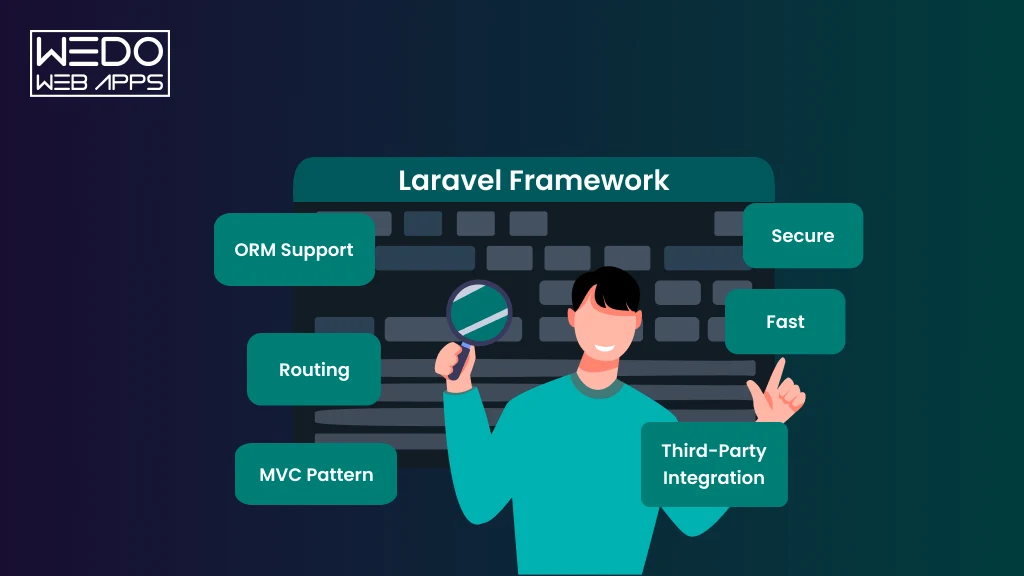
Laravel PHP framework is an open-source PHP framework designed for building and maintaining modern web applications. It provides developers with structured tools for routing, database interaction, authentication, queues, testing, caching, and other common development requirements. You can use Laravel as a full-stack framework or as an API backend for a separate frontend or mobile application.
Laravel as a PHP Web Framework
Laravel works with PHP to provide a consistent structure for developing web applications. Instead of creating separate solutions for common requirements, your development team can use Laravel's built-in capabilities and extend them when the project needs custom functionality.
The framework provides tools such as routing, controllers, middleware, validation, database migrations, Eloquent ORM, queues, and task scheduling. These capabilities make the Laravel framework for web development suitable for applications that need more than basic server-side scripting.
Laravel also supports different frontend approaches. You can build interfaces with Blade and Livewire or connect Laravel with technologies such as React, Vue, and Svelte through its current starter kits and Inertia-based approach.
What Is Laravel Used For?
Laravel can support applications that require custom business logic, database-driven functionality, user accounts, APIs, or third-party integrations.
| Application type | How Laravel can be used |
|---|---|
| Business websites | Custom content management, forms, user accounts, and business workflows |
| Ecommerce applications | Product management, orders, customers, payments, and integrations |
| SaaS platforms | User accounts, subscriptions, dashboards, permissions, and workflows |
| Custom web applications | Business processes, databases, reporting, and internal tools |
| APIs | Backend services for web, mobile, and frontend applications |
| Internal systems | Employee portals, dashboards, reporting, and operational tools |
For example, suppose you need a customer portal with secure login, role-based access, customer records, notifications, and external API integrations. Laravel can provide the backend structure needed to connect these requirements within one application.
How Laravel Supports Web Application Development
Laravel brings several development requirements into one framework. Routing determines how an application responds to requests. Middleware can inspect and filter those requests. Eloquent provides an ORM for working with application data, while queues and scheduled jobs can handle background processes. Laravel also provides testing tools for unit, feature, HTTP, and browser tests.
This structure gives your development team a consistent environment for adding functionality and maintaining the application as requirements change. You can introduce new integrations, modify database structures, extend application logic, and test changes within the same framework.
Laravel 13, the current major release, also includes newer capabilities for modern application development, including JSON resources, expanded PHP attributes, and queue routing improvements. This makes it important to evaluate Laravel based on its current capabilities rather than older framework versions.
Why Use Laravel Framework for Web Development?
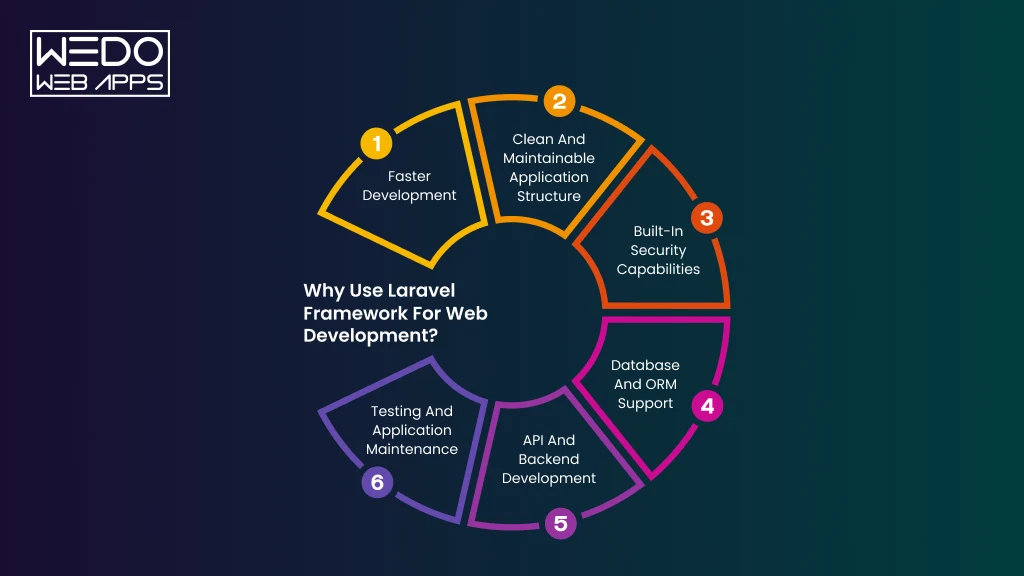
If your application needs custom workflows, database-driven functionality, user management, APIs, and ongoing updates, choosing the right framework can affect how efficiently your team builds and maintains it. Why use Laravel framework for these requirements? Laravel brings common development tools into a structured environment while giving developers room to build project-specific functionality.
Here are the main reasons businesses consider Laravel for web application development.
Faster Development
Laravel provides ready-to-use tools and conventions for common development tasks. Developers can work with routing, validation, database migrations, authentication, queues, and other capabilities without creating each component from the ground up.
Example: If you are building a customer portal, your team can use Laravel's existing framework capabilities for routing, validation, database interaction, and authentication while focusing development time on your specific business workflows.
Clean and Maintainable Application Structure
A growing application can become difficult to maintain when its code lacks structure. Laravel provides conventions and a defined application architecture that help developers organize routes, controllers, models, services, and other application components.
This can make it easier for your team to understand existing code and introduce changes as your requirements evolve.
Example: When you add a new customer management module months after launch, developers can work within the existing application structure instead of rebuilding the backend around the new requirement.
Built-In Security Capabilities
Security needs to be considered across authentication, user input, database queries, sessions, and application requests. Laravel provides features and framework protections that help developers address several common web application security requirements.
Laravel includes protection mechanisms for areas such as cross-site request forgery, secure password hashing, and SQL injection through its query builder and Eloquent ORM. Developers still need to configure and implement security correctly for the specific application.
Example: A membership platform handling customer accounts can use Laravel's authentication and password hashing capabilities as part of a broader application security strategy.
Database and ORM Support
Database operations are central to many web applications. Laravel's Eloquent ORM provides an object-oriented way to work with application data, while migrations help developers manage database structure changes through version-controlled code.
This can simplify development when your application needs relationships between customers, products, orders, payments, or other business records.
Example: For an ecommerce application, developers can define relationships between products, customers, carts, and orders through Eloquent rather than writing every database operation manually.
API and Backend Development
Modern applications often need a backend that communicates with websites, mobile applications, frontend frameworks, or external services. Laravel can be used to build API driven applications and backend services while managing business logic, data, authentication, and integrations.
Laravel's documentation also provides dedicated guidance for API resources, authentication, routing, and related backend development requirements.
Example: If you have a React frontend and a mobile application that both use the same customer data, Laravel can provide a centralized API layer for those applications.
Testing and Application Maintenance
Launching an application is only one part of development. You also need to verify changes and reduce the risk of introducing errors as new functionality is added. Laravel provides support for unit and feature testing, along with tools that help developers test application behaviour.
This becomes particularly useful for applications that receive frequent updates.
Example: If your team adds a new payment workflow, automated tests can help verify existing checkout functionality before the updated application is released.
Laravel Features for Web Development
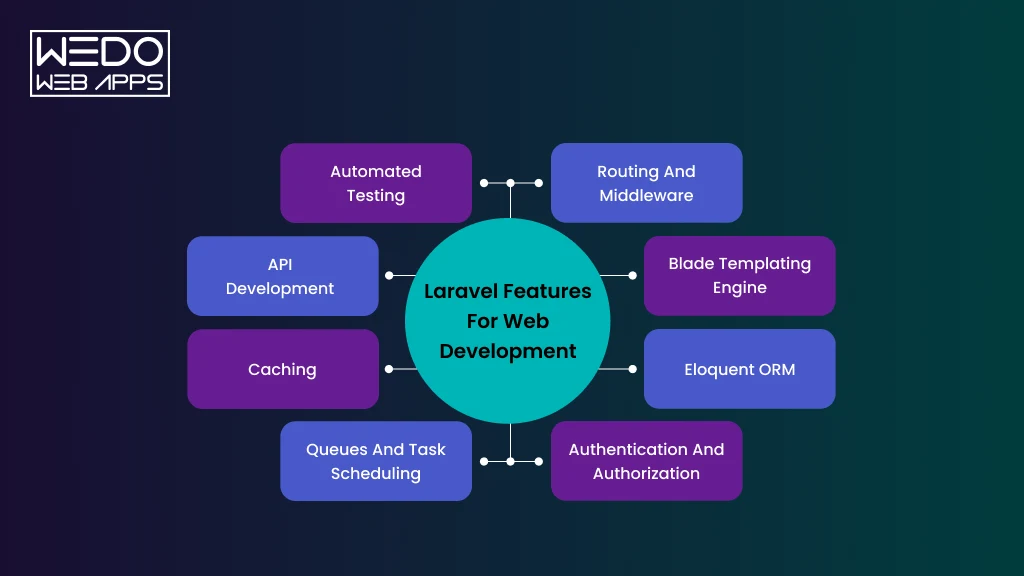
The framework you choose directly affects how your team handles application logic, data users, integrations, and ongoing updates. The Laravel features for web development bring many of these requirements into one PHP framework, giving you a structured starting point for building custom applications.
Here is a quick look at what the core features help you manage:
| Feature | What it does | Where you may use it |
|---|---|---|
| Routing and middleware | Manages requests and access rules | Websites, dashboards, APIs |
| Blade | Builds server-rendered interfaces | Business websites, portals |
| Eloquent ORM | Handles database models and relationships | eCommerce, SaaS, CRM |
| Authentication and authorization | Manages identity and permissions | Customer and admin accounts |
| Queues and scheduling | Processes background and recurring tasks | Emails, reports, data processing |
| Caching | Stores frequently accessed data | High-traffic applications |
| API development | Connects applications and services | Mobile apps, frontend systems |
| Automated testing | Checks application behavior | New features and updates |
Routing and Middleware
Laravel's routing system determines how incoming requests are handled. You can define routes for web pages, form submissions, API endpoints, and other application actions. Middleware sits between the incoming request and your application logic, allowing you to apply checks or processing before the request continues.
For example, you can use middleware to verify that a customer is authenticated before allowing access to a private account dashboard. This gives your development team a clear way to manage application access rules.
Blade Templating Engine
Blade is Laravel's templating engine for creating application views. It lets developers combine HTML with Laravel's template syntax while supporting reusable layouts and components.
You may use Blade for dashboards, account pages, forms, content-driven websites, and other server-rendered interfaces. If your project needs a different frontend approach, Laravel can also work with technologies such as React, Vue, and Svelte through its current starter kits.
Eloquent ORM
Working with databases is central to most business applications. Laravel's Eloquent ORM lets developers interact with database records through PHP models and define relationships between different types of data.
Imagine an ecommerce application with customers, products, carts, and orders. Your developers can define relationships between these records and retrieve related data through Eloquent. This provides a structured way to work with application data without handling every database operation manually.
Authentication and Authorization
Authentication answers one question: Who is the user?
Authorization answers another: What can that user access or change?
Laravel provides tools for both requirements. Its authorization system includes gates and policies that can help define permissions around specific actions or resources.
For example, customers may be able to view their orders while administrators can create products, update inventory, and manage customer accounts.
Queues and Task Scheduling
Some application tasks can take time without needing to block the user's request. Laravel's queue system allows developers to move selected jobs into background processing. Its task scheduling capabilities can manage recurring commands and application tasks.
This can be useful when your application needs to:
- Send large volumes of emails
- Generate reports
- Process uploaded files
- Synchronize external data
- Run recurring maintenance tasks
For a SaaS application, for instance, scheduled jobs could handle recurring account checks while queued jobs process notifications without making the user wait for every operation.
Caching
Caching allows frequently accessed information to be stored temporarily so it does not have to be regenerated or retrieved from the underlying data source every time. Laravel provides a consistent cache API that supports different cache stores.
This can help when your application repeatedly serves the same data. A product catalogue, for example, may contain information that is requested frequently but changes relatively infrequently.
Caching should still be planned around your application's actual data patterns. Poor cache design can create stale data or unnecessary complexity.
API Development
Your application may need to communicate with a mobile app, frontend application, payment service, CRM, or another external system. Laravel provides tools that support API based application architectures, including routing, authentication, and API resources for transforming models into structured responses.
This can allow you to maintain a centralized backend while different applications consume the same business data.
For example, you could build a Laravel backend that serves a React web application while also providing APIs for an iOS or Android application.
Automated Testing
Adding new functionality can introduce problems in existing features if changes are not properly tested. Laravel provides support for unit and feature tests, along with tools for testing HTTP requests and other application behaviour.
For example, if you update the checkout process of an ecommerce application, your team can use automated tests to verify important purchase flows before releasing the changes.
This becomes particularly useful for applications that receive frequent updates or contain multiple interconnected features.
How Laravel Is Used in Web Development
Knowing what Laravel can do is useful, but the more important question is where it fits your project. Laravel framework for web development can support applications with different business models, user roles, data requirements, and integration needs.
You may consider Laravel when your project requires more than a basic website and needs custom backend functionality.
Business Websites
A business website may need more than pages and contact forms. You might need customer accounts, appointment systems, enquiry management, content administration, reporting, or connections with other business software.
Laravel can provide the backend structure for these requirements while giving your team room to add custom workflows as the business grows.
Example: A professional services company could use Laravel to manage customer enquiries, service requests, appointment records, and an internal administration panel from one application.
eCommerce Applications
eCommerce platforms often involve several connected processes. Product management, customer accounts, carts, orders, payments, inventory, shipping, and notifications all need to work together.
Laravel can provide the application backend for these workflows and connect with payment gateways, shipping providers, CRM platforms, and other third-party services.
Best suited when: You need an ecommerce application with business rules or workflows that go beyond the capabilities of a standard off-the-shelf platform.
SaaS Applications
SaaS products need to manage users, permissions, subscriptions, account data, billing workflows, and application functionality from a central system. Laravel can provide the backend structure needed to manage these requirements.
For example, a project management SaaS could use Laravel to manage workspaces, users, roles, projects, tasks, notifications, and subscription-related processes.
Laravel's queues, scheduling, authentication, database tools, and API capabilities can also support different parts of the application architecture.
Custom Web Applications
Some businesses need software built around processes that do not fit a standard platform. This could include a booking system, customer portal, logistics application, workflow management platform, or industry-specific business tool.
In these cases, Laravel can be used to build the application around your actual processes rather than forcing those processes into a predefined structure.
Consider Laravel when your requirements include:
- Custom business rules
- Database-driven workflows
- Multiple user roles
- Third-party integrations
- Custom dashboards
- Automated processes
APIs and Backend Systems
Your users may interact with your business through several applications. A website, mobile application, partner portal, and internal system may all need access to the same data.
Laravel can act as the backend layer that manages business logic and provides APIs to these applications. Laravel's API resources can also help transform application data into structured responses for clients consuming the API.
Example: A delivery business could use a Laravel backend to provide order and delivery data to its customer website, driver application, and internal operations dashboard.
Admin Panels and Internal Applications
Internal software often needs controlled access to business data and processes. Laravel can support administration panels, employee portals, reporting systems, inventory tools, and operational dashboards.
You can define different permissions for different users and build workflows around the way your team actually operates.
For example, a manufacturing business could use a Laravel-based internal application to manage production records, inventory data, employee access, supplier information, and operational reports.
The common factor across these use cases is the need for custom web application development. Laravel gives your development team a PHP-based framework around which these application-specific requirements can be built.

Laravel Advantages and Disadvantages
Choosing Laravel for a project depends on what you are building, how your team works, and what the application may require over time. Understanding the Laravel advantages and disadvantages can help you assess whether the framework is a practical fit before development begins.
Advantages of Laravel
| Advantage | Why it matters for your project |
|---|---|
| Faster development | Ready-to-use tools can reduce repetitive development work. |
| Structured application development | Consistent conventions can make projects easier to organize and maintain. |
| Extensive ecosystem | Laravel provides a broad ecosystem around common application development needs. |
| Database tools | Eloquent, migrations, and query tools simplify many database operations. |
| Authentication and authorization | Built-in capabilities support common user access requirements. |
| Testing support | Developers can test application behavior as new functionality is introduced. |
| API development | Laravel can support backend APIs for web, mobile, and external applications. |
| Documentation and community | Developers have access to official documentation and an established developer community. |
Where this helps: If you are building a SaaS platform with multiple users, database relationships, APIs, and regular feature updates, these capabilities can give your development team a structured starting point.
Disadvantages of Laravel
Laravel is not automatically the best choice for every PHP project. You should also consider its limitations before selecting it.
- PHP expertise is required
Laravel is built on PHP, so your development team needs a good understanding of PHP as well as Laravel's conventions and tools. Hiring developers without the required experience can increase onboarding and development time.
- It may be more than you need for a very small application
A simple website with limited server-side functionality may not require a full framework with Laravel's range of capabilities. In such cases, a lighter solution may be more appropriate.
- There is a learning curve
Developers who are new to Laravel need to understand its architecture, conventions, ecosystem, and development tools. The learning requirement becomes more noticeable when the project uses advanced Laravel features.
- Larger applications need careful infrastructure planning
Laravel can support complex applications, but application performance depends on more than the framework itself. Database design, caching, queues, server configuration, application architecture, and monitoring all need to be planned properly as usage increases.
- Highly customized applications can become complex
Laravel gives developers considerable flexibility. That flexibility still needs to be managed through good architecture, coding standards, testing, and documentation. Without these practices, a large application can become difficult to maintain regardless of the framework being used.
Is Laravel Right for Your Project?
A simple way to assess the choice is to look at your actual requirements.
Laravel may be a strong fit when you need:
- Custom business functionality
- Database-driven applications
- Authentication and user permissions
- API integrations
- SaaS functionality
- Regular feature development
- A PHP-based development stack
Another solution may be worth considering when:
- You only need a very simple website.
- Your existing team specializes in another technology.
- Your project has requirements better matched to another framework or technology stack.
The right framework should fit your application's requirements rather than being selected because it is popular. This is also why comparing Laravel vs other PHP frameworks becomes useful before committing to a development approach.
Laravel vs Other PHP Frameworks
Choosing a PHP framework is easier when you compare it against the alternatives you may already be considering. Laravel vs other PHP frameworks is not simply a question of which framework has more features. Your project scope, development team, application architecture, integrations, and long-term maintenance requirements should guide the choice.
Laravel, Symfony, and CodeIgniter all support PHP application development, but they take different approaches to application structure and development.
| Factor | Laravel | Symfony | Codelgniter |
|---|---|---|---|
| Development approach | Convention-driven framework with a broad set of development tools | Modular framework built around reusable components | Lightweight framework focused on simplicity and performance |
| Learning curve | Moderate | Moderate to high for developers new to its architecture | Relatively straightforward |
| Built-in capabilities | Broad range of application development tools | Extensive components and framework capabilities | More focused and lightweight |
| Database support | Eloquent ORM, query builder, and migrations | Doctrine ORM and database tools | Query Builder and database libraries |
| Ecosystem | Large Laravel ecosystem and supporting tools | Mature Symfony ecosystem and reusable components | Smaller ecosystem |
| API development | Strong support for API based applications | Strong support through Symfony components and tools | Suitable for lightweight API development |
| Best suited for | Custom web application, SaaS, ecommerce, APIs, and business systems | Complex applications and projects requiring highly modular architecture | Lightweight applications and projects prioritizing simplicity |
Laravel vs Symfony
Laravel and Symfony are both established PHP frameworks, but their development approaches differ. Laravel provides a broad set of tools through a cohesive framework and emphasizes developer productivity. Symfony is highly modular and provides reusable components that can also be used independently.
Symfony can be a strong option when your project requires a highly modular architecture or when your team already has extensive Symfony experience. Laravel may be more suitable when you want an integrated framework with a broad collection of tools for common web application requirements.
Laravel vs CodeIgniter
CodeIgniter takes a more lightweight approach than Laravel. It has a smaller footprint and provides developers with a relatively simple framework for building PHP applications.
Laravel provides a broader collection of tools and a larger ecosystem for applications that require features such as authentication, queues, database abstraction, testing, APIs, and other application services.
If you are building a relatively simple application and want a lightweight framework, CodeIgniter may be worth considering. If your project requires a broader application structure and expects ongoing feature development, Laravel may offer a better fit.
Which PHP Framework Should You Choose?
There is no single PHP framework that is right for every project. Your choice should reflect what you need to build and how your team plans to maintain it.
Consider Laravel when you need:
- A broad set of web application development tools
- Custom business workflows
- SaaS or ecommerce functionality
- Database-driven applications
- APIs and third-party integrations
- A framework with an extensive ecosystem
Consider Symfony when you need:
- A highly modular architecture
- Reusable Symfony components
- A team experienced with Symfony
- Complex applications with specific architectural requirements
Consider CodeIgniter when you need:
- A lightweight PHP framework
- A relatively simple application structure
- Lower framework overhead for a smaller project
The best choice depends on your application requirements, developer expertise, expected traffic, integrations, hosting environment, and long-term maintenance plans. Before selecting a framework, evaluate the complete technical picture rather than comparing feature counts alone.
When Should You Choose Laravel for Web Development?
Laravel can be a strong choice when your application needs custom backend functionality, structured development, and room for future changes. The question is not whether Laravel can build your application. The better question is whether its capabilities match what you need to build.
You should consider Laravel when your project involves the following requirements.
You Need Custom Business Functionality
Standard website platforms work well when your requirements fit their existing features. Laravel becomes more relevant when your application needs workflows designed around your business.
This could include custom booking logic, approval processes, customer portals, pricing rules, reporting systems, or role-based workflows.
Your Application Is Database Driven
If your application relies heavily on customer records, products, transactions, bookings, documents, or other structured data, Laravel provides database tools that can support these requirements.
Eloquent ORM, migrations, query building, and database relationships can help your team manage application data as the project develops.
You Need APIs and Third Party Integrations
Your application may need to exchange data with payment gateways, CRMs, mobile applications, shipping platforms, analytics tools, or other external services.
Laravel can provide the backend and API layer required to connect these systems while keeping business logic within your application.
Your Product Requires User Accounts and Permissions
Applications with multiple user types often need different access rules. A customer may have access to their own records, while an employee, manager, or administrator needs additional permissions.
Laravel provides authentication and authorization capabilities that can support these access requirements.
You Are Building a SaaS Product
SaaS applications often combine user management, subscriptions, dashboards, databases, notifications, APIs, and recurring processes.
Laravel can provide the backend structure for these requirements and give your team a framework for adding functionality as the product develops.
Your Application Has Complex Backend Workflows
Some applications involve processes that need several steps before an action is completed. A logistics platform, for example, may need order creation, assignment, tracking, notifications, status updates, and reporting.
Laravel's routing, queues, events, database tools, and scheduling capabilities can support these types of workflows.
You Expect Long-Term Development
If you expect your application to receive regular updates, new integrations, or additional modules, the development framework should support ongoing maintenance.
Laravel's established conventions, testing support, ecosystem, and development tools can give your team a consistent environment for maintaining and extending the application.
When Laravel May Not Be the Right Choice
Laravel does not need to be used simply because you are building with PHP. A very small website with limited backend requirements may not need the capabilities of a full web application framework.
You may also want to consider another technology if your existing team has strong expertise in a different stack or if your project's technical requirements are better matched to another framework.
A practical decision check: If your project requires custom business logic, structured data, user management, APIs, integrations, and ongoing development, Laravel is worth evaluating. If most of these requirements are absent, a simpler solution may be sufficient.

How to Choose a Laravel Development Company
Choosing a Laravel development company should involve more than checking whether an agency offers PHP development. Your development partner will influence the application's architecture, code quality, integrations, testing process, and ability to support future changes.
Before you hire a team, assess these areas.
Check Laravel Development Experience
Start by looking at how much relevant Laravel experience the company can demonstrate. Ask whether its developers have worked with the Laravel capabilities your project actually needs, such as Eloquent, APIs, queues, authentication, testing, and third-party integrations.
You should also check whether the team keeps its Laravel knowledge current. Framework versions and development practices change, so experience with an outdated version alone does not tell you enough about current technical capability.
Review Relevant Projects
A portfolio becomes more useful when the projects are similar to yours. Look for examples involving comparable business processes, application complexity, integrations, or user requirements.
For example, if you need a SaaS application, a portfolio filled only with brochure websites will give you limited evidence of the team's ability to handle subscriptions, user permissions, dashboards, APIs, and database-driven workflows.
Evaluate Technical Expertise
Your Laravel development company should understand more than Laravel syntax. Evaluate its knowledge of PHP, database architecture, APIs, authentication, frontend integration, testing, deployment, and application performance.
Ask how the team approaches your specific technical requirements. A strong technical discussion should help you understand why a particular architecture or implementation approach is being recommended.
Understand the Development Process
A clear development process reduces uncertainty once work begins. Before signing a project, understand how the company handles requirements, architecture, UI development, coding, testing, deployment, and communication.
A practical process should give you clear visibility into what is being built, what has been completed, and what needs your input.
Ask About Testing and Security
Testing and security should be discussed before development starts rather than after the application is ready for launch. Ask how the team handles automated testing, authentication, authorization, validation, data protection, code reviews, and production configuration.
Laravel provides dedicated testing capabilities, while its deployment guidance also highlights production configuration and security considerations. Your development partner should explain how these practices will apply to your specific application.
Confirm Post-Launch Support
Your relationship with a development company should not necessarily end when the application goes live. Updates, bug fixes, performance improvements, security patches, monitoring, and new integrations may be needed as your business changes.
Before choosing a partner, clarify what post-launch support includes, how issues are handled, and whether you can retain the same technical team for future development.
A Simple Selection Checklist
Before making your final choice, make sure you can answer yes to these questions:
- Does the team have relevant Laravel project experience?
- Can it demonstrate technical expertise beyond basic PHP development?
- Has it built applications similar to yours?
- Is its development and testing process clearly defined?
- Can it handle APIs and third-party integrations?
- Does it provide post-launch maintenance and support?
- Can the team explain technical decisions in terms you can understand?
The right Laravel development company should be able to connect its technical capabilities with your business requirements. That makes the selection process less about choosing the longest list of services and more about finding a team that can build, maintain, and develop your application over time.
Why Choose WEDOWEBAPPS for Laravel Development?
Choosing a Laravel development partner is easier when you can see how the team approaches the actual requirements of your application. At WEDOWEBAPPS, our Laravel development approach focuses on building applications around your business processes, technical requirements, and future development needs.
Laravel Development Expertise
Our Laravel development services can support custom web applications that require structured backend development, database integration, APIs, authentication, and business-specific workflows.
We can assess your requirements first and then determine which Laravel capabilities are relevant to your application rather than adding features that your project does not need.
Custom Web Application Development
Your business may have processes that do not fit neatly into an existing software platform. Our team can build custom Laravel applications around those processes.
This can include customer portals, management systems, SaaS products, ecommerce applications, dashboards, booking platforms, and other database-driven solutions.
API Development and Integrations
Modern applications often need to communicate with other platforms. Your Laravel application may need to connect with payment gateways, CRM systems, third-party APIs, mobile applications, or frontend technologies.
Our developers can build and integrate APIs based on your application's data and business logic requirements.
UI and Backend Development
A web application needs both a usable interface and a reliable backend. Our team can work across Laravel backend development and frontend integration to connect application logic with the user experience.
Depending on your project, Laravel can work with server-rendered interfaces or modern frontend technologies. The implementation can be selected according to your application's requirements.
Testing and Maintenance
Development does not end when the first version is released. New functionality, integrations, and business requirements can introduce changes across the application.
Our team can support testing, bug fixes, application updates, performance improvements, and ongoing Laravel maintenance so your application can continue to evolve with your business.
Dedicated Laravel Developers
If you need an extended development team rather than a one-time project delivery, dedicated Laravel developers can work alongside your existing team or manage defined development responsibilities.
This model can be useful when you have a long-term product roadmap, regular feature releases, or ongoing maintenance requirements.
Post-Launch Support
Once your Laravel application is live, you may need technical assistance with updates, integrations, troubleshooting, or additional functionality.
Our support can continue beyond the initial development phase, giving you a technical resource for maintaining and extending the application as your requirements change.
If you are planning a new Laravel application or need to modernize an existing PHP solution, our team can assess your requirements and recommend an appropriate development approach.
Conclusion
Choosing a framework is an important step when you are planning a web application. Laravel gives you a structured PHP environment with tools for databases, authentication, APIs, queues, testing, and other common development requirements.
The right choice still depends on what you need to build. A custom SaaS product may have very different requirements from a small business website. Your application's complexity, integrations, development team, budget, and long-term plans should all be considered before you commit to a framework.
If Laravel fits those requirements, the next step is finding a development team that understands both the framework and your business needs. At WEDOWEBAPPS, we can help you plan, develop, integrate, test, and maintain custom Laravel applications based on your project requirements.