
Introduction
Your app launch date is getting closer. The product still has unfinished features. Developers are fixing issues that appeared late in testing. Stakeholders are asking for changes. A third-party integration is taking longer than planned.
For UK startups and growing businesses, these delays can have a real commercial impact. A slower launch can mean losing a market opportunity, falling behind competitors, or spending more on development than originally planned.
This is where your app time to market UK strategy matters.
The pressure to launch quickly can push teams towards rushed development, reduced testing, or an overloaded MVP. Those shortcuts may save time on paper. They can also create bugs, rework, and technical problems that take even longer to resolve.
The smarter approach is to find where development time is being wasted and remove those bottlenecks early. A focused MVP, clear requirements, the right technology stack, parallel workflows, and continuous testing can help your team move faster while keeping quality under control.
In this guide, we will explore practical ways to reduce mobile app development time UK businesses can apply, from initial planning through testing and launch.
Why Does App Development Take Longer Than Expected
An app rarely misses its launch date because developers suddenly become slower. More often, the delays begin much earlier. A vague requirement here, an unplanned integration there, and a few late feature requests can gradually push the entire project off schedule.
For UK businesses, understanding these bottlenecks is an important first step towards reducing development time.
Unclear Requirements Create Development Rework
When developers start building without a clear understanding of the product requirements, changes are almost inevitable. A feature may work technically but fail to match what users or stakeholders expected.
The team then spends time revisiting completed work instead of progressing with the next release.
Feature Creep Keeps Moving the Finish Line
An MVP can quickly become much larger than planned. A new dashboard, another payment option, or an additional user role may seem small individually. Together, they can add significant development and testing effort.
Without firm scope control, the launch date keeps moving.
Sequential Workflows Create Unnecessary Waiting
When design has to be completely finished before development begins, or testing starts only after every feature is built, teams spend valuable time waiting for the next stage.
Bringing the right activities closer together can keep work moving.
Late Testing Exposes Problems Too Close to Launch
Finding a major usability, compatibility, or performance issue just before release creates pressure. Developers may need to revisit code, designs, and integrations that were considered complete.
Testing critical functionality earlier makes these problems easier to isolate and fix.
Platform Duplication Increases Development Effort
Building separate solutions for iOS and Android can increase the amount of development, testing, and maintenance required. Depending on the product, a suitable cross-platform approach can reduce duplicated effort.
Third-Party Integrations Introduce Unexpected Delays
Payments, authentication, maps, analytics, and other external services can become launch blockers if their requirements are not checked early.
Understanding these dependencies during planning gives the team more time to address technical or approval-related issues.
The common thread is simple: reducing mobile app development time UK teams need is often less about making individual developers work faster and more about preventing avoidable work from entering the development cycle in the first place.
The App Time-to-Market Trade-Off: What Should You Accelerate and What Should You Never Rush?
When a launch date is approaching, the easiest reaction is to cut time wherever possible. Fewer testing cycles. Faster approvals. More features pushed into development at once.
That approach can create bigger problems after launch.
A better app time to market UK strategy separates work that can be accelerated from work that protects the product. The goal is to remove unnecessary effort while keeping security, usability, and reliability intact.
| Development Area | Can You Accelerate it? | What to do? |
|---|---|---|
| Feature Prioritisation | Yes | Remove low-value features from the first release |
| Design Iterations | Yes | Focus early reviews on critical user journeys |
| Reusable Components | Yes | Avoid rebuilding common functionality |
| Automated Testing | Yes | Reduce repetitive manual checks |
| User Feedback | Yes | Validate important decisions earlier |
| Security Testing | No | Keep essential security checks in place |
| Compliance Requirements | No | Address applicable requirements before launch |
| Core QA | No | Test the functionality users depends on |
| Nice-to-Have Features | Yes | Move them to a later release |
| Critical Integrations | Carefully | Validate them early rather than rushing implementation |
Accelerate Decisions, Not Essential Quality Checks
The biggest gains often come from making decisions earlier. Confirm the product scope. Validate the core user journey. Choose the technology approach. Identify integration requirements.
These decisions can prevent weeks of rework later.
Defer Features Instead of Lowering Standards
If the launch window is tight, look at the feature list first. A secondary reporting dashboard can wait. A core payment flow cannot. An optional personalisation feature can be released later. Authentication security cannot.
This distinction allows teams to reduce mobile app development time UK projects require while keeping the product dependable.
The principle is simple: speed up the work that can move faster, and protect the work that keeps the app safe, usable, and reliable.
Define a Launch-Ready MVP Before Development Starts
A rushed app is often the result of an overloaded first release. Teams want to include every feature they have discussed, every request from stakeholders and every idea that could improve the product.
That makes the first launch harder to plan and slower to deliver.
A focused MVP gives the development team a clear target. It also gives the business a faster route to real user feedback.
Identify the Core Problem Your App Needs to Solve
Start with one question:
What should users be able to accomplish when they open the app?
Build the first release around that outcome. If a feature does not contribute to the core user journey, question whether it needs to be ready on launch day.
Separate Essential Features From Future Enhancements
Not every useful feature needs to be part of version one.
A simple prioritisation approach can help:
| Feature Type | Launch Decision |
|---|---|
| Core user functionality | Include |
| Revenue-critical functionality | Include |
| Security or compliance requirement | Include |
| Supporting convenience feature | Consider later |
| Experimental feature | Validate first |
| Low-use enhancement | Defer |
This keeps development focused without weakening the product itself.
Prioritise the Complete Core User Journey
Reducing the number of features is not enough. The features you keep need to work together.
For example, a booking app may need search, availability, booking and payment for its core journey. Building only the search functionality may produce a smaller app, but it does not create a usable product.
The goal is a complete core experience, not simply a smaller feature list.
Define Acceptance Criteria Before Development
Developers should know what success looks like before a feature enters development. Clear acceptance criteria reduce interpretation, unnecessary revisions, and approval delays.
They also give QA teams a practical basis for testing.
Freeze the Initial Scope at the Right Point
Once the MVP has been validated and development begins, new ideas should have a clear path for consideration. They should not automatically enter the current sprint.
This discipline helps teams how to launch an app faster UK businesses can realistically achieve, while leaving room to improve the product after the initial release.
Create a Faster Development Plan Before Writing Code
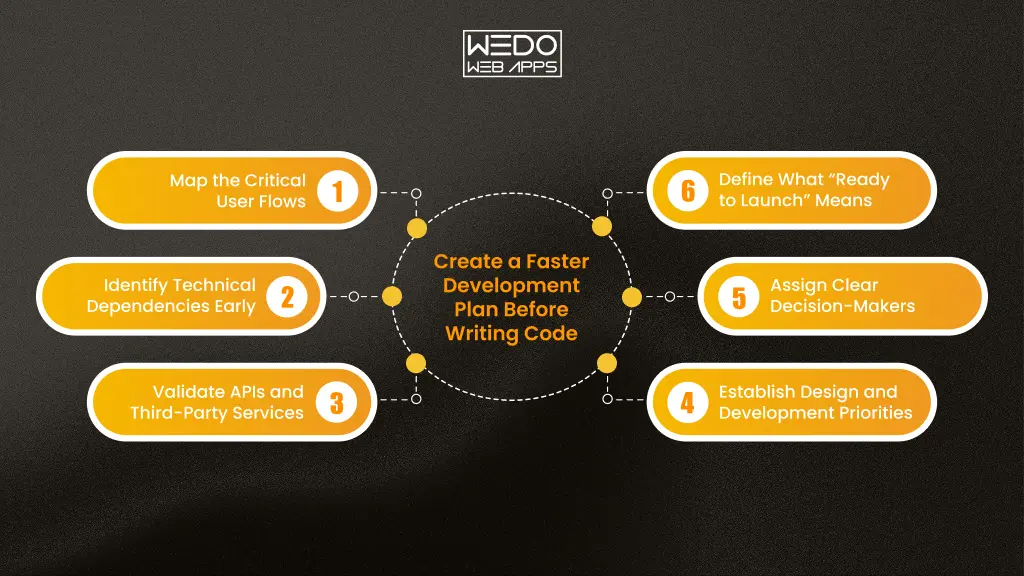
Once the MVP is defined, the next risk is starting development too quickly. A development team can have a clear feature list and still lose weeks to unanswered questions, technical dependencies, and decisions made halfway through the project.
A solid plan gives developers fewer reasons to stop, revisit work, or wait for clarification.
Map the Critical User Flows
Document how users will move through the app to complete its most important tasks. This helps designers, developers, and testers work towards the same outcome.
It also highlights gaps before they become development issues.
Identify Technical Dependencies Early
List the services, APIs, platforms, and infrastructure the app will rely on. Check their documentation, access requirements, and limitations before development depends on them.
A dependency discovered late can quickly become a launch blocker.
Validate APIs and Third-Party Services
Don’t assume an external service will work exactly as expected. Confirm its available endpoints, SDK support, authentication process, pricing requirements, and platform compatibility.
Early validation can prevent major changes later.
Establish Design and Development Priorities
Give the team a clear order of execution. Critical user journeys should take priority over secondary screens and supporting features.
This means useful functionality starts taking shape early rather than waiting for the entire product to be completed.
Assign Clear Decision-Makers
Development slows down when simple questions sit unanswered for days. Establish who can approve requirements, designs, technical decisions, and scope of changes.
A clear decision-making structure keeps work moving.
Define What “Ready to Launch” Means
Agree on the conditions that must be met before release. These may include functional testing, performance checks, security validation, app store requirements, and stakeholder approval.
With these expectations established upfront, teams can work towards a defined finish line instead of discovering new launch requirements at the last minute.
Choose the Right App Development Approach for Faster Delivery
The technology behind an app can influence how quickly a team can build, test, and release it. Choosing a framework simply because it is popular, however, can create problems later.
The better question is: which development approach fits the product without adding unnecessary complexity?
When Native App Development Makes Sense
Native development gives teams direct access to platform-specific capabilities. It can be the right choice for apps that depend heavily on advanced device features, complex hardware interactions, or highly specialised performance requirements.
For these products, building specifically for iOS and Android may justify the additional development effort.
When Cross-Platform Development Can Reduce Delivery Time
If an app needs to reach both iOS and Android users with broadly similar functionality, maintaining separate codebases can mean duplicated development and testing work.
A suitable cross-platform approach allows teams to share more of the application code while still delivering experiences for both platforms. This can make iteration and maintenance more efficient.
Use React Native for Faster Cross-Platform Delivery
React Native for faster cross-platform delivery can be a practical option when a product needs to support both major mobile platforms while keeping development effort manageable.
Teams can reuse a significant portion of their codebase, share components, and apply changes across platforms more efficiently. Its suitability still depends on the app’s functionality, integrations, and performance requirements.
When Cross-Platform Development Isn’t the Right Choice
Cross-platform development is not automatically the fastest option.
Native development may be more appropriate when an app requires:
- Extensive platform-specific functionality
- Advanced hardware integration
- Highly specialised performance
- Deep operating-system integration
- Complex native SDK requirements
The objective is not to choose the framework with the shortest development promise. It is to choose an approach that reduces unnecessary work without creating technical limitations that slow the product down later.

Run Design and Development in Parallel
A development process can lose days simply because one team is waiting for another to finish. If every screen must be designed, approved, and documented before development begins, the project can move in the long sequence of hand-offs.
A more efficient workflow keeps the right activities moving together.
Validate the Highest-Priority Screens First
Start with the screens that support the app’s core user journey. Once those designs are validated, developers can begin working on them while the remaining screens are being refined.
This keeps development moving without forcing the entire design phase to finish first.
Use Reusable Design Components
Buttons, forms, navigation elements, cards, and other recurring interface patterns should follow a consistent design system. Developers can then build reusable components instead of recreating similar elements for every screen.
That saves time during both development and future updates.
Give Developers Validated Design Progressively
Design does not need to arrive as one finished package. Delivering approved screens in logical batches allows development to start earlier and gives the team opportunities to identify technical constraints before they affect later work.
Resolve Technical Feasibility Issues During Design
A design may look simple but require complex implementation. Discussing feasibility early helps designers adjust where necessary before development effort has already been invested.
This collaborative approach reduces unnecessary back-and-forth and keeps the project moving towards launch.
The aim is not to rush designers or developers. It is to remove unnecessary waiting between them while keeping decisions and approvals clear.
Test Earlier to Launch Faster Without Sacrificing Quality
Testing is often treated as the final checkpoint before an app goes live. That creates a difficult situation when a critical issue appears late in development, and the team has little time to fix it.
Moving testing earlier changes the equation. Smaller problems can be found while the relevant feature is still fresh, making them easier to investigate and resolve.
Test Critical User Journeys Throughout Development
Don’t wait for the entire app to be complete. Test important workflows as soon as they become functional.
For example, if payments are central to the product, validate the complete payment journey early. This gives the team time to address functional, usability, or integration issues before release preparation begins.
Automate Repetitive Testing
Some checks need to be repeated every time the app changes. Automated tests can handle suitable regression and functional checks without requiring the same manual effort each time.
This allows testers to spend more time investigating complex issues that require human judgement.
Test Across Devices and Operating Systems Early
An app that works correctly on one device may behave differently elsewhere. Screen sizes, operating-system versions, permissions, and device capabilities can all affect the experience.
Early device testing gives the team time to resolve compatibility issues instead of discovering them immediately before launch.
Integrate Security Checks Into Development
Security should not become a final-stage activity. Authentication, data handling, permissions, and sensitive user information need appropriate checks throughout development.
Fixing a security issue early is generally less disruptive than discovering it after the application is ready to release.
Use Beta Testing Before the Full Release
A controlled beta can reveal issues that internal testing may miss. Real users interact with the product differently, helping teams identify confusing workflows, usability problems, and unexpected behaviour.
The result is a more confident launch without requiring the team to wait until every possible improvement is complete.
| Late Testing | Earlier Testing |
|---|---|
| Problems accumulate | Problems are identified sooner |
| Fixes can affect completed work | Fixes are easier to isolate |
| Launch pressure increases | Release preparation is more predictable |
| Rework can delay launch | Smaller issues are resolved continuously |
Speed and quality work together when testing is built into the development process rather than left until the final days before release.

Reduce Rework With Faster Feedback and Decision-Making
Development can slow down even when the technical work is progressing well. A design is waiting for approval. A product decision has not been made. Two stakeholders have different expectations about how a feature should work.
These small delays can accumulate quickly.
A faster feedback loop keeps the team aligned and reduces the amount of work that needs to be revisited.
Keep One Source of Truth for Requirements
Product requirements, approved designs, feature decisions, and acceptance criteria should be easy for the team to find. Scattered information across emails, messages, and documents makes it harder to know which version is current.
A shared source of truth reduces confusion.
Review Completed Features Regularly
Don’t wait until the entire app is ready for stakeholder review. Demonstrate completed functionality at regular intervals.
This gives decision-makers an opportunity to identify misunderstandings while changes are still manageable.
Give Feedback Against Agreed Criteria
Feedback should answer a specific question: does the feature meet the agreed requirement?
This keeps reviews focused and reduces subjective changes that can send completed work back into development unnecessarily.
Assign Decision Ownership
Every project needs people who can make timely decisions about product scope, design, and technical direction. Without clear ownership, even simple questions can remain unsolved.
Fast decisions help developers continue working instead of waiting.
Prevent Late-Stage Scope Changes
New ideas will always appear during development. The important part is deciding whether they belong in the current release.
If a new request does not affect the core launch objective, add it to the post-launch roadmap rather than automatically expanding the current scope.
A development team does not need constant pressure to work faster. It needs fewer reasons to stop, wait, and redo work. Faster feedback loops provide exactly that.
Use Automation and Reusable Components to Reduce Development Time
Teams often lose development time on work that has already been solved before. Rebuilding common interface elements, setting up environments manually, running repetitive checks, and repeating the same deployment steps can all slow down delivery.
Automation and reusable components help remove this unnecessary effort.
Build Reusable UI Components
Common elements such as buttons, forms, navigation, cards, and input fields can be created as reusable components. Developers can then apply tested components across different screens instead of rebuilding them from scratch.
This also improves consistency and reduces the chance of introducing small UI issues.
Create a Shared Design System
A design system gives designers and developers agreed patterns for colours, typography, spacing, components, and interactions. New screens can be designed and developed faster because the basic rules are already established.
It also reduces repeated discussions about major design decisions.
Automate Repetitive Development Tasks
Automated builds, deployments, code quality checks, and suitable regression tests can reduce manual work throughout the development cycle.
For teams working towards a faster app time to market UK target, these improvements can save time access multiple sprints rather than only at the final launch stage.
Reuse Proven Services and Integrations
Authentication, analytics, notifications, and other common capabilities can often be supported through established libraries, APIs, or internal services. Reusing reliabke solutions can reduce unnecessary development effort.
The goal is not to automate every decision. Engineering judgement still matters. The aim is to let automation handle predictable, repeatable work so developers can spend more time solving the parts of the product that actually require expertise.
Next, we’ll cover third-party integrations because they are a common source of unexpected delays when their requirements are discovered too late.
Manage Third-Party Integrations Before They Become Bottlenecks
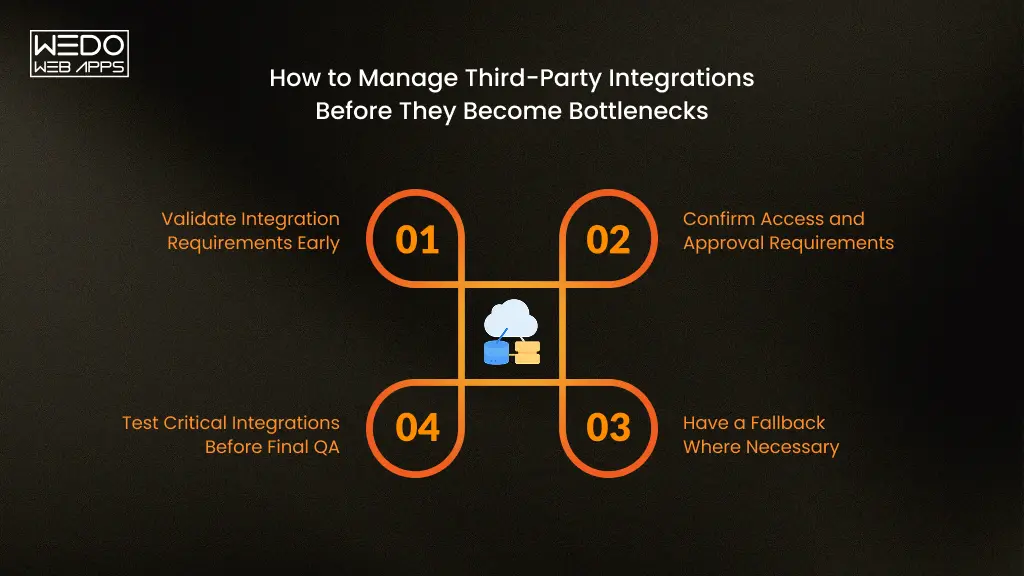
Third-party services can speed up development, but they can also become unexpected launch blockers. Payment gateways, authentication providers, maps, analytics platforms and communication services may have technical, security or approval requirements that affect the development schedule.
The earlier these dependencies are checked, the easier they are to manage.
Validate Integration Requirements Early
Before development depends on an external service, check its API documentation, SDK availability, authentication process, supported platforms and technical limitations.
A quick technical validation can reveal compatibility issues before they affect core development.
Confirm Access and Approval Requirements
Some services require account verification, business checks, domain approval or production access before they can be used fully. These processes can take time and should be included in the project plan.
Test Critical Integrations Before Final QA
Do not leave payment, authentication or other essential integrations until the final development stage. Test them with the core user journey early so problems can be identified while changes are still manageable.
Have a Fallback Where Necessary
For critical services, understand what happens if an API changes, becomes unavailable or fails during testing. A suitable fallback can prevent one external dependency from delaying the entire launch.
Early integration planning helps teams how to launch an app faster UK businesses need while reducing the risk of last-minute technical surprises.
Next, we’ll shift from development practices to a practical launch framework specifically for UK startups, keeping the focus on speed without cutting essential quality controls.
Build a Faster App Launch Strategy for UK Startups
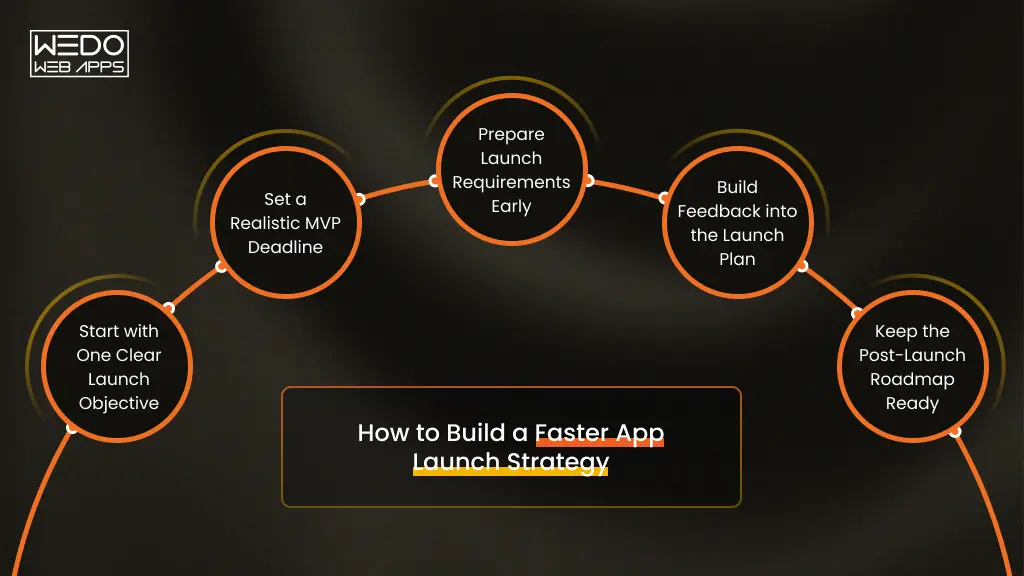
For a UK startup, launching faster is often about making better decisions earlier. A small team cannot afford long approval cycles, unnecessary features or development work that has to be repeated.
A practical faster app launch strategy for UK startups should connect product priorities, development and launch preparation from the beginning.
Start with One Clear Launch Objective
Define what the first release needs to prove. It could be attracting early customers, validating a booking process or testing demand for a new service.
This objective should guide feature decisions throughout development.
Set a Realistic MVP Deadline
Choose a target launch window based on the core user journey rather than an oversized feature list. A firm target creates a reason to prioritise and makes scope changes easier to challenge.
Prepare Launch Requirements Early
App Store and Google Play requirements, privacy documentation, analytics, payment setup, support processes and production accounts should not be left until the final sprint.
Preparing these alongside development reduces last-minute delays.
Build Feedback into the Launch Plan
A first release should create an opportunity to learn from real users. Plan for beta testing, feedback collection and post-launch improvements rather than trying to perfect every possible feature before release.
Keep the Post-Launch Roadmap Ready
A clear roadmap makes it easier to say no to non-essential requests during development. Features that do not support the first launch can be documented for later releases instead of delaying the initial product.
For UK startups, the objective is not simply to release an app quickly. It is to reach the market with a usable, reliable product that can start generating real user feedback.
A Practical App Development Timeline for Faster Delivery
A development timeline becomes more useful when it shows dependencies rather than simply assigning dates to each phase. Some activities can overlap, while others need to happen before development can move forward.
For teams looking to reduce mobile app development time UK projects require, the following structure provides a practical starting point.
| Development stage | Key activities | How to protect delivery time |
|---|---|---|
| Discovery and planning | Requirements, user flows, MVP scope | Make product decisions early |
| UX and UI design | Wireframes, key screens, design system | Validate priority screens first |
| Development | Core features, integrations, backend work | Build critical user journeys first |
| Testing | Functional, device, security and performance checks | Test continuously, not only at the end |
| Beta release | Controlled user testing and feedback | Fix high-impact issues first |
| Launch preparation | Store submission, analytics, support and monitoring | Prepare launch requirements early |
| Release | Production deployment and monitoring | Keep a clear rollback plan |
Overlap Work Where Dependencies Allow
Design does not always need to finish completely before development starts. While developers build approved core screens, designers can continue working on lower-priority areas.
Similarly, testing can begin as soon as stable functionality becomes available.
Protect Time for Testing and Launch Preparation
A common mistake is using every available day for feature development and leaving testing for the final stretch.
Reserve time for quality checks, bug fixing, store requirements and production preparation from the beginning.
Keep a Buffer for Unexpected Issues
Third-party services can fail. App store reviews can take longer than expected. A critical bug may require additional development.
A small buffer gives the team room to handle these issues without immediately moving the launch date.
The exact timeline will vary by product, platform and complexity. The important principle is to plan dependencies early, overlap suitable activities and protect quality work instead of squeezing it into the final days.
How Do You Know Your App Team Is Actually Getting Faster?
A shorter development timeline does not automatically mean a more efficient team. If speed comes from skipping testing or pushing unfinished work forward, the apparent improvement may disappear after launch.
Track indicators that show whether the team is genuinely reducing wasted effort.
Measure Cycle Time
Track how long it takes a feature to move from approved requirement to completed, tested functionality. A gradual reduction can indicate that processes are becoming more efficient.
Monitor Rework
Record how often completed features return to development because of unclear requirements, design changes or missed expectations. Less rework usually means better decisions earlier in the process.
Track Blocked Time
Note how often developers are waiting for approvals, technical access, third-party responses or product decisions. Repeated blockers can reveal where the delivery process needs attention.
Measure Escaped Defects
A faster team should not create more production problems. Monitor significant defects discovered after release alongside delivery speed.
These measures give a more realistic view of app time to market UK performance. The goal is not simply fewer development days. It is less waiting, less rework and fewer avoidable defects while maintaining release quality.
When Should You Work With a Mobile App Development Agency?
Building an app internally can work well when you already have the right product, design and engineering capabilities. But hiring an experienced mobile app development agency UK teams can also make sense when internal resources are limited or the project requires expertise you do not currently have.
You Need Specialist Expertise
If your team lacks experience with a particular platform, framework, integration or technical requirement, an experienced development partner can reduce the learning curve.
Your Internal Team is Already at Capacity
Adding a new app project to an overloaded team can create competing priorities and slow existing work. An external team can provide additional development capacity without requiring immediate permanent hiring.
You Need to Launch Across Multiple Platforms
An agency with cross-platform and native development experience can help determine the most suitable approach based on your product requirements, rather than forcing a single technology choice.
You Need Stronger Delivery Processes
An experienced partner can bring established practices for planning, development, testing and release management. This can be particularly useful for startups preparing their first commercial app.
The right agency should not simply promise a faster launch. It should be able to explain where time can realistically be saved, what should not be rushed and how quality will be protected throughout development.
How to Reduce Mobile App Development Time Without Cutting Corners
Reducing development time does not mean asking developers to work longer hours or removing essential quality checks. It means identifying where time is being lost and changing the process around those delays.
For teams looking to reduce mobile app development time UK projects require, the biggest opportunities usually come from better preparation and tighter execution.
Focus on:
- Defining a focused MVP before development begins
- Making product and technical decisions early
- Reusing proven components and services
- Validating third-party integrations before they become dependencies
- Overlapping design, development and testing where practical
- Keeping feedback cycles short
- Measuring rework, blockers and defects alongside delivery speed
The result should be a development process where every sprint moves the product closer to launch instead of creating work that needs to be revisited later.
The key question is simple: does this activity help the app reach a reliable launch sooner, or is it creating work that could have been avoided?

Conclusion
Reducing app time to market UK businesses need is less about rushing development and more about removing avoidable delays.
A focused MVP, clear decisions, suitable technology, reusable components, early testing and disciplined scope management can help teams reach users sooner without compromising the quality that matters.
The strongest launch strategy is one that protects security, usability and reliability while removing unnecessary waiting, duplication and rework.
For UK startups and growing businesses, that approach creates a faster path to launch while leaving room to learn from real users and improve the product after release.