
Introduction
Imagine a manufacturing line where every product is inspected without slowing production, a warehouse that can identify damaged packages automatically, or a construction site that can detect missing safety equipment in real time. These are no longer theoretical applications of AI. They are practical ways businesses are using computer vision to turn images and video into actionable business intelligence.
For UK businesses, this creates opportunities far beyond simple automation. Computer vision applications can help reduce operational costs, improve quality control, strengthen workplace safety, increase efficiency, and support faster decision-making. From manufacturing and logistics to retail, construction, healthcare, and food production, organisations are finding new ways to automate visual tasks that once depended entirely on human attention.
But adopting computer vision isn’t simply a matter of installing cameras and an AI model. Business leaders need to determine where the technology can deliver genuine value, what implementation involves, and whether the expected returns justify the investment.
This guide explores practical computer vision use cases for UK industries, explains how computer vision works for UK businesses, and examines the costs, implementation considerations, and potential ROI behind different applications. Whether you are exploring AI for the first time or looking to automate an existing visual process, the goal is to help you identify where computer vision could make a measurable difference to your business.
Why are UK Businesses Investing in Computer Vision?
For many UK businesses, the value of computer vision is not simply that it can “see” what is happening. Its real value lies in turning visual information into decisions that can improve how the business operates. A camera can capture an image, but a computer vision system can analyse that image, identify a defect, recognise an object, detect unsafe behavior, or flag an unusual event without requiring someone to review every frame manually.
This makes computer vision particularly useful for businesses where visual inspection is repetitive, time-consuming, costly, or difficult to perform consistently at scale.
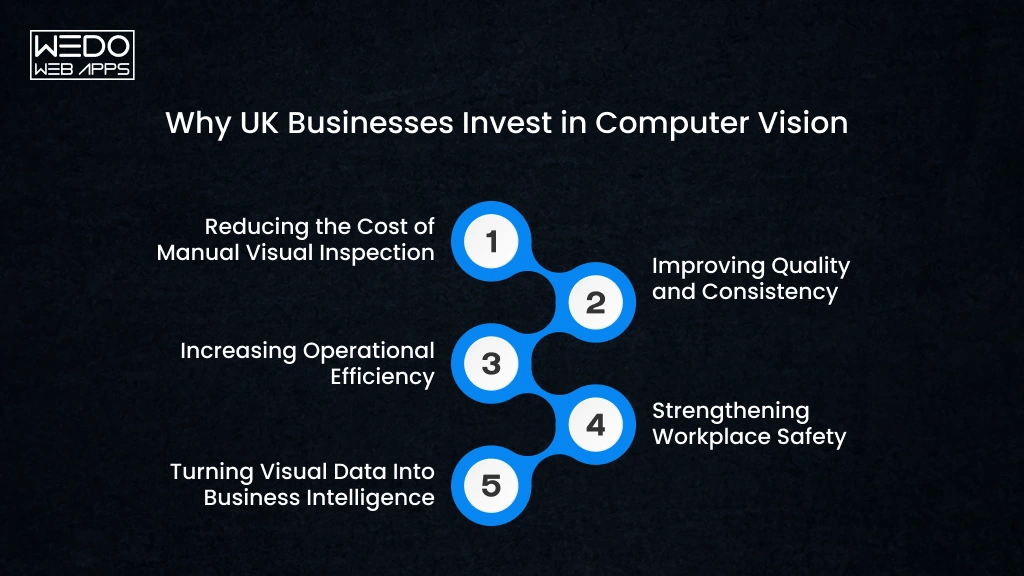
Reducing the Cost of Manual Visual Inspection
Quality checks, stock counting, safety monitoring, and equipment inspection can require employees to spend significant amounts of time observing and assessing visual information. Computer vision can automate parts of these processes, allowing employees to focus on tasks that require judgement, expertise, or direct intervention.
Improving Quality and Consistency
Human inspections can vary between employees, shifts, and working conditions. AI-powered vision systems can apply the same detection criteria repeatedly, helping businesses identify defects, inconsistencies, or process deviations earlier.
Increasing Operational Efficiency
Computer vision can analyse images and video continuously, allowing businesses to identify issues without waiting for a manual inspection cycle. In manufacturing, logistics, and warehousing, this can help teams respond to problems faster and keep operations moving.
Strengthening Workplace Safety
Businesses can use computer vision to detect situations such as missing personal protective equipment, entry into restricted areas, or potentially unsafe activities. Instead of relying on periodic checks, organisations can introduce continuous visual monitoring where appropriate.
Turning Visual Data Into Business Intelligence
Perhaps the biggest opportunity is using computer vision beyond individual detections. When integrated with existing business systems, camera insights can trigger alerts, update records, support workflows, or provide operational data for managers.
For a UK business considering computer vision, the key question therefore isn’t “Can AI analyse our images?” It is “Which visual process is costing us time, money, quality, or productivity, and could automated analysis improve it?”
That question provides a much stronger starting point for identifying valuable computer vision applications for UK businesses.
What is Computer Vision and How Does it Work for UK Businesses?
Computer Vision is a branch of AI that enables software to interpret and analyse images and video. For businesses, this means turning visual information from cameras, scanners, or other imaging devices into useful insights and automated actions.
Instead of simply recording what a camera sees, computer vision can determine what is happening, identify something unusual, and trigger the appropriate business response.
What Can Computer Vision Identify?
Depending on the business application, a computer vision system can:
- Detect product defects or damaged goods
- Recognise objects, vehicles, or people
- Count products, packages, or inventory
- Identify missing PPE or safety violations
- Monitor movement and activity
- Detect anomalies or unusual patterns
- Read text, labels, barcodes, or number plates
- Analyse medical or industrial images
How Computer Vision Works for UK Businesses
A typical system follows a simple process:
- Capture Visual Data: Cameras or other imaging devices capture images or video from the relevant business environment.
- Process the Data: The system prepares the visual information for AI analysis.
- Analyse with an AI Model: The computer vision model identifies objects, patterns, defects, behaviors, or other predefined characteristics.
- Generate an Insight: The system determines whether the visual information meets the required criteria.
- Trigger a Business Action: The result can generate an alert, record an event, reject a product, update another system, or prompt human intervention.
A Simple Example
Consider a UK manufacturing business inspecting products on a production line:
Camera -> Product image -> AI inspection -> Defect detected -> Product removed -> Quality record updated
The same principle can be applied to warehouses, retail stores, construction sites, logistics operations, and other environments where visual information influences business decisions.
The technology itself is only one part of the equation. The real business value comes from connecting computer vision insights to a specific operational process and measurable business outcome.
8 Real-World Computer Vision Applications for UK Businesses
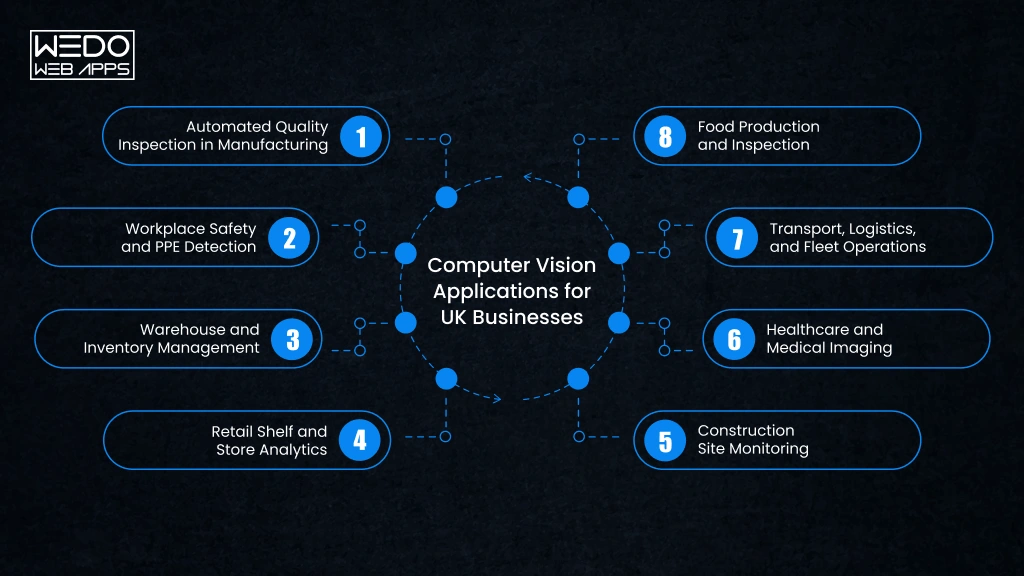
The strongest computer vision applications in UK businesses are those that address a recurring operational problem and produce a measurable outcome. From identifying defects on production lines to monitoring stock in warehouses, visual AI can support processes where speed, accuracy, and consistency matter.
Here are some of the most practical computer vision use cases for UK industries.
1. Automated Quality Inspection in Manufacturing
Manufacturers often rely on employees to inspect products for defects, incorrect assembly, surface damage, or inconsistencies. Computer vision can automate much of this inspection process. How it Works:
- Cameras capture products as they move through the production line.
- AI models inspect images against predefined quality criteria.
- Defects or anomalies are identified in real time.
- Failed products can be automatically flagged or removed.
Business value:
- Reduce manual inspection workload
- Identify defects earlier
- Minimise waste and rework
- Improve production consistency
- Increase inspection speed
For UK manufacturers, AI vision systems can make quality control more scalable without requiring every product to be manually inspected.
2. Workplace Safety and PPE Detection
Computer vision can help businesses monitor safety conditions in environments where compliance is critical. Systems can detect:
- Missing helmets, high-visibility clothing, or other PPE
- Entry into restricted areas
- Unsafe movement or activities
- People entering hazardous zones
- Safety-rule violations
Instead of relying only on periodic inspections, businesses can use real-time alerts to help safety teams respond quickly.
3. Warehouse and Inventory Management
Warehouses handle large volumes of products, packages, and stock movements. Manual counting and monitoring can become slow and error-prone as operations grow. Computer vision can support:
- Automated inventory counting
- Package identification
- Damaged-goods detection
- Shelf and storage monitoring
- Movement tracking
- Picking and packing verification
This can give warehouse managers better visibility while reducing repetitive manual checks.
4. Retail Shelf and Store Analytics
UK retailers can use computer vision to understand what is happening across physical stores without relying entirely on manual observation. Applications include:
- Detecting empty or incorrectly stocked shelves
- Checking planogram compliance
- Monitoring queues
- Analysing customer movement
- Tracking product availability
- Identifying store-level operational issues
The resulting insights can help retailers improve product availability, staffing decisions, and in-store operations.
5. Construction Site Monitoring
Construction businesses can use computer vision to monitor sites and identify potential safety or operational issues. Possible applications include:
- PPE compliance monitoring
- Restricted-area detection
- Equipment tracking
- Site activity monitoring
- Progress documentation
- Hazard identification
This can supplement existing safety and project-management processes while giving site managers greater visibility.
6. Healthcare and Medical Imaging
Computer vision can support healthcare organisations by analysing medical images and monitoring visual information. Potential applications include:
- Medical-image analysis
- Patient monitoring
- Asset and equipment tracking
- Workflow monitoring
- Diagnostic decision support
In healthcare, computer vision should be positioned as a tool that supports qualified professionals and existing clinical workflows, rather than replacing professional judgement.
7. Transport, Logistics, and Fleet Operations
Transport and logistics businesses deal with vehicles, packages, roads, and infrastructure that can all generate valuable visual data. Computer vision can help with:
- Vehicle detection and tracking
- Number-plate recognition
- Cargo inspection
- Package identification
- Driver and road monitoring
- Infrastructure condition assessment
Automating these visual tasks can help logistics teams improve visibility and respond to operational issues faster.
8. Food Production and Inspection
Food manufacturers need consistent quality checks throughout production and packaging. Computer vision can inspect products at high speed while applying consistent criteria. Applications include:
- Detecting damaged or misshapen products
- Checking packaging
- Verifying labels
- Identifying foreign objects
- Monitoring product consistency
- Inspecting production lines
For high-volume food production, automated visual inspection can help reduce waste while maintaining consistent quality standards.
Choosing the Right Application Matters
Not every computer vision project delivers the same level of business value. The strongest opportunities typically involve high-volume, repetitive visual tasks where errors, delays, or manual inspection already have a measurable cost. The next step is therefore not simply identifying what computer vision can do, but determining which use case is worth investing in first.
Which Computer Vision Use Cases Offer the Best ROI?
Not every computer vision application delivers the same return. For UK businesses, the strongest opportunities are usually those where a visual task is frequent, repetitive, costly, and measurable.
A business should therefore evaluate a potential use case against factors such as:
| Factor | What to Consider |
|---|---|
| Frequency | How often does the visual task occur? |
| Current Cost | How much does manual inspection or monitoring cost? |
| Error Impact | What does a missed defect, incident, or error cost the business? |
| Automation Potential | Can AI perform the task reliably with limited human intervention? |
| Scalability | Can the solution handle increasing volumes without similar increases in labour? |
| Data Availability | Does the business have sufficient images or video to develop and validate the system? |
High-Value Computer Vision Use Cases by Industry
| Industry | Use Case | Potential Business Value | Implementation Complexity |
|---|---|---|---|
| Manufacturing | Defect detection | Very high | Medium |
| Logistics | Package inspection and tracking | High | Medium |
| Warehousing | Inventory monitoring | High | Medium |
| Construction | Safety and PPE monitoring | High | Medium |
| Retail | Shelf and product monitoring | Medium-high | Medium |
| Food Production | Quality inspection | Very high | Medium |
| Transport | Vehicle and infrastructure monitoring | High | Medium-high |
| Healthcare | Medical image analysis | High | High |
The table is a starting point rather than a universal ranking. A use case that delivers significant savings for one business may have limited value for another.
What Makes a Computer Vision Use Case Worth Investing In?
The best candidates typically have three characteristics:
High Volume: The task happens often enough for automation to create meaningful savings.
Clear Business Cost: Errors, delays, waste, or manual labour can be quantified.
Measurable Outcome: The business can track improvements through metrics such as inspection time, defect rates, waste, throughput, or operating costs.
For example, a manufacturer inspecting thousands of products every day may have a stronger business case for automated defect detection than a company that performs a similar inspection only a few times each week.
This is why choosing among computer vision use cases for UK industries should begin with the business problem, not the technology. The most valuable project is the one where improved visual intelligence can produce a measurable financial or operational outcome.
How Much Can Computer Vision Save a UK Business?
The ROI of computer vision depends on what the system is replacing, improving, or preventing. A business automating a high-volume inspection process may achieve a very different return from one using computer vision for occasional monitoring. For decision-makers, the most useful approach is to connect the technology to specific financial and operational metrics.
Where Does the ROI Come From?
Computer vision can create financial value by improving areas such as:
- Labour efficiency: Automate repetitive visual inspection and monitoring tasks.
- Quality control: Detect defects earlier and reduce rework, returns, and waste.
- Productivity: Analyse processes continuously without relying on manual inspection cycles.
- Safety: Identify potential hazards or compliance issues before they result in costly incidents.
- Inventory accuracy: Reduce errors associated with manual counting and tracking.
- Downtime: Detect equipment or process abnormalities earlier.
- Throughput: Inspect or classify products faster without compromising consistency.
The most important point is that computer vision ROI should be measured against the existing cost of the business process, not against the technology in isolation.
How to Calculate Computer Vision ROI
A simple starting formula is:ROI = (Financial Benefits − Implementation Costs) ÷ Implementation Costs × 100When estimating financial benefits, consider:
- Current labour costs
- Cost of defects and rework
- Material waste
- Downtime
- Returns or rejected products
- Safety-related costs
- Additional production capacity
- Ongoing operational savings
Implementation costs may include AI development, data preparation, cameras and other hardware, software integration, infrastructure, testing, deployment, and ongoing maintenance.
Worked Example: ROI for a UK Manufacturing Business
Consider a hypothetical UK manufacturer that manually inspects a high volume of products every day.
Suppose the business currently spends £100,000 per year on inspection-related labour and incurs an additional £50,000 due to preventable defects and rework.
A computer vision system could potentially reduce these costs, but the actual savings would need to be validated through a pilot.
For illustration:
| Metric | Example Value |
|---|---|
| Current annual inspection and rework costs | £150,000 |
| Estimated annual savings | £60,000 |
| Initial implementation cost | £120,000 |
| Estimated first-year net benefit | -£60,000 |
| Potential payback period | 2 years |
This example is illustrative, not an industry benchmark. Actual ROI depends on factors such as detection accuracy, process volume, labour costs, integration requirements, and how much of the existing process can realistically be automated.
Measure ROI Before Scaling
A proof of concept can help a business replace assumptions with evidence. Instead of committing to a full deployment immediately, the business can test whether the system achieves its required accuracy and delivers measurable improvements under real operating conditions.
For UK business leaders, this makes the ROI question much more useful:
Not "How much can computer vision save?" but "How much can this specific computer vision application save our business?"
What Does Computer Vision Cost for a UK Business?
There is no fixed price for a computer vision system because every project has different requirements. A simple image-classification solution may require far less investment than a real-time industrial inspection system connected to production equipment and business software.
For UK businesses, the overall cost typically depends on what the system needs to detect, how accurately it must perform, how much visual data is available, and how deeply it needs to integrate with existing operations.
What Determines Computer Vision Development Cost?
Several factors can influence the investment required:
| Cost Factor | What It Covers |
|---|---|
| Data preparation | Collecting, cleaning, labelling, and preparing images or video |
| AI model development | Training and optimising models for the required use case |
| Cameras and hardware | Cameras, sensors, processing devices, and installation |
| System integration | Connecting computer vision with existing software and workflows |
| Infrastructure | Cloud, edge, storage, and computing requirements |
| Testing and deployment | Validating performance in real operating environments |
| Ongoing maintenance | Monitoring, updates, retraining, and technical support |
The complexity of the visual task is often a major cost driver. Detecting whether a product is present may be relatively straightforward, while identifying subtle manufacturing defects under changing lighting and production conditions can require considerably more development and testing.
Proof of Concept vs Full Production System
UK businesses don't necessarily need to commit to a full-scale deployment from day one.A proof of concept (PoC) can be used to test whether computer vision can solve the specific business problem before making a larger investment.
A PoC can help answer questions such as:
- Can the system achieve the required accuracy?
- Does the available visual data support the use case?
- Can the solution work in real operating conditions?
- What hardware and infrastructure are required?
- Does the expected business value justify further investment?
If the results support the business case, the solution can then be developed into a production-ready system.
Why the Cheapest Computer Vision Solution May Not Be the Best
A lower initial development cost does not automatically mean a better investment. A system that produces frequent false positives, cannot integrate with existing software, or requires excessive manual intervention may deliver little practical ROI.
The better approach is to evaluate total cost against expected business value. A more capable system can justify a higher initial investment if it produces greater savings, improves accuracy, or scales effectively as the business grows.
How Should a UK Business Start a Computer Vision Project?
A successful computer vision project starts with a business problem, not a technology choice. Before investing in development, UK businesses should establish what they want to improve, how the current process performs, and how success will be measured.A practical approach is to follow these steps:
1. Identify a High-Value Visual Problem
Look for processes involving frequent inspection, monitoring, counting, recognition, or visual quality checks.Ask:
- Is the task repetitive?
- Does it require significant employee time?
- Do errors create measurable costs?
- Could faster detection improve the process?
2. Quantify the Current Business Cost
Establish a baseline before introducing automation.Measure factors such as:
- Labour hours
- Defect rates
- Waste and rework
- Inspection time
- Downtime
- Operational errors
This gives you something meaningful to compare against after implementation.
3. Assess Your Visual Data
Computer vision models need suitable images or video to learn from and operate reliably.Evaluate:
- What visual data already exists?
- Is the image quality sufficient?
- Are there enough examples of relevant conditions?
- Will new cameras or sensors be required?
- Does the data need labelling?
Poor-quality or insufficient data can undermine an otherwise promising computer vision project.
4. Define Clear Success Metrics
Decide what the system needs to achieve before development begins.Depending on the use case, KPIs could include:
- Detection accuracy
- Inspection time
- Defect reduction
- Labour hours saved
- Waste reduction
- Throughput
- Response time
Clear KPIs make it easier to determine whether the project is delivering genuine business value.
5. Build and Test a Proof of Concept
A proof of concept allows the business to validate the idea before committing to a full deployment.Test the system against real-world operating conditions, including variations in lighting, product types, camera positions, environmental conditions, and expected edge cases.
6. Connect the Solution to Existing Workflows
Computer vision becomes more useful when its insights can trigger business actions.
Depending on the project, it may need to connect with:
- ERP systems
- Warehouse management platforms
- Manufacturing software
- CRM systems
- Dashboards
- Alerting systems
- Other internal applications
The goal is to make visual intelligence part of the existing workflow rather than creating another isolated system.
7. Measure the Actual Business Impact
Once the pilot is operating, compare its results against the original baseline.
Look at: Before implementation → After implementation → Financial impact
This provides a more reliable basis for calculating ROI than relying on assumptions made before development.
8. Scale Only After the Business Case Is Proven
If the pilot demonstrates sufficient accuracy, reliability, and financial value, the business can expand the solution across additional sites, production lines, locations, or processes.
Scaling should be based on proven performance and business results, not simply because the initial deployment worked.
For many UK businesses, this staged approach reduces investment risk while creating a clearer path from an initial computer vision solution to a scalable production system.
What Could Prevent a Computer Vision Project From Delivering ROI?
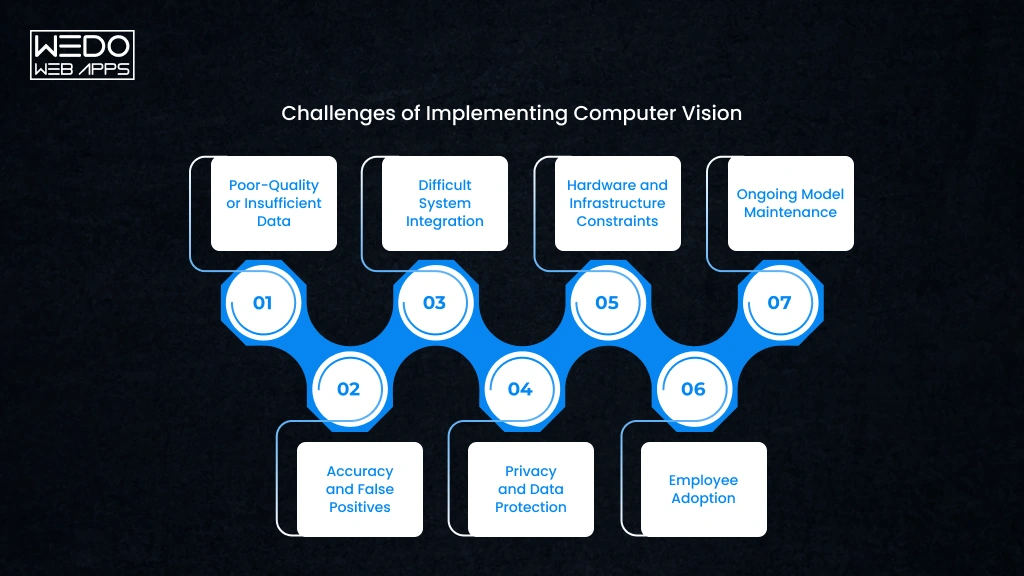
Computer vision can create significant business value, but successful implementation isn't automatic. A technically impressive system can still deliver poor ROI if it doesn't perform reliably in the real environment or fails to fit the existing business process.
UK businesses should consider the following factors before committing to a large-scale deployment.
Poor-Quality or Insufficient Data
Computer vision models depend on suitable visual data. Blurry images, inconsistent lighting, limited examples, or poorly labelled datasets can affect detection accuracy.
Business impact: More development time, unreliable results, and additional manual intervention.
Accuracy and False Positives
A system that frequently misses defects or incorrectly flags acceptable products can disrupt operations rather than improve them.
Business impact: Rework, unnecessary inspections, production delays, and reduced employee confidence in the system.
Difficult System Integration
A computer vision model may work effectively on its own but provide limited value if its outputs cannot connect with existing business systems.
Business impact: Employees may still need to transfer information manually, reducing the expected efficiency gains.
Privacy and Data Protection
Applications involving people, workplaces, or identifiable information require careful consideration of privacy and data protection obligations.
Business impact: Poorly designed data practices can create compliance risks and undermine employee or customer trust.
Hardware and Infrastructure Constraints
Cameras, lighting, network connectivity, processing capacity, storage, and environmental conditions can all affect system performance.
Business impact: Unexpected infrastructure costs or inconsistent performance after deployment.
Employee Adoption
Computer vision should generally support employees rather than simply be presented as a replacement for human oversight.
Business impact: Poor adoption can lead to workarounds, low trust, and reduced utilisation of the system.
Ongoing Model Maintenance
A computer vision model may need monitoring and updates as products, environments, equipment, or operating conditions change.
Business impact: Accuracy can decline over time if the system is not properly monitored and maintained.
The lesson for business leaders is straightforward: ROI depends on the entire solution, not just the AI model. Data quality, workflow integration, infrastructure, adoption, and ongoing support all influence whether a computer vision investment produces sustainable business value.
When Is Computer Vision Not the Right Investment?
Computer vision can solve complex visual problems, but that doesn't mean every business should invest in it. A strong technology decision starts by comparing the expected business value with the cost and complexity of implementation.
Computer vision may not be the right investment when:
The Visual Task Happens Too Infrequently
If employees only perform an inspection or monitoring task occasionally, automation may not generate enough savings to justify development and infrastructure costs.
The Existing Process Is Already Cost-Effective
If a manual process is inexpensive, accurate, and fast enough for the business's current scale, replacing it with AI may provide little additional value.
There Isn't Enough Suitable Visual Data
Some applications require large and varied datasets to achieve reliable performance. If relevant images or video cannot be collected effectively, developing a dependable system may be difficult.
The Cost of Errors Is Too High
Where a missed detection could create significant safety, financial, or operational consequences, the system may require extensive validation and human oversight before it can be used.
The Expected ROI Is Too Low
A computer vision project should have a measurable business case. If projected savings or additional revenue cannot reasonably justify the investment, another form of automation may be more appropriate.
The Business Is Solving the Wrong Problem
Sometimes the underlying issue isn't visual at all. Investing in computer vision simply because a business wants to "use AI" can create unnecessary complexity without addressing the actual operational bottleneck.
The goal isn't to automate every process that involves a camera. It's to identify visual processes where AI can deliver a clear, measurable advantage over the existing approach.
How to Choose a Computer Vision Development Partner in the UK
Choosing the right development partner can have as much impact on project ROI as the technology itself. A computer vision system needs to work reliably in real business conditions, integrate with existing workflows, and remain useful as requirements evolve.
When evaluating computer vision development services, UK businesses should look beyond a provider's ability to build an AI model.
What Should You Look for in a Development Partner?
Relevant computer vision experience
Look for experience developing solutions around your specific visual problem or industry.
Machine learning expertise
Computer vision often requires data preparation, model training, testing, optimisation, and ongoing improvement. Strong machine learning development capabilities can support these requirements.
Understanding of business processes
The partner should understand how visual insights will fit into your existing operations rather than treating the AI model as a standalone product.
Integration capabilities
Check whether the provider can connect the solution with your existing ERP, CRM, warehouse, manufacturing, or other business systems.
Scalability
The solution should be capable of handling increased data volumes, additional locations, or new use cases as the business grows.
Security and data protection
Discuss how visual data will be collected, processed, stored, and protected, particularly when systems involve employees, customers, or other identifiable information.
Testing and ongoing support
Computer vision performance can change as environments and business requirements evolve. Your development partner should have a clear approach to monitoring, maintenance, optimisation, and support.
Ask About the Business Case, Not Just the Technology
A capable partner should be able to discuss more than models, cameras, and development frameworks. They should help you answer:
- What problem is the system solving?
- What data will it require?
- How will success be measured?
- What will the implementation involve?
- How will it integrate with existing systems?
- What could affect accuracy?
- How can the solution scale?
- How will ROI be measured after deployment?
The right partner should ultimately help you build computer vision solutions that solve a measurable business problem, rather than implementing AI simply because the technology is available.
For businesses that have identified a viable use case, working with an experienced provider of computer vision development services can help turn that opportunity into a practical, scalable solution.
Conclusion
Computer vision can help UK businesses turn images and video into actionable insights, but its value ultimately depends on the business problem it solves.
From AI vision systems for UK manufacturing and automated quality inspection to warehouse monitoring, retail analytics, safety detection, and logistics, the potential applications are broad. However, the strongest opportunities are usually those where visual tasks are repetitive, high-volume, and linked to measurable costs or inefficiencies.Before investing, businesses should assess the available data, define clear KPIs, estimate the potential ROI, and validate the idea through a proof of concept where appropriate. Choosing the right technology partner is equally important for developing a reliable and scalable solution.
The goal isn't to adopt computer vision simply because AI is becoming more accessible. It's to use computer vision solutions where they can deliver a clear operational, financial, or competitive advantage.
For UK businesses with a suitable use case, the next step is to assess the opportunity, define the business case, and determine what a practical computer vision solution could look like.