Introduction
UK businesses are not short of data. The real problem is knowing which data matters, what it is telling you, and what to do about it before an opportunity or risk passes. Sales figures sit in one system, customer behavior in another, operational metrics in dashboards, and financial information in spreadsheets. By the time teams bring these numbers together, the business decisions may already be overdue.
This is where AI analytics for UK businesses can make a practical difference. Instead of relying solely on historical reports, AI-powered analytics can connect large datasets, uncover patterns, identify anomalies, predict likely outcomes, and surface insights that decision-makers can act on. A retailer can anticipate demand before stock runs low, a logistics company can spot operational delays earlier, and a growing enterprise can identify changes in customer behavior before they affect revenue.
For UK companies, the bigger opportunity is therefore not simply using AI. It is turning existing business data into a reliable decision-making advantage. With the right AI strategy consulting, organisations can move from asking “What happened?” to understanding “Why did it happen, what could happen next, and what should we consider doing?” That shift can make data-driven decision-making for UK business leaders faster, more informed, and more proactive.
What is AI-Powered Analytics?
AI-Powered Analytics uses artificial intelligence and machine learning to turn business data into actionable insights, predictions, and recommendations.
Instead of making teams manually analyse multiple reports and spreadsheets, it helps businesses identify:
- Patterns that may be difficult to spot manually
- Trends across sales, customers, finance, or operations
- Anomalies that could indicate emerging problems
- Predictions about future business outcomes
- Recommendations that can support better decisions
What Can AI-Powered Analytics Analyse?
Depending on the business and its objectives, AI analytics can process data from:
- CRM and customer databases
- Sales and eCommerce platforms
- Financial and accounting systems
- Marketing and advertising platforms
- Website and application analytics
- Inventory and supply chain systems
- Operational and production systems
This allows businesses to connect information that may otherwise remain scattered across different systems.
AI Analytics vs Traditional Analytics
The key difference is simple: traditional analytics tells you what happened, while AI analytics can help you understand why it happened and what could happen next.
| Traditional Analytics | AI-Powered Analytics |
|---|---|
| Reports historical performance | Analyses historical and current data |
| Shows what happened | Identifies what happened and why |
| Uses predefined reports | Detects patterns and anomalies |
| Often requires manual analysis | Automates parts of data analysis |
| Provides periodic insights | Can provide real-time insights |
| Supports reporting | Supports prediction and decision-making |
Why Does This Matter to UK Businesses?
For decision-makers, the value is not the AI technology itself. It is the business outcome it enables.
AI-powered analytics can help organisations:
- Make faster decisions - Get relevant insights without waiting for manual reporting.
- Forecast more accurately - Identify likely changes in demand, revenue, or customer behavior.
- Spot problems earlier - Detect unusual patterns before they become larger operational or financial issues.
- Use resources more effectively - Base investments, staffing, inventory, and budgets on data-backed insights.
- Move from reactive to proactive decisions - Anticipate potential outcomes instead of responding only after problems occur.
In short, AI analytics transforms business data from a record of what happened into a resource that can help teams decide what to do next.
Why UK Businesses Are Turning to AI-Powered Analytics
The question for UK businesses is no longer whether they have enough data. It is whether they can extract useful insights from the data quickly enough to act on them.
The latest UK Business Data Surveyshows that 86% of UK businesses handled digitised data in 2025-26, while 41% of businesses handling digitised data reported using AI for at least one purpose. AI-using businesses were also more likely to analyse data than businesses that did not use AI.
This creates a clear opportunity for businesses to move beyond simply collecting information and start using it more intelligently.
What is Driving AI Analytics Adoption?
1. Growing Volumes of Business Data
Customer interactions, transactions, marketing activity, financial records, and operational systems are generating more data than teams can realistically analyse manually.
2. Faster Decision-Making Demands
Business leaders cannot always wait for weekly or monthly reports to identify changing customer behavior, operational issues, or market opportunities.
3. Greater Pressure on Efficiency
AI analytics can automate repetitive analysis and reporting, allowing teams to spend more time acting on insights rather than preparing them.
4. Need for Better Forecastin
Businesses can use historical and current data to anticipate demand, revenue changes, customer churn, inventory requirements, and operational risks.
5. Increasing AI Adoption Across UK Businesses
AI use is already more established among larger organisations. The 2026 UK Business Data Survey found that 82% of large businesses handling digitised data reported using AI, compared with 51% of small and 58% of medium-sized businesses.
The Bigger Opportunity is Integration
Simply adopting an AI tool does not automatically create better decisions.
In fact, only 21% of AI-using businesses surveyed reported that their AI tools were integrated into existing business systems. Businesses with integrated AI were also more likely to report analysing data than those with non-integrated AI tools.
This highlights an important distinction:
- AI adoption: Using an AI tool for a specific task
- AI-powered analytics: Connecting business data, analytics, AI models, and workflows to support better decisions
For UK companies, the real value comes from building analytics capabilities around actual business problems, rather than adding AI simply because the technology is available.
How AI-Powered Analytics Helps UK Businesses Make Smarter Decisions
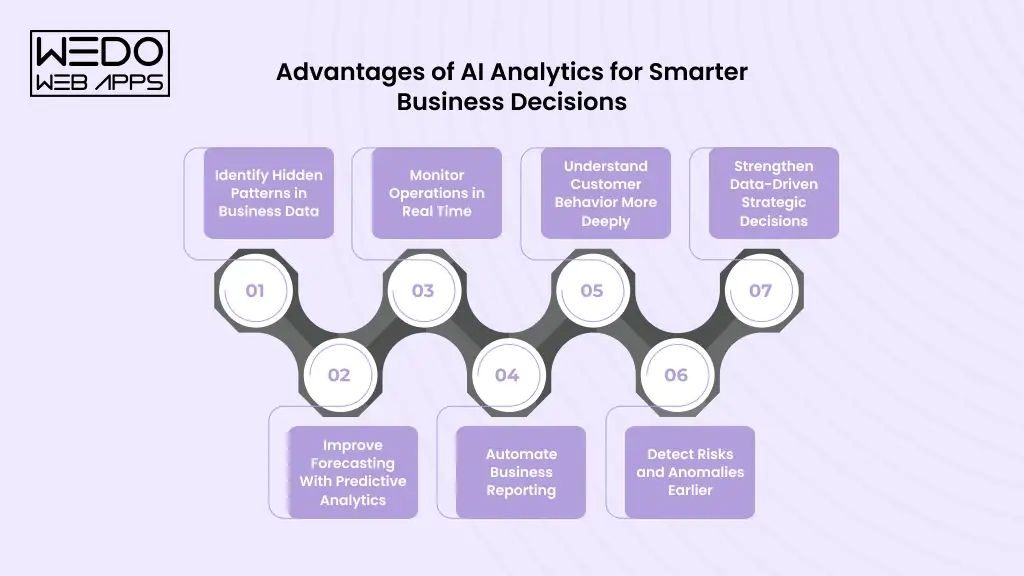
AI analytics becomes valuable when it solves a specific business problem. Instead of giving decision-makers more dashboards to review, it can help them find meaningful patterns, anticipate changes, and act before problems become costly.
Here are the most practical ways UK businesses can use AI-powered analytics:
1. Identify Hidden Patterns in Business Data
Business data can contain relationships that are difficult to spot through spreadsheets or standard reports.
AI analytics can analyse larger datasets to uncover:
- Changes in customer behavior
- Unusual sales patterns
- Product performance trends
- Operational bottlenecks
- Marketing performance patterns
- Factors influencing business outcomes
Business Impact:
Decision-makers can discover opportunities and problems that may otherwise remain hidden in disconnected datasets.
2. Improve Forecasting With Predictive Analytics
What if your business could anticipate a change in demand instead of reacting after it happens?
Predictive analytics for UK companies uses historical and current data to estimate likely future outcomes.
Predictive analytics can be developed around specific business requirements using machine learning development services , helping companies build customised forecasting models from their own data.
Businesses can use it to forecast:
- Sales - Estimate future revenue and sales performance
- Demand - Predict which products or services customers may need
- Customer Churn - Identify customers who may be at risk of leaving
- Inventory - Anticipate stock requirements and potential shortages
- Workforce Needs - Forecast staffing requirements based on demand
- Cash Flow - Identify potential financial changes before they occur
Business Impact :
Better forecasts can help companies plan resources, budgets, inventory, and strategies with greater confidence.
3. Monitor Operations in Real Time
A monthly or weekly report may show that something went wrong. Real-time analytics can help businesses identify the change while it is happening.
Real time analytics for UK operations can continuously monitor important business metrics and trigger alerts when unusual activity occurs.
For example:
| Business Area | Real-Time Insight |
|---|---|
| Retail | Sudden changes in product demand |
| Logistics | Delivery delays or route disruptions |
| Finance | Unusual transaction activity |
| eCommerce | Sudden conversion-rate changes |
| Manufacturing | Production or equipment anomalies |
| Customer Service | Spikes in complaints or support requests |
Business Impact:
Teams can respond to emerging issues faster instead of discovering them after they have already affected performance.
4. Automate Business Reporting
Preparing recurring reports can involve collecting data from several systems, cleaning spreadsheets, updating dashboards, and manually interpreting results.
AI powered reporting an business process automationcan reduce much of this repetitive work.
AI powered reporting tools UK business can use may help with:
- Automated data consolidation
- Recurring performance reports
- Intelligent summaries
- Dashboard generation
- Anomaly detection
- Performance alerts
- Trend identification
Instead of spending hours preparing a report, teams can focus on understanding what changed and deciding what action to take.
Business Impact:
Less manual reporting and faster access to decision-ready information.
5. Understand Customer Behavior More Deeply
Customer data becomes significantly more useful when businesses can identify patterns across multiple interactions.
AI analytics can connect information such as:
- Purchase history
- Website activity
- Marketing engagement
- Customer service interactions
- Product preferences
- Feedback and reviews
This can help businesses identify:
- High-value customers: Understand behaviors associated with stronger customer lifetime value.
- Churn risks: Detect behavioral changes that may indicate customers are likely to leave.
- Purchase patterns: Identify products or services frequently purchased together.
- Personalisation opportunities: Deliver more relevant offers, content, or recommendations.
Business Impact:
Better customer insights can support retention, personalisation, and revenue opportunities.
6. Detect Risks and Anomalies Earlier
Not every important business signal looks like a major problem at first.
A small change in transaction activity, customer behavior, inventory levels, or operational performance could indicate a larger issue developing.
AI analytics can establish patterns of normal activity and flag unusual changes for review.
This can support:
- Fraud detection
- Financial monitoring
- Operational risk management
- Inventory monitoring
- Cybersecurity analysis
- Equipment monitoring
Business Impact:
Early warnings give teams more time to investigate and respond before an issue escalates.
7. Strengthen Data-Driven Strategic Decisions
Senior decision-makers often need to evaluate major choices without having complete certainty.
AI analytics can bring together information from different parts of the business to provide a broader view of potential outcomes.
It can support decisions around:
- Entering new markets
- Launching products
- Changing prices
- Allocating budgets
- Expanding operations
- Managing resources
- Improving customer strategies
- Planning future investments
This makes data driven decision making UK business leaders more evidence-based and proactive.
The goal is not for AI to make every strategic decision independently. Instead, it gives leadership teams better evidence, clearer trends, and stronger forecasts to support their own judgement.
The Decision-Making Shift
The real advantage of AI-powered analytics is the shift from:
“What Happened?” -> “Why did it happen?” -> “What is likely to happen next?” -> “What action should we consider?”
That progression turns analytics from a reporting function into a practical decision-support capability for UK Businesses.
AI Analytics vs Traditional Business Reporting
Traditional reporting remains useful for tracking business performance, but it can become limiting when decision-makers need faster insights, predictive information, or real-time visibility.
The main difference is what each approach helps a business understand:
| Traditional Business Reporting | AI-Powered Analytics |
|---|---|
| Shows historical performance | Analyses historical and current data |
| Answers what happened | Explores what happened and why |
| Relies on predefined metrics | Identifies patterns and anomalies |
| Often requires manual analysis | Automates parts of analysis |
| Provides periodic reports | Supports real-time insights |
| Focused on descriptive insights | Supports predictive insights |
| Helps review performance | Helps anticipate potential outcomes |
Which Approach Should UK Businesses Choose
It does not have to be an either-or decision.
Traditional reporting works well for established KPIs, financial statements, compliance reporting, and routine performance tracking.
AI analytics adds value when businesses need to:
- Forecast future demand or revenue
- Identify unusual business activity
- Analyse large and complex datasets
- Understand changing customer behavior
- Monitor operations in real time
- Automate repetitive analysis
- Support complex business decisions
The strongest approach is often to combine both. Traditional reports provide consistent performance visibility, while AI business intelligence solutionscan add deeper analysis, predictive insights, and intelligent reporting.
This allows UK businesses to move from simply reviewing past performance to using data more proactively when planning their next decision.
How UK Businesses Can Use AI Analytics Across Different Functions
AI Analytics is not limited to one department. When connected to the right business data, it can support decisions across sales, finance, marketing, operations, customer service, and leadership.
| Business Function | AI Analytics Application | Decision-Making Benefit |
|---|---|---|
| Sales | Forecast demand and identify sales patterns | Prioritise opportunities and improve revenue planning |
| Marketing | Analyse campaigns and customer behavior | Allocate budgets to better-performing activities |
| Finance | Forecast cash flow and detect anomalies | Improve financial planning and risk management |
| Operations | Monitor performance and identify bottlenecks | Improve efficiency and resource allocation |
| Supply Chain | Predict demand and inventory requirements | Reduce shortages and excess stock |
| Customer Service | Identify recurring issues and churn signals | Improve retention and customer experience |
| Leadership | Combine business data for strategic analysis | Make more informed growth decisions |
The Key Advantage
The real value comes from connecting insights across departments.
For example, declining sales may not be a sales problem alone. AI analytics could reveal that the change is connected to inventory shortages, lower customer engagement, pricing changes, or operational delays.
By bringing these signals together, businesses can understand the full picture behind a business outcome instead of making decisions based on a single metric.
What Should UK Businesses Consider Before Adopting AI Analytics?
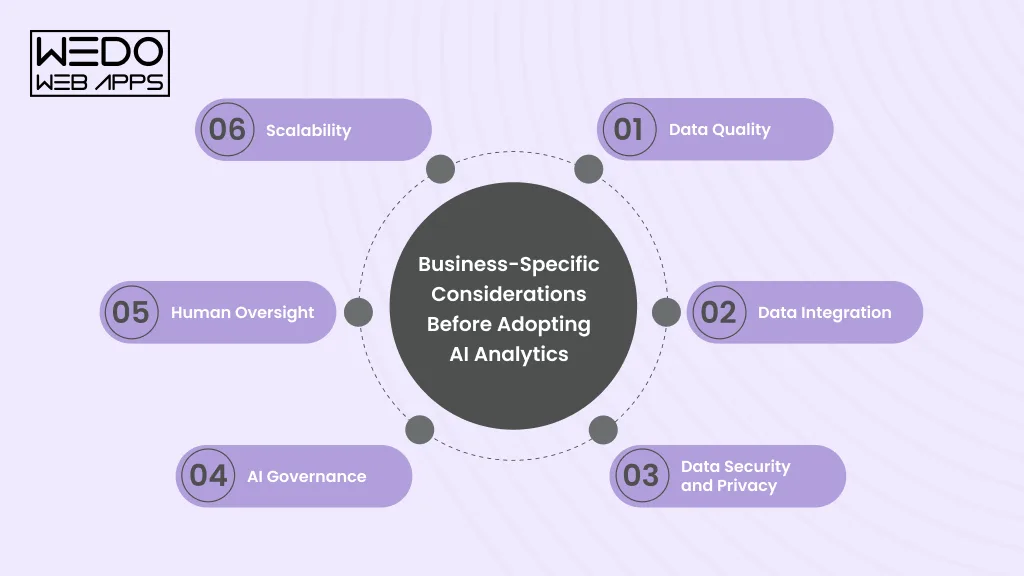
AI Analytics can deliver valuable insights, but its effectiveness depends on data, technology, and processes supporting it. Before investing, UK businesses should evaluate a few practical considerations.
1. Data Quality
Poor quality data can produce unreliable insights. Businesses should check whether their data is:
- Accurate
- Complete
- Consistent
- Up to date
- Free from unnecessary duplication
2. Data Integration
Business information is often spread across CRM, ERP, finance, eCommerce, marketing, and operational systems.
AI integration servicescan help businesses securely connect these data sources so they can be interpreted together.
3. Data Security and Privacy
AI analytics may involve customer, employee, financial, or other sensitive information. UK businesses should consider:
- Data access controls
- Secure data storage
- Encryption
- Data minimisation
- Appropriate retention practices
- Applicable UK data protection requirements
The Information Commissioner’s Office(ICO) recommends organisations assess issues including lawfulness, transparency, fairness, security, and individual rights when using AI with personal data.
4. AI Governance
Businesses need clear processes for determining:
- How AI models are used
- Who can access analytics
- How outputs are reviewed
- How errors are identified
- When human intervention is required
5. Human Oversight
AI should support business expertise rather than automatically make every important decision.
Human review remains particularly important for high-impact, strategic, financial, or customer-related decisions.
6. Scalability
The analytics solution should be capable of supporting:
- More data sources
- Additional users
- New business functions
- Increasing data volumes
- More advanced AI use cases
Choosing a scalable architecture from the beginning can prevent businesses from having to rebuild their analytics infrastructure as adoption grows.
How to Choose AI Reporting Tools for UK Companies
The right AI reporting tools for UK companies should do more than create attractive dashboards. They should make business information easier to understand, act on, and share across teams.
Before choosing a platform, evaluate these capabilities:
| Capability | Why It Matters |
|---|---|
| Data integration | Connects information from existing business systems |
| Automated reporting | Reduces repetitive manual reporting work |
| Predictive analytics | Helps forecast potential business outcomes |
| Real-time monitoring | Highlights important changes as they occur |
| Custom dashboards | Presents relevant metrics for different teams |
| Anomaly detection | Flags unusual activity for investigation |
| Access controls | Limits sensitive information to authorised users |
| Scalability | Supports growing data volumes and business needs |
| Ease of use | Helps non-technical teams interpret insights |
What Should Businesses Avoid?
Choosing an analytics platform based only on the number of AI features it offers can create unnecessary complexity.
Instead, UK businesses should ask:
- Does it solve a specific business problem?
- Can it integrate with existing systems?
- Can decision-makers easily understand its insights?
- Can it scale as data requirements increase?
- Does it provide appropriate security and governance?
- Can employees actually incorporate it into their daily workflows?
The best AI powered reporting tools UK businesses can adopt are those that connect technology with measurable business outcomes, not simply those with the longest feature list.
The Future of AI-Powered Analytics for UK Businesses
AI analytics is moving beyond dashboards that simply describe past performance. The next stage is about helping businesses anticipate changes and respond with greater confidence.
The progression can be viewed as:
Descriptive analytics-> What happened?
Predictive analytics-> What is likely to happen?
Prescriptive analytics-> What actions could we consider?
For UK businesses, this could mean analytics systems that can:
- Detect a performance change
- Identify the factors behind it
- Predict its potential business impact
- Recommend possible responses
- Alert the relevant decision-maker
What Will Drive This Evolution?
More connected business data:
CRM, finance, operations, customer, and marketing systems will increasingly work together.
Smarter machine learning models:
Models can become more useful as businesses collect better-quality historical and real-time data.
More automated decision support:
AI can increasingly move from reporting insights to triggering relevant workflows and recommendations.
Greater focus on responsible AI:
Businesses will need stronger governance, transparency, security, and human oversight as AI becomes more deeply integrated into operations.
The businesses that gain the most value will not necessarily be those using the most AI, but those that connect AI analytics with their broader digital transformation strategy.
They will be the ones that connect AI analytics to the decisions that matter most to their performance and growth.
Conclusion
AI-powered analytics can help UK businesses turn scattered data into faster insights, stronger forecasts, and more informed decisions.From predictive analytics and real-time monitoring to automated reporting and customer analysis, businesses can use AI to move beyond simply reviewing past performance.
The key is to start with a clear business problem, reliable data, and an analytics solution that fits existing systems and workflows.
If your business needs customised analytics, predictive models, or intelligent data solutions, partnering with an experienced AI development company UK businesses can rely on can help turn these capabilities into practical, scalable solutions.