Introduction
Imagine a UK retailer receives a shipment from a supplier. The supplier has one record of the order, the logistics provider has another, and the retailer’s system stores a third. If a product is delayed, damaged, or questioned for its origin, someone has to reconcile those records manually.
Now imagine every authorised party working from the same tamper-resistant transaction history. A product is registered when it leaves the supplier, its movement is recorded through the supply chain, and delivery is verified when it reaches the retailer. Rules encoded in a smart contract can even trigger predefined actions when agreed conditions are met.
That is where blockchain technology for small businesses can deliver practical value.
Rather than treating blockchain as a replacement for existing business software, SMEs can use blockchain solutions for SMEs to solve specific problems involving shared data, verification, traceability, transactions, and multi-party workflows.
The opportunity is broader than supply chains. Blockchain app development for SMEs can support applications for payments, digital identity, document verification, loyalty programmes, intellectual property, and automated business agreements.
But adopting blockchain simply because it is an advanced technology can create unnecessary complexity. The right approach starts with the business problem, evaluates whether blockchain is technically justified, and then builds a solution around measurable outcomes.
This guide explores the most relevant blockchain use cases for SMEs, their benefits, development considerations, costs, adoption challenges, and how blockchain can work alongside AI and other advanced technology solutions.
What is Blockchain Technology for Small Businesses?
Blockchain is a distributed digital ledger that records transactions across a network instead of storing the complete transaction history in one central database. Once a record is validated and added to the chain, altering it retrospectively becomes difficult because subsequent records depend on the existing transaction history.
For a small or medium-sized business, the important point is not decentralisation itself. The value comes from creating a shared, verifiable record when multiple parties need to exchange or validate information.
For example, a manufacturer could use blockchain to record when a component is produced, shipped, received, and inspected. Suppliers, logistics partners, and buyers can access authorised records without maintaining completely separate versions of the same information.
How Blockchain Works in an SME Environment
A typical blockchain application involves several technical components:
- A distributed ledger stores validated transaction records across participating network nodes.
- A consensus mechanism determines how transactions are validated before being added.
- Smart contracts execute predefined business rules automatically when specified conditions are met.
- Cryptographic security helps verify transactions and protect records from unauthorised modification.
- APIs and integrations connect blockchain applications with existing ERP, CRM, payment, inventory, or logistics systems.
This means blockchain does not necessarily replace an SME’s existing technology stack. Instead, it can operate as an additional trust and verification layer alongside conventional applications and databases.
Public vs Private Blockchain for SMEs
The choice of blockchain architecture depends on who needs access to the network and how transactions should be governed.
| Blockchain Type | Suitable Scenario |
|---|---|
| Public Blockchain | Open networks where transactions need broad visibility and decentralised participation. |
| Private Blockchain | Controlled environments managed by a single organisation. |
| Permissioned Blockchain | Business networks where identified participants require authorised access. |
For many business applications, a private or permissioned blockchain can provide greater control over participants, data access, governance, and performance.The right architecture therefore depends on the business requirement; not simply on which blockchain technology is most popular.
Why are SMEs Exploring Blockchain Adoption?
For an SME, blockchain adoption is rarely about adding another technology to the stack. It is usually driven by a specific operational problem that becomes difficult to manage as the business grows.
Consider a business working with several suppliers, distributors, payment providers, or customers. Each organisation may maintain its own database, documents, and transaction records. When those records need to be compared, verified, or updated, the process can involve emails, spreadsheets, manual approvals, and third-party intermediaries.
Blockchain can provide a shared layer for recording and verifying selected business transactions.
This makes blockchain adoption for small businesses particularly relevant in situations where:
- Multiple parties share business data and need a consistent transaction history.
- Records require traceability, such as product origin, ownership, or shipment status.
- Manual verification creates delays across suppliers, customers, or internal teams.
- Business agreements involve repetitive conditions that could be automated through smart contracts.
- Fraud or unauthorised record changes are a concern, and stronger audit trails are required.
- Different systems need a trusted source of transaction data without giving one participant complete control.
However, blockchain adoption should follow a problem-first approach. An SME does not need blockchain simply because it can provide an immutable ledger. If a conventional database can solve the same problem more efficiently, it may remain the more appropriate choice.
The business case becomes stronger when blockchain can reduce reconciliation, improve verification, automate workflows, or create transparency between parties that need to collaborate without relying entirely on a single central record.
That distinction is important when evaluating the benefits of blockchain for SMEs: the technology creates value only when its technical capabilities align with a genuine business requirement.
What are the Benefits of Blockchain for SMEs?
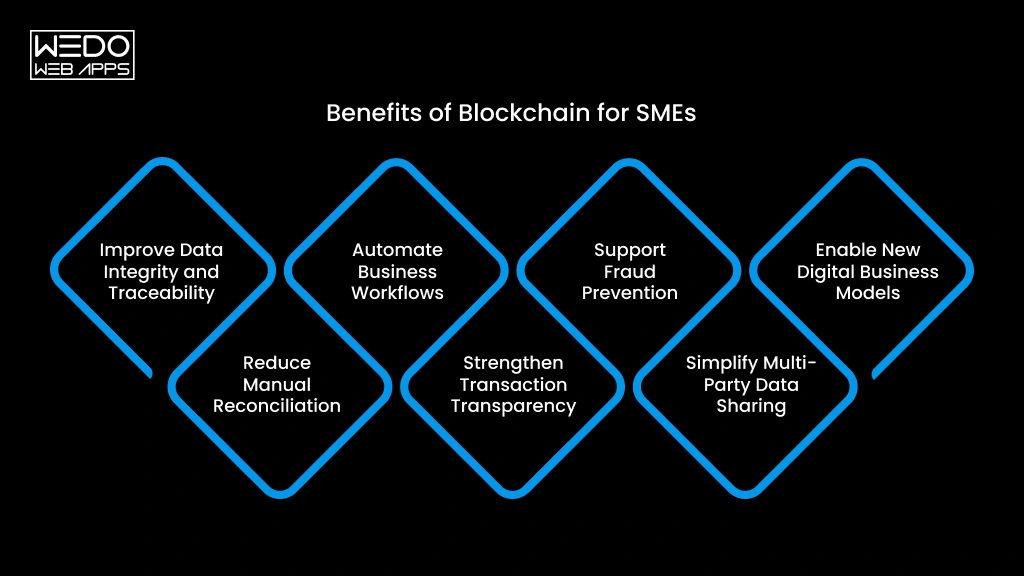
The value of blockchain for an SME depends on the problem being solved, but several capabilities can translate into measurable operational advantages. Instead of simply storing information, blockchain can help businesses create verifiable records, coordinate transactions between parties, and automate predefined processes.
Here are the key benefits of blockchain for SMEs:
1. Improve Data Integrity and Traceability
Blockchain creates a chronological record of transactions that authorised participants can independently verify. This can help SMEs trace products, transactions, documents, or assets throughout their lifecycle.
For example, a food business can record product movement from supplier to distributor, making it easier to identify where a particular batch originated or where it was handled.
2. Reduce Manual Reconciliation
When different organisations maintain separate transaction records, teams often spend time comparing invoices, orders, delivery records, and payment information.
A shared blockchain ledger can reduce this reconciliation workload by giving authorised participants access to a consistent record of relevant transactions.
3. Automate Business Workflows
Smart contracts allow predefined rules to execute automatically when specified conditions are satisfied.
An SME could, for instance, configure a contract to initiate a payment workflow after a delivery is verified. This can reduce manual intervention for repetitive, rule-based processes.
4. Strengthen Transaction Transparency
Blockchain can provide participating parties with a verifiable history of relevant transactions. This can improve transparency between suppliers, partners, customers, and other stakeholders.
Access controls can still determine which participants can view or interact with specific information.
5. Support Fraud Prevention
Because blockchain records are designed to be tamper-resistant, they can make unauthorised alterations easier to detect.
This can be useful for applications involving certificates, product provenance, transaction histories, ownership records, or other information where authenticity matters.
6. Simplify Multi-Party Data Sharing
Blockchain can provide a common transaction layer when several independent organisations need to collaborate.
Instead of repeatedly transferring and validating copies of the same information, participants can interact with an agreed record according to predefined permissions and governance rules.
7. Enable New Digital Business Models
Blockchain applications can support digital credentials, tokenised assets, programmable rewards, and other technology-driven business models.
For SMEs, these capabilities can create new ways to manage digital ownership, customer engagement, transactions, or access, where there is a genuine commercial use case.Ultimately, blockchain is valuable when these capabilities translate into less manual work, better visibility, stronger verification, or more efficient transactions. The next step is identifying where those advantages can be applied in real SME operations.
What Are the Most Practical Blockchain Use Cases for SMEs?
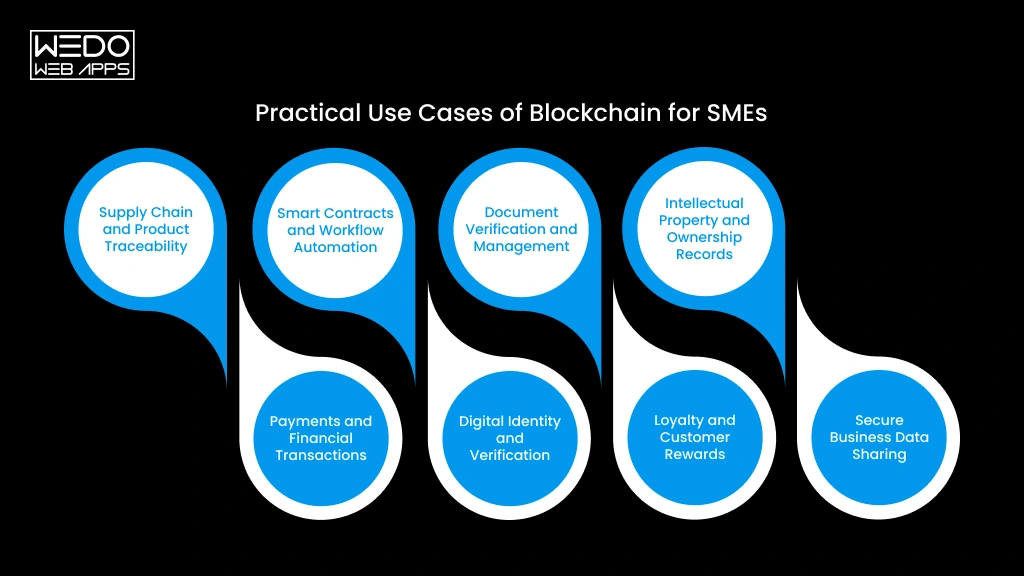
The strongest blockchain use cases for SMEs are not about putting an entire business on a blockchain. They focus on specific processes where shared records, verification, traceability, or automated transactions can solve a genuine operational challenge.
Here are some of the most practical applications:
1. Supply Chain and Product Traceability
SMEs working with suppliers, manufacturers, distributors, or logistics providers often need to track products across multiple stages.
A blockchain application can record key events such as production, shipment, inspection, and delivery. Each authorised participant can verify the relevant transaction history, creating a more traceable supply chain.
This can be particularly useful for businesses where product origin, authenticity, or handling history matters.
2. Payments and Financial Transactions
Blockchain applications can support certain payment and settlement workflows by creating a shared record of transactions between participating parties.
Businesses operating across borders may also explore blockchain-based payment infrastructure where it fits their regulatory and operational requirements.
For SMEs, the potential value lies in reducing reconciliation, improving transaction visibility, and automating selected payment processes, not simply replacing conventional banking systems.
3. Smart Contracts and Workflow Automation
Smart contracts are programs deployed on a blockchain that execute predefined rules when specified conditions are met.
An SME could use them for processes such as:
- Releasing payments after delivery confirmation
- Triggering supplier approvals
- Managing contractual milestones
- Recording completion of agreed services
- Automating royalty or reward distribution
This makes smart contracts particularly relevant for repetitive workflows involving clearly defined rules.
4. Digital Identity and Verification
Businesses frequently need to verify customers, suppliers, employees, certifications, or professional credentials.
Blockchain-based identity applications can provide verifiable credentials or records that authorised parties can validate without repeatedly relying on manually supplied documents.
The implementation must still account for privacy, identity governance, and applicable data-protection requirements.
5. Document Verification and Management
Contracts, certificates, invoices, licences, and other business documents can be associated with blockchain records to establish evidence of their creation, registration, or subsequent verification.
Rather than storing sensitive documents directly on-chain, an application can store appropriate references or cryptographic hashes while keeping the original files in conventional secure storage.
This approach can provide evidence that a document has not been altered without putting the complete document onto the blockchain.
6. Loyalty and Customer Rewards
SMEs can explore blockchain applications to create programmable loyalty points, digital rewards, or transferable customer incentives.
For example, a retailer could allow customers to earn digital rewards through purchases and automatically apply predefined rules for redemption.
The value depends on whether blockchain adds functionality that a conventional loyalty platform cannot provide efficiently.
7. Intellectual Property and Ownership Records
Creative businesses, software companies, designers, and other SMEs can use blockchain applications to create verifiable records associated with digital assets or intellectual property.
A blockchain record can establish a time-stamped history associated with an asset, although it should not be treated as a substitute for legal ownership rights or formal intellectual-property registration.
8. Secure Business Data Sharing
An SME may need to exchange selected information with suppliers, partners, auditors, or customers without giving every participant unrestricted access to internal systems.
A permissioned blockchain can provide a controlled shared record where participants have defined roles and access rights.
This can be useful when several independent organisations need to work from trusted transaction data while retaining control over their own systems.
The common thread across these blockchain applications for businesses is shared trust. When the same information must be verified by multiple parties, blockchain can provide a structured way to record and validate that information without making one participant the sole source of truth.
How Can SMEs Use Blockchain Across Different Industries?
Blockchain applications can be adapted to different business environments depending on how data, transactions, assets, and stakeholders are managed. The technology is particularly relevant where several parties need to verify the same information or maintain a reliable transaction history.
Here are some examples of blockchain applications for businesses across industries:
Retail and eCommerce
Retailers can use blockchain for product provenance, supplier verification, inventory traceability, digital loyalty programmes, and selected payment workflows.
For example, a retailer could provide customers with a verifiable history of a product's origin and movement through its supply chain.
Manufacturing
Manufacturers can use blockchain to create shared records across suppliers, production facilities, logistics providers, and buyers.
Potential applications include component tracking, quality-control records, warranty information, and supply-chain documentation.
Logistics and Transportation
Logistics businesses manage information across shippers, carriers, warehouses, customs providers, and customers.
A blockchain-based application can provide a shared record of shipment events, helping authorised participants verify milestones and reduce discrepancies between separate systems.
Financial Services
Fintechs and financial SMEs can explore blockchain for transaction records, digital identity, asset tokenisation, settlement workflows, and programmable financial processes.
Applications in this sector require particular attention to regulatory requirements, security, identity verification, and data privacy.
Healthcare
Healthcare-related businesses can explore blockchain for credential verification, consent management, supply-chain traceability, and controlled data sharing.
Sensitive patient information should not automatically be placed directly on a blockchain. Application architecture must consider privacy, access controls, and applicable regulations.
Real Estate
Property-related SMEs can use blockchain to support document verification, transaction records, digital contracts, and selected ownership or asset-management workflows.
Smart contracts can also automate predefined steps when agreed conditions have been verified.
Professional and Creative Services
Consultancies, agencies, designers, software businesses, and other professional firms can explore blockchain for credential verification, intellectual-property records, contract workflows, and digital asset management.
The most suitable application will depend on the business process, participants, data requirements, and expected return on investment.
Across these industries, the same principle applies: blockchain should be selected because it solves a specific business problem, not simply because it is a newer technology.
Is Blockchain Actually Right for Your SME?
Blockchain can solve specific business problems, but it is not automatically better than a conventional database or cloud application. Before investing in blockchain solutions for SMEs, businesses should determine whether decentralised or shared verification provides a meaningful advantage.
Blockchain May Be a Good Fit If
Your business may have a strong blockchain use case when:
- Multiple independent parties share the same data and need a consistent transaction history.
- Participants need to verify records without relying entirely on one organisation.
- Traceability is important, such as tracking products, assets, documents, or transactions.
- Manual reconciliation consumes significant resources across teams or organisations.
- Business rules can be clearly defined, making them suitable for smart-contract automation.
- Records need to be tamper-resistant and independently auditable.
Blockchain May Not Be Necessary If
A conventional technology stack may be more appropriate when:
- One organisation controls the entire workflow and database.
- A standard relational database already solves the problem efficiently.
- The business does not require shared verification between independent parties.
- Blockchain would introduce more infrastructure and development complexity without measurable benefits.
- The application requires characteristics that the selected blockchain architecture cannot provide efficiently.
A Simple Blockchain Suitability Test
Before beginning blockchain app development, an SME can ask five questions:
- Who needs to trust the data? Identify every party that creates, accesses, or verifies the information.
- Is there a trust or reconciliation problem? Determine whether conflicting records, manual verification, or intermediary dependencies are creating operational costs.
- Does immutability provide real value? Establish whether maintaining a verifiable history is important to the business process.
- Can smart contracts automate the workflow? Look for repetitive transactions governed by clear, predefined conditions.
- Can the expected business value justify the technical complexity? Compare the potential gains with development, integration, infrastructure, compliance, and maintenance requirements.
If the answers point towards shared trust, traceability, verification, or automation, blockchain may warrant a proof of concept. If not, a conventional application may deliver the required outcome with less complexity.
This problem-first assessment is an important part of blockchain adoption for small businesses because it keeps technology investment connected to a measurable business objective.
How to Approach Blockchain App Development for SMEs
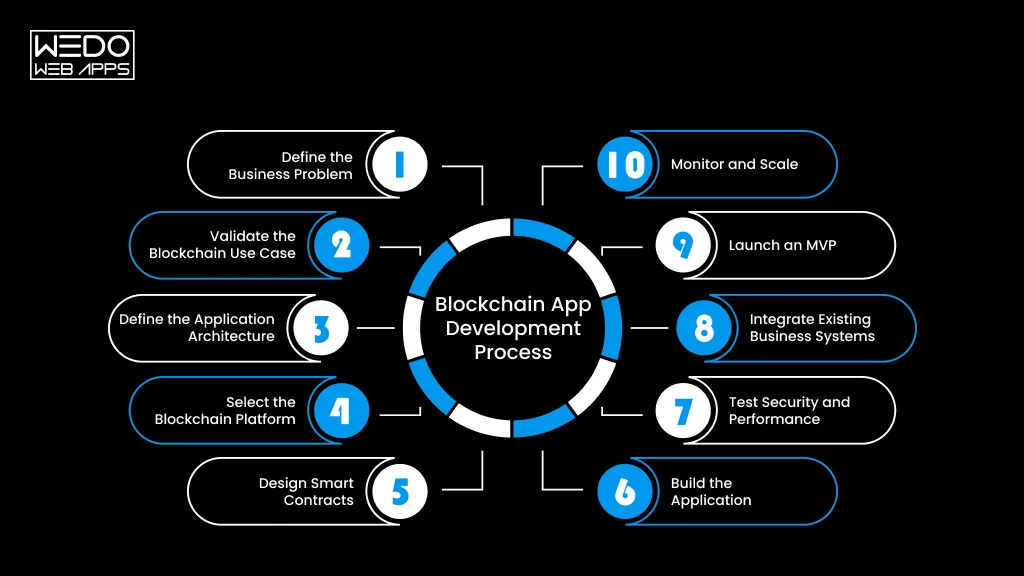
Once an SME has identified a genuine blockchain use case, the next challenge is turning that business requirement into a secure, usable application. Blockchain app development for SMEs should begin with the workflow and expected outcome, then determine which blockchain components are actually necessary.
A practical development process typically includes the following stages:
1. Define the Business Problem
Start by documenting the process that needs improvement, the stakeholders involved, existing systems, and the expected business outcome.
2. Validate the Blockchain Use Case
Compare blockchain with conventional databases and other technologies. Move forward only when blockchain provides a clear advantage in areas such as shared verification, traceability, or automation.
3. Define the Application Architecture
Determine how the blockchain will interact with the frontend, backend, databases, APIs, wallets, identity systems, and existing business applications.
4. Select the Blockchain Platform
Choose between public, private, or permissioned infrastructure based on factors such as transaction volume, access control, governance, scalability, and integration requirements.
5. Design Smart Contracts
Translate suitable business rules into smart contracts. Contracts should be designed carefully because errors in their logic can affect transactions and application behaviour.
6. Build the Application
Develop the user interface, backend services, blockchain integrations, APIs, authentication, dashboards, and other application components required by users.
7. Test Security and Performance
Test smart contracts and application logic for vulnerabilities while evaluating transaction performance, access controls, integration reliability, and failure scenarios.
8. Integrate Existing Business Systems
Connect the blockchain application with relevant ERP, CRM, inventory, payment, accounting, or other systems rather than forcing the SME to replace its entire technology stack.
9. Launch an MVP
A focused minimum viable product allows the business to validate the technology with a limited workflow and user group before committing to wider deployment.
10. Monitor and Scale
After launch, monitor application performance, transaction costs, security, user adoption, and infrastructure requirements. Scale the solution as the business case is validated.
For SMEs, this staged approach can reduce unnecessary development costs while creating an opportunity to measure whether the blockchain application delivers the expected operational value.
How Should an SME Choose the Right Blockchain Platform?
Choosing a blockchain platform is a technical decision that should follow the application's requirements. There is no single blockchain platform that is suitable for every SME or use case.
Before selecting a platform, businesses should evaluate:
Access and Governance
Determine who can participate in the network and who has permission to read, submit, or validate transactions. Businesses working with known partners may require a permissioned architecture rather than an open public network.
Transaction Requirements
Consider expected transaction volume, confirmation times, throughput, and transaction costs. The platform should support current requirements while leaving room for business growth.
Smart Contract Support
If the application depends on automated agreements, assess the platform's smart contract capabilities, development ecosystem, testing tools, and security considerations.
Integration Requirements
The blockchain should work with the SME's existing technology environment through suitable APIs, SDKs, middleware, or other integration mechanisms. Compatibility with existing systems can significantly influence development effort.
Security and Compliance
Evaluate identity management, access controls, encryption, auditing, data-handling practices, and relevant regulatory requirements before implementation.
Development Ecosystem
Availability of experienced developers, documentation, development tools, testing frameworks, and long-term platform support can affect both development speed and ongoing maintenance.
Scalability and Cost
Look beyond initial development costs. Infrastructure, transactions, integrations, upgrades, monitoring, security audits, and maintenance can all contribute to the long-term cost of a blockchain application.
The right choice therefore depends on the business model, network participants, technical requirements, regulatory environment, and expected scale. An experienced development team can evaluate these factors before recommending a platform rather than selecting one
How Can Blockchain Work With AI and Other Advanced Technology Solutions?
Blockchain does not have to operate as a standalone technology. SMEs can combine it with AI, IoT, cloud computing, and automation when these technologies address different parts of the same business workflow.
The combination can be useful when blockchain provides trusted records and verification, while other technologies handle analysis, connectivity, infrastructure, or automation.
Blockchain + AI
AI can analyse large volumes of business data, identify patterns, generate predictions, and support automated decision-making. Blockchain can provide a verifiable record of selected data, transactions, or events used within those workflows.
For example, an SME could combine blockchain-based supply-chain records with AI analytics to identify unusual shipment patterns or potential disruptions.
Blockchain + IoT
IoT devices continuously generate data from machines, vehicles, warehouses, and other connected assets. Blockchain can record selected IoT events in a tamper-resistant ledger, creating a verifiable history of device-generated information.
A logistics business, for instance, could combine connected sensors with blockchain to record relevant shipment conditions and movement events.
Blockchain + Cloud
Cloud platforms provide the infrastructure needed to deploy and scale many components surrounding a blockchain application, including APIs, databases, analytics systems, authentication services, and application interfaces.
This allows an SME to retain blockchain functionality without building every supporting infrastructure component from scratch.
Blockchain + Automation
Blockchain and smart contracts can complement workflow automation by allowing predefined actions to be triggered when verified conditions are met.
This can support processes such as approvals, settlements, asset transfers, or partner transactions where business rules can be clearly defined.
Blockchain + Cybersecurity
Blockchain can contribute to specific security architectures through cryptographic verification, decentralised records, and controlled access. However, it should complement rather than replace established cybersecurity measures such as encryption, identity management, secure APIs, monitoring, and vulnerability testing.
For SMEs exploring AI and advanced technology solutions, the key is to combine technologies based on their individual strengths. Blockchain can provide the trust layer, while AI, cloud, IoT, and automation can provide intelligence, connectivity, scalability, and operational efficiency.
How Much Does Blockchain App Development Cost for SMEs?
The cost of blockchain app development for an SME depends on the application's functionality, blockchain architecture, integrations, security requirements, and development complexity. A simple proof of concept and a production-ready multi-party platform can have very different budgets.
Instead of relying on a generic price range, SMEs should assess the main cost drivers first.
Key Factors That Influence Blockchain Development Cost
Application complexity: A basic blockchain-enabled application requires less development than a platform involving multiple user roles, transactions, dashboards, and workflows.
Blockchain architecture: Public, private, and permissioned networks can involve different infrastructure, governance, and implementation requirements.
Smart contract complexity: Simple business rules are generally less demanding than contracts involving multiple conditions, assets, or transaction flows.
System integrations: Connecting blockchain applications with ERP, CRM, accounting, payment, inventory, or other existing systems can increase development effort.
Security requirements: Smart-contract audits, penetration testing, access controls, identity management, and security monitoring can add to project costs but are important for production systems.
User-facing features: Wallets, dashboards, authentication, notifications, reporting, administration panels, and other application features contribute to the overall scope.
Maintenance and infrastructure: Post-launch monitoring, upgrades, infrastructure, security updates, bug fixes, and ongoing development should be included in the long-term budget.
How SMEs Can Manage Blockchain Development Costs
A practical approach is to avoid building the complete solution immediately.
Start with a clearly defined use case and develop a proof of concept or MVP around the highest-value workflow. Once the business validates the technology and measures its results, additional features and integrations can be introduced progressively.
This approach helps SMEs control upfront investment while determining whether the expected efficiency, transparency, automation, or verification benefits justify wider blockchain adoption for small businesses.
What Are the Challenges of Blockchain Adoption for Small Businesses?
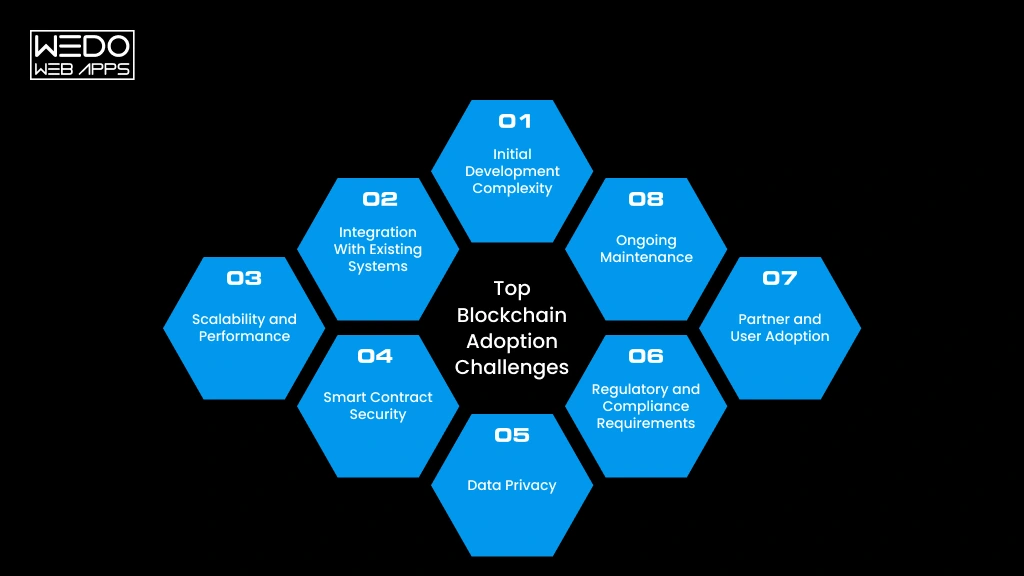
Blockchain can introduce meaningful improvements, but SMEs also need to account for the technical, operational, and regulatory challenges that can affect implementation. Understanding these limitations early can help businesses avoid unnecessary complexity and design a more practical solution.
1. Initial Development Complexity
Blockchain applications require specialised knowledge of distributed systems, smart contracts, cryptography, wallets, network architecture, and blockchain infrastructure. Finding the right technical expertise can increase development effort compared with conventional applications.
2. Integration With Existing Systems
Most SMEs already rely on business software such as ERP, CRM, accounting, inventory, and payment systems. Connecting these systems with a blockchain application requires carefully designed APIs and data flows.
3. Scalability and Performance
Blockchain networks can have different transaction-throughput and confirmation characteristics from conventional databases. The architecture must therefore be designed around the application's expected transaction volume and performance requirements.
4. Smart Contract Security
Smart contracts can automate transactions, but programming errors or vulnerabilities can affect application behaviour and potentially cause financial or operational losses. Security testing and, where appropriate, independent contract audits should be considered before deployment.
5. Data Privacy
Blockchain's persistent records can create challenges when applications handle sensitive or personally identifiable information. A suitable architecture may keep sensitive data off-chain while storing only appropriate references, hashes, or transaction metadata on the ledger.
6. Regulatory and Compliance Requirements
Blockchain applications may involve financial transactions, digital assets, identity information, or other regulated activities. SMEs need to assess applicable UK and international requirements before launching a solution.
7. Partner and User Adoption
A blockchain solution involving multiple organisations delivers limited value if participants do not use or trust the system. SMEs may need clear governance, onboarding processes, permissions, and incentives to encourage adoption across the network.
8. Ongoing Maintenance
Blockchain applications still require monitoring, security updates, infrastructure management, contract upgrades where supported, and application maintenance after launch.
These challenges do not make blockchain unsuitable for SMEs. They highlight why blockchain adoption for small businesses should be approached as a business and technology project rather than simply a software development exercise.
How Can SMEs Start With Blockchain Adoption?
Blockchain adoption does not have to begin with a large-scale transformation. For most SMEs, a focused pilot can provide a clearer understanding of the technology's practical value before significant resources are committed.
A structured approach can help reduce both technical and financial risk.
1. Identify One Business Problem
Start with a process involving measurable challenges such as manual reconciliation, limited traceability, repeated verification, or multi-party coordination.
2. Define the Expected Business Outcome
Establish what success should look like. This could include reducing processing time, improving record accuracy, lowering administrative effort, or increasing transaction visibility.
3. Assess Blockchain Suitability
Compare blockchain with conventional databases and other available technologies. Move forward only when blockchain provides a meaningful advantage for the identified problem.
4. Build a Proof of Concept
Develop a small technical implementation around the core workflow. This allows the SME to validate network architecture, integrations, smart contracts, and user requirements before building the complete application.
5. Test With Relevant Stakeholders
If the solution involves suppliers, customers, logistics providers, or other organisations, involve them early. Their technical requirements and willingness to participate can directly affect the application's viability.
6. Measure the Results
Compare the pilot against predefined metrics such as processing time, reconciliation effort, transaction costs, error rates, or user adoption.
7. Scale the Application Gradually
If the pilot demonstrates clear business value, expand the application with additional users, workflows, integrations, and features.
This approach makes blockchain technology for small businesses more manageable. Instead of investing in a complex platform based on assumptions, an SME can validate the technology against a real business problem and scale its blockchain solution when the results justify further investment.
What Is the Future of Blockchain Applications for Businesses?
Blockchain is moving beyond standalone cryptocurrency applications into broader digital infrastructure for identity, asset management, transactions, and business networks. For SMEs, the opportunity will depend less on adopting blockchain as a trend and more on identifying practical applications where its underlying capabilities provide measurable value.
Several areas are worth watching:
Tokenisation of Real-World Assets
Blockchain can represent ownership or rights associated with certain real-world assets as digital tokens. This could support new approaches to asset management, investment, ownership records, and transactions where the legal and regulatory framework allows it.
Verifiable Digital Identity
Businesses can increasingly use cryptographically verifiable credentials to confirm identity, qualifications, or other attributes without repeatedly exchanging complete documents.
Smarter Business Automation
As smart contracts become more closely integrated with conventional business software, SMEs may use programmable rules to automate selected transactions and multi-party workflows.
Blockchain and AI Convergence
AI can analyse and act on business data, while blockchain can provide verifiable records for selected transactions or data inputs. Together, they can support applications requiring both intelligent processing and trusted data.
Greater Interoperability
Business applications increasingly need to exchange information across different platforms and networks. Improvements in blockchain interoperability could make it easier for organisations to connect blockchain-based systems with existing enterprise technology.
For SMEs, these developments create opportunities but do not eliminate the need for careful evaluation. The future of blockchain applications for businesses will ultimately be shaped by factors such as usability, integration, security, regulation, cost, and whether the technology delivers a clear business outcome.
Conclusion: Make Blockchain Solve a Business Problem
For SMEs, blockchain is most valuable when it addresses a problem that conventional systems struggle to solve efficiently. Shared records, traceability, transaction verification, smart-contract automation, and controlled data sharing can all create practical opportunities when the underlying use case justifies the technology.
The key to successful blockchain app development for SMEs is therefore not adopting blockchain for its own sake. Businesses should first identify a measurable problem, evaluate whether blockchain is the right technical approach, validate the idea through a focused MVP, and then scale the solution based on real results.
With the right architecture and development strategy, blockchain solutions for SMEs can become part of a broader technology ecosystem alongside AI, cloud, IoT, and automation.
For businesses ready to explore a blockchain application, the next step is to turn the potential use case into a technically and commercially viable solution.