Introduction
The mobile app industry has become a major part of how people communicate, shop, work, manage finances, access healthcare, consume entertainment, and use digital services. Businesses are also treating mobile applications as direct channels for customer engagement, transactions, and service delivery.
The industry is changing quickly. App downloads still matter, but revenue, time spent, subscriptions, in-app purchases, and user retention now provide a broader view of market performance. At the same time, generative AI is creating new app categories and adding intelligent features to established applications.
For businesses planning a mobile app, understanding these shifts can help you identify stronger opportunities and avoid outdated assumptions. This mobile app industry analysis covers the latest statistics, market growth, major industry trends, leading app categories, regional developments, challenges, and the future of the mobile app industry.
Mobile App Industry Overview
The mobile app industry includes much more than the companies that design and develop applications. It is a broad ecosystem connecting app developers, businesses, technology providers, app stores, advertisers, payment providers, and consumers. Together, these groups support the creation, distribution, monetization, and continued use of mobile applications.
What Is the Mobile App Industry?
Think of the mobile app industry as an ecosystem rather than a single market. An application may begin with a business idea, but reaching the user involves several connected participants.
- Developers and development companies turn business requirements into functional applications and maintain them after launch.
- Businesses and app publishers define the product, target audience, revenue model, and commercial objectives.
- App stores such as Apple’s App Store and Google Play provide distribution, discovery, payments, and platform policies.
- Technology providers supply cloud infrastructure, analytics, payment services, APIs, AI models, development frameworks, and other technical components.
- Advertisers and monetization providers support revenue generation through advertising, subscriptions, sponsorships, and in-app purchases.
- Consumers complete the ecosystem through downloads, usage, purchases, subscriptions, ratings, and feedback.
These connections mean that changes in one part of the ecosystem can affect the others. A new privacy requirement can change how developers collect data. A new AI capability can create an entirely new app category. A shift in consumer spending can change which business models receive investment.
How Has the Mobile App Industry Evolved?
The industry's progression can be viewed through the way people began using their smartphones.
From utilities to everyday services
Early smartphone applications largely handled basic tasks such as communication, calendars, navigation, games, and simple productivity. As smartphones became more capable, applications started replacing several activities that once required a website, desktop software, or physical service.
From downloads to continuous engagement
Social media, streaming, gaming, and messaging changed the role of apps from occasional tools to products people use throughout the day. This made retention and engagement important measures for businesses.
From information to transactions
Shopping, banking, food delivery, travel booking, digital payments, and other services brought transactions directly into mobile applications. Businesses could now use apps as complete customer service and sales channels.
From standalone software to connected platforms
Cloud computing enabled applications to synchronize information, connect with external services, and handle more complex workloads. Mobile apps increasingly became interfaces for larger technology ecosystems.
From programmed features to AI-powered experiences
The latest shift is toward applications that can understand natural language, generate content, automate tasks, provide recommendations, and adapt experiences based on user behaviour. Generative AI is therefore influencing both new applications and established products.
How Big Is the Mobile App Industry?
There is no single figure that represents the entire mobile app industry.
Market research firms use different definitions, data sources, application categories, regions, and revenue models when calculating market size. One report may measure the application market itself, while another may focus on app revenue, advertising, development services, or a particular geographic region.
Grand View Research estimates that the global mobile application market was worth $285.7 billion in 2025 and projects it to reach $885.3 billion by 2033, at a15.5% CAGR from 2026 to 2033.
Market size, however, tells only part of the story. To understand the industry's current position, you also need to consider downloads, consumer spending, engagement, time spent, subscriptions, advertising, and in-app purchases.
That broader view becomes particularly important as non-gaming apps and AI-powered applications generate a growing share of consumer spending. The next section examines these numbers in detail.
Mobile App Industry Statistics You Should Know in 2026
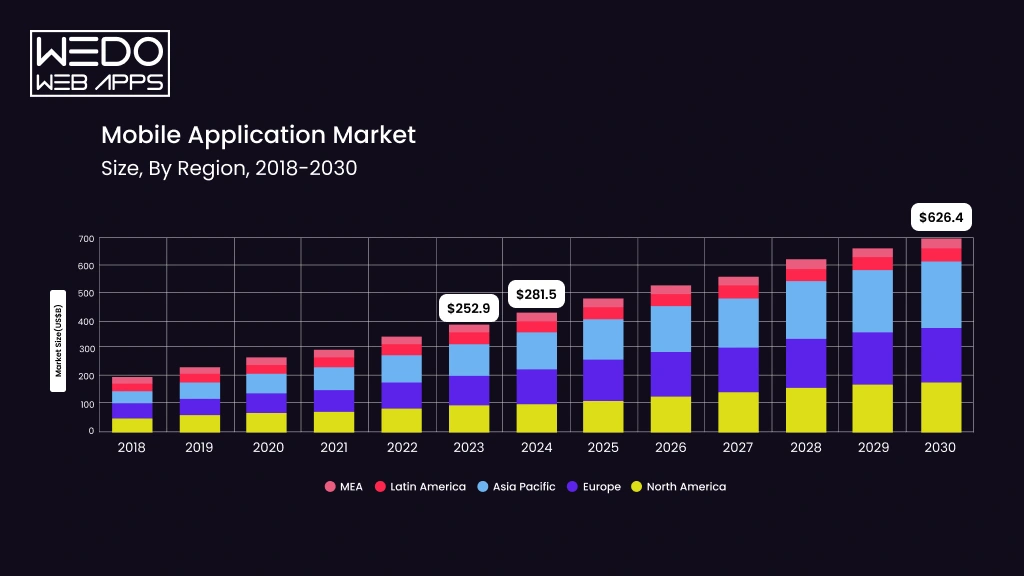
The latest figures show that the mobile app industry is entering a more mature phase. Downloads continue to grow, but revenue and engagement are growing at a different pace. In 2025, consumers spent 5.3 trillion hours across iOS and Google Play apps, while in-app purchases and paid app revenue reached $167 billion, up 10.6% year over year. Global downloads also rose 0.8% to nearly 150 billion.
| Mobile App Industry Metric | Latest Figure |
|---|---|
| Global app downloads in 2025 | Nearly 150 billion |
| Time spent in apps in 2025 | 5.3 trillion hours |
| Global in-app purchase and paid app revenue | $167 billion |
| Growth in-app revenue | 10.6% YoY |
| Generative AI app downloads in H1 2025 | Nearly 1.7 billion |
| Generative AI app IAP revenue in H1 2025 | Nearly $1.9 billion |
| Apps monitoring AI downloaded in H1 2025 | &.5 billion |
These figures come from different Sensor Tower reports and cover different measures and periods. They should therefore be treated as individual indicators rather than combined into one market size calculation.
Global Mobile App Downloads and Usage
Global app downloads reached nearly 150 billion in 2025, representing a 0.8% increase from the previous year. At the same time, people spent 5.3 trillion hours using apps, which was up 3.8% year over year. Sensor Tower estimates this at roughly 3.6 hours per day per mobile user.
The numbers point to an important change in how mobile app growth should be evaluated. Download volume shows how many installations take place, but engagement indicates whether users continue returning to an application. A product that attracts downloads but fails to retain users has a very different commercial position from an app that becomes part of a user's regular routine.
For businesses, this makes retention, frequency of use, session activity, and customer lifetime value useful measures alongside download numbers.
Mobile App Consumer Spending
Mobile users are spending more money inside applications. In 2025, global revenue from in-app purchases and paid apps and games reached $167 billion, growing 10.6% year over year.
This revenue comes from several models, including subscriptions, premium features, virtual goods, paid content, and other in-app purchases. Advertising also remains an important monetization channel, particularly for applications that offer free access to large audiences.
The growth in spending shows that mobile applications are not simply distribution channels. They have become direct revenue platforms for businesses across entertainment, finance, productivity, shopping, education, health, and other categories.
Gaming vs Non-Gaming App Revenue
Gaming remains a major part of mobile spending, but the balance between games and other applications has changed significantly.
In 2025, non-gaming apps generated more in-app purchase revenue than games for the first time. Non-gaming IAP revenue grew 21% year over year, with generative AI services helping drive the increase.
This shift matters because it broadens the commercial opportunity beyond traditional gaming. Applications for productivity, entertainment, finance, photo and video, education, health, and AI can now compete for a larger share of consumer spending.
The change also reflects a wider movement toward utility-driven mobile applications. Users are increasingly willing to pay when an app provides an ongoing service, solves a specific problem, or delivers enough value to justify a subscription.
AI App Growth Statistics
Generative AI has become one of the fastest-growing areas of the mobile application market.
In the first half of 2025, generative AI applications generated nearly 1.7 billion downloads and close to $1.9 billion in in-app purchase revenue globally. Downloads increased 67% compared with the second half of 2024, while IAP revenue more than doubled during the same period.
AI adoption is also spreading into existing application categories. Apps mentioning AI-related terms accounted for 7.5 billion downloads in H1 2025, around 10% of global app downloads during that period. These downloads were up 52% year over year.
The trend has continued into 2026. Sensor Tower reports that global time spent on generative AI apps is projected to reach 36 billion hours in H1 2026, compared with 17.2 billion hours in H1 2025. AI app in-app purchase revenue is also expected to exceed $4 billion in H1 2026.
For app businesses, this signals a move from simply adding AI as a feature to creating products where AI directly supports the core user experience.
Mobile App Usage by Region
Mobile adoption is not developing at the same pace everywhere. Mature markets tend to generate strong consumer spending and engagement, while emerging markets often contribute substantial download volumes and provide room for new categories to scale.
Asia Pacific remains a major source of mobile growth. Generative AI provides a useful example. AI app downloads in Asia increased 80% between H2 2024 and H1 2025, compared with 51% growth in Europe and 39% in North America.
North America continues to be a strong monetization market. In H1 2025, it generated $762 million in generative AI app IAP revenue, up 74% from H2 2024.
Europe also recorded strong AI app revenue growth, with generative AI IAP revenue increasing 121% between H2 2024 and H1 2025.
The UK should be viewed separately when discussing the European market because of its strong app economy and importance to the WEDOWEBAPPS audience. For the final version, I recommend adding a current UK-specific statistic from a reliable UK or mobile intelligence source rather than using an older estimate simply to fill the regional comparison.
India is another market worth highlighting. Sensor Tower estimates around 25 billion app downloads annually in India and reports that annual IAP revenue exceeded $1 billion in 2025. It expects that figure to reach approximately $1.25 billion by the end of 2026.
What These Statistics Tell Us
The current data points to a mobile market where engagement and monetization are becoming more important than downloads alone. AI is accelerating growth in several categories, while non-gaming applications are taking a larger share of consumer spending.
For businesses entering the mobile app market, the opportunity is therefore not simply to build an application and acquire installations. The stronger objective is to create a product that users return to, find useful, and are willing to pay for.
Mobile App Market Growth and Key Drivers
The mobile app market growth is being driven by a combination of consumer behaviour, technology adoption, payment infrastructure, and business investment. The market is no longer expanding simply because more people have smartphones. Applications are becoming part of how people purchase products, manage money, access services, work, and interact with businesses.
Grand View Research estimates that the global mobile application market was valued at $285.7 billion in 2025 and could reach $885.3 billion by 2033, growing at a CAGR of 15.5% between 2026 and 2033.
Growing Smartphone Adoption
A larger smartphone user base directly increases the potential audience for mobile applications. However, device adoption is only one part of the change. Modern smartphones can support high-quality video, biometric authentication, location services, real-time communication, advanced graphics, and AI-based functionality.
This has expanded the types of services that can be delivered through an app.
| Earlier mobile use | Current mobile use |
|---|---|
| Basic communication | Real-time collaboration |
| Simple games | Cloud-based gaming |
| Mobile browsing | Complete shopping journeys |
| SMS banking | Full digital banking |
| Basic navigation | Location-based services |
| Simple utilities | AI-assisted applications |
For businesses, this creates opportunities to reach customers through products that are available whenever and wherever they need them.
Expansion of Mobile Commerce
Mobile commerce has changed the role of applications from product discovery tools into complete transaction channels.
A customer can now discover a product, compare options, receive recommendations, make a payment, track delivery, and contact support without leaving an application. Retailers can also use apps to deliver loyalty programmes, personalised offers, and repeat purchase options.
The same model has expanded into food delivery, travel, ticketing, grocery shopping, and other service categories.
Business impact: Mobile commerce allows companies to bring discovery, conversion, payment, and post-purchase engagement into one customer journey.
AI-Powered Mobile Experiences
AI is creating a new source of mobile app market growth by changing both what applications can do and what types of apps businesses can build.
Generative AI applications recorded nearly 1.7 billion downloads during the first half of 2025, while their in-app purchase revenue approached $1.9 billion during the same period.
AI is also being integrated into established applications through:
- Conversational search
- Personalised recommendations
- Content generation
- Image and video processing
- Automated customer support
- Predictive insights
- Voice-based interactions
- Workflow automation
This means AI is contributing to the market in two ways. It is creating entirely new application categories while also increasing the capabilities of existing products.
Growth of Digital Payment
Mobile payments have removed much of the friction associated with app-based transactions. Digital wallets, mobile banking, biometric authentication, stored payment information, and contactless payments allow users to complete transactions directly from their devices.
This has strengthened several mobile app categories.
- Fintech: Banking, investment, lending, insurance, and payment applications can provide services without relying on physical branches.
- Retail: Customers can pay, manage orders, and access loyalty benefits through the same application.
- Subscriptions: Streaming, fitness, productivity, education, and other services can collect recurring payments through mobile platforms.
As payment infrastructure improves, more businesses can build revenue-generating services directly into their applications.
Increasing Business Adoption of Mobile Apps
Businesses are no longer investing in mobile applications only to create another customer communication channel.
| Business use case | How mobile apps support it |
|---|---|
| Customer engagement | Notifications, loyalty programmes, personalised content |
| Sales | Product discovery, ordering, payments |
| Customer services | In-app support and self-service |
| Field operations | Job assignments, location tracking, reporting |
| Employee productivity | Internal communication and workflow tools |
| Data collection | Customer behavior and operational insights |
This broader adoption is expanding demand across both B2C and B2B applications.
For a retail company, the priority may be increasing repeat purchases. For a logistics company, it may be improving field operations. For a financial institution, the focus could be delivering more services through digital channels.
The growth of the mobile app market therefore comes from a combination of larger mobile audiences, new transaction models, AI capabilities, digital payments, and wider business adoption rather than one single factor.

Mobile App Industry Trends in 2026
The mobile app industry is moving beyond the idea of an app as a standalone product. Applications are increasingly becoming intelligent service layers that connect users with payments, content, commerce, automation, and other digital services.
Some trends are creating entirely new app categories. Others are changing how established applications compete for attention and revenue.
Generative AI Is Moving Into the Core App Experience
AI is shifting from an optional feature to a core capability within many applications. Generative AI apps recorded nearly 1.7 billion downloads in H1 2025, while their in-app purchase revenue approached $1.9 billion during the same period.
The change is also visible in existing products. Developers are using AI for conversational search, content creation, recommendations, image processing, customer support, and task automation.
For businesses, the question is no longer simply whether an app should contain AI. It is whether AI can remove friction or deliver a service that was previously difficult to provide.
AI Native Apps Are Creating New Categories
Some applications are being designed around AI from the beginning rather than adding it to an existing product.
These products can understand natural language, generate content, process documents, analyse images, or complete multi-step tasks. Their value comes from what the AI can accomplish rather than from a traditional collection of static app features.
This creates opportunities for startups and established companies to rethink products that previously depended on manual workflows.
Non-Gaming Apps Are Taking a Larger Share of Spending
Mobile gaming remains commercially significant, but the revenue balance is changing.
In 2025, non-gaming applications generated more consumer spending through in-app purchases than games for the first time. Sensor Tower reported 21% year-over-year growth in non-gaming IAP revenue, with generative AI services contributing strongly to the increase.
This opens more commercial space for categories such as:
| Category | Emerging opportunity |
|---|---|
| Productivity | AI-assisted work and automation |
| Finance | Personalised financial services |
| Education | Adaptive learning and AI tutoring |
| Health | Personalised health management |
| Entertainment | AI-generated and personalised content |
| Commerce | Smarter recommendations and purchasing |
The implication is significant for businesses outside gaming. Consumer spending is increasingly distributed across a wider range of mobile services.
Subscription Models Are Becoming More Sophisticated
Subscriptions remain an important monetization model for mobile applications, particularly where users receive continuing value.
However, simply placing an application behind a recurring payment does not guarantee retention. Users increasingly expect regular improvements, useful features, personalised experiences, and clear value for the price.
This is encouraging businesses to experiment with combinations such as:
- Free access + premium features
- Limited usage + paid upgrades
- Subscription + one-time purchases
- Advertising + premium plans
The right model depends on the application category, audience, frequency of use, and value delivered.
Personalization Is Becoming More Contextual
Mobile applications have access to signals such as preferences, location, purchase history, usage patterns, and interaction behaviour. When handled responsibly, this information can support more relevant experiences.
Instead of showing the same content to every user, applications can adapt recommendations, notifications, offers, and interfaces according to individual needs.
AI is accelerating this shift by allowing applications to process larger amounts of behavioural information and generate more responsive recommendations.
Mobile Commerce Is Becoming More Integrated
Commerce applications are moving beyond digital storefronts.
Product discovery, recommendations, payments, loyalty programmes, customer support, order tracking, and post-purchase communication can all exist within the same application.
Social commerce is adding another layer. Users can discover products through content, creators, communities, and recommendations before moving directly to purchase.
For retailers, this makes the app part of the complete customer journey rather than simply another sales channel.
Privacy Is Influencing App Design
Users and regulators are paying closer attention to how applications collect and use personal information. At the same time, major mobile platforms continue to introduce controls around permissions, tracking, and data access.
Privacy therefore needs to be considered during product design rather than treated as an issue after development.
Applications that request unnecessary permissions or provide unclear explanations can create trust problems. Businesses need to collect appropriate data, explain its purpose clearly, and give users meaningful control.
Cross-Platform Development Is Supporting Faster Delivery
Businesses increasingly need applications for both Android and iOS without maintaining completely separate development efforts.
Cross-platform technologies such as React Native and Flutter allow teams to share significant portions of application code while still delivering experiences across multiple platforms.
The benefit is not simply development speed. A shared approach can also reduce duplication in maintenance, testing, and future updates when the product is suitable for cross-platform development.
Super Apps Are Bringing More Services Together
The super app model combines several services within one application. Payments, messaging, shopping, transportation, food delivery, financial services, and other functions can be connected under a single account.
This approach is more established in some Asian markets than in Western markets. Still, the underlying idea is influencing how businesses think about ecosystems and customer retention.
Rather than creating separate experiences for every service, companies can look for logical ways to connect related services within one mobile environment.
On-Device AI Will Gain More Attention
AI processing does not always need to happen entirely in the cloud. Some tasks can be performed directly on supported devices.
On-device processing can reduce latency and may provide greater control over certain types of data. It can also allow some AI features to work with limited connectivity.
As smartphone hardware becomes better suited to AI workloads, developers will have more options for deciding which tasks should run locally and which should rely on cloud infrastructure.
The Direction of Mobile App Development Is Changing
The major mobile app industry trends in 2026 point toward applications that are more intelligent, personalised, transaction-ready, and connected to wider services.
For businesses, this means app planning should start with the user problem and commercial objective rather than a list of fashionable technologies. AI, subscriptions, payments, cross-platform development, and personalisation are useful when they create measurable value for the people using the application.
Mobile Application Industry Analysis by App Category
The mobile application market does not grow uniformly across every category. User demand, spending behaviour, monetization methods, and technology adoption differ significantly between sectors. Looking at individual categories therefore gives a clearer picture of where the market is gaining momentum and where businesses can find new opportunities.
| App Category | Current Direction | Key Growth Opportunity |
|---|---|---|
| Gaming | Large and highly competitive | In-app purchases, live services, immersive experiences |
| Social Media | Strong engagement | Creator economy, advertising, AI-powered content |
| Entertainment | Expanding beyond traditional streaming | Short-form content, subscriptions, personalized media |
| eCommerce | Strong mobile adoption | Personalization. Loyalty, embedded payments |
| Fintech | Increasing digital adoption | Mobile banking, payments, investing, AI assistance |
| Healthcare | Growing use of digital services | Remote care, monitoring, health management |
| Education | Increasing mobile learning | Adaptive learning and AI tutoring |
| Travel | Mobile-first customer journeys | Booking, personalization, digital assistance |
| Productivity | Rapid AI adoption | Automation, collaboration, intelligent assistants |
| AI Applications | Fast-emerging category | Generative AI, agents, content and task automation |
Gaming Apps
- Mobile gaming remains one of the largest app categories by revenue and engagement.
- Free-to-download models continue to rely on in-app purchases, advertising, subscriptions, and virtual goods.
- Multiplayer features, live events, social interaction, and regular content updates are increasing retention.
- Competition remains high, making user acquisition and long-term engagement major challenges.
Social Media Apps
- Short-form video, creator content, messaging, and online communities continue to shape the category.
- AI is increasingly being used for recommendations, content creation, moderation, and personalized feeds.
- Social commerce is connecting content discovery with product purchasing.
- Businesses can use these applications for community building, customer communication, advertising, and direct sales.
Entertainment and Streaming Apps
- Video, music, podcasts, and short-form content continue to attract substantial mobile engagement.
- Recommendation systems help platforms personalise what users watch or listen to.
- Subscription models remain common, while advertising-supported plans provide additional monetization options.
- AI-generated and personalised content is creating new opportunities for entertainment platforms.
eCommerce and Retail Apps
- Retail applications are becoming complete purchasing channels rather than mobile versions of websites.
- Features such as personalized recommendations, loyalty programmes, push notifications, and mobile payments support repeat purchases.
- First-party customer data can help retailers understand preferences and deliver relevant offers.
- Social commerce and personalised shopping experiences are creating additional growth opportunities.
Fintech and Banking Apps
- Mobile banking, digital wallets, investment platforms, insurance, and payment services are reducing dependence on physical branches.
- Biometric authentication and mobile payments make financial transactions faster and more accessible.
- AI can support fraud detection, customer service, spending analysis, and personalised financial assistance.
- Security, privacy, regulatory compliance, and data protection remain major requirements.
Healthcare Apps
- Healthcare applications are expanding across appointment management, telehealth, medication reminders, health records, and remote monitoring.
- Connected devices can provide applications with real-time health and activity data.
- AI can assist with personalised recommendations, administrative tasks, and patient communication.
- Healthcare apps require strong privacy controls, security measures, accessibility, and regulatory compliance.
Education and Learning Apps
- Mobile learning makes educational content available beyond traditional classrooms.
- Language learning, professional training, exam preparation, and tutoring remain strong use cases.
- AI enables adaptive learning paths, automated feedback, and conversational tutoring.
- Subscription and freemium models allow providers to offer different levels of access.
Travel and Mobility Apps
- Users can search, compare, book, pay, and manage travel services through mobile applications.
- Location-based features can provide real-time navigation, recommendations, updates, and local information.
- Digital tickets and mobile check-in can simplify parts of the travel journey.
- Personalised recommendations can help travel companies improve engagement and increase additional bookings.
Productivity and Business Apps
- Businesses use mobile applications for collaboration, sales, field operations, communication, reporting, and workflow management.
- AI assistants can summarise information, generate content, organise tasks, and automate repetitive activities.
- Mobile access allows employees to complete work outside traditional office environments.
- Integration with existing business systems is often more valuable than adding unnecessary features.
AI Applications
- Generative AI has become one of the fastest-growing areas within mobile applications.
- Generative AI apps recorded nearly 1.7 billion downloads in H1 2025 and generated almost $1.9 billion in in-app purchase revenue during the same period.
- AI assistants, image generation, writing tools, education apps, productivity tools, and specialised business applications are expanding the category.
- AI is also influencing other app categories by adding conversational interfaces, automation, recommendations, and intelligent search.
What the Category Analysis Shows
- Gaming continues to generate substantial revenue, but non-gaming categories are gaining more consumer spending.
- AI is creating new products while changing established application categories.
- Fintech and commerce are benefiting from wider digital payment adoption.
- Healthcare and education are using mobile applications to make services more accessible.
- Productivity applications are increasingly incorporating AI and automation.
- Entertainment and social platforms continue competing heavily for user attention.
The strongest opportunities are therefore not concentrated in one category. They are emerging where mobile applications can combine useful services, recurring engagement, convenient transactions, and intelligent features.
Mobile App Industry by Region
Mobile app adoption varies by region because smartphone penetration, consumer spending, payment infrastructure, app preferences, and regulatory conditions are different across markets. A regional view therefore gives businesses a better idea of where demand is concentrated and how user behaviour differs.
Mobile App Industry in North America
- North America remains one of the strongest markets for mobile app monetization, supported by high consumer spending and established digital payment infrastructure.
- The United States is a major market for AI applications, subscriptions, entertainment, finance, and productivity tools.
- Generative AI applications generated approximately $762 million in in-app purchase revenue in North America during H1 2025, with revenue increasing 74% compared with H2 2024.
- Businesses entering this market face strong competition, making product differentiation and retention particularly important.
Mobile App Industry in Europe
- European users have strong adoption across finance, commerce, travel, entertainment, healthcare, and productivity applications.
- Privacy and data protection have a particularly strong influence on application development and user expectations.
- Generative AI app in-app purchase revenue in Europe increased 121% between H2 2024 and H1 2025, according to Sensor Tower.
- Businesses targeting European users need to consider local regulations, payment preferences, languages, and market-specific customer behaviour.
Mobile App Industry in the UK
- The UK represents an important mobile market for financial services, retail, entertainment, travel, healthcare, and professional applications.
- Strong digital payment adoption supports app-based purchasing and subscription services.
- Consumers increasingly expect mobile services to provide convenience across discovery, transactions, communication, and customer support.
- For businesses operating in the UK, applications can support both customer acquisition and ongoing engagement when they provide a clear reason for users to return.
Mobile App Industry in Asia Pacific
- Asia Pacific is one of the most active regions for mobile application adoption and innovation.
- Large smartphone populations create significant opportunities for consumer applications, fintech, commerce, entertainment, and social platforms.
- Generative AI app downloads in Asia increased by 80% between H2 2024 and H1 2025, making the region one of the fastest-growing markets for AI applications.
- Super apps, mobile wallets, social commerce, and integrated digital services are particularly influential in several Asian markets.
India
- India is a major download market because of its large smartphone user base and growing digital service adoption.
- Sensor Tower estimates that India generates around 25 billion app downloads annually.
- Annual in-app purchase revenue in the country exceeded $1 billion in 2025 and is projected to reach approximately $1.25 billion by the end of 2026.
- Fintech, entertainment, commerce, education, gaming, and AI applications provide significant opportunities in the Indian market.
- Businesses targeting Indian users need to account for price sensitivity, regional languages, varied connectivity, and different levels of device capability.
Regional Comparison
| Region | Major opportunity areas | Key consideration |
|---|---|---|
| North America | AI, fintech, subscriptions, entertainment | High competition and strong monetization expectations |
| Europe | Finance, commerce, travel, healthcare | Privacy, regulation, and localization |
| UK | Fintech, retail, professional services, entertainment | Customer experience and digital payment adoption |
| Asia Pacific | Super apps, fintech, commerce, social apps, AI | Large and diverse user base |
| India | Fintech, education, entertainment, commerce, AI | Affordability, localization, and device diversity |
The regional picture shows why businesses should not treat the mobile market as one uniform audience. An application that performs well in one country may require changes to its pricing, features, payment options, language, or user experience before entering another market.
Challenges Facing the Mobile App Industry
A growing market does not mean an easier market. More businesses are entering mobile, users have more choices, and platforms are imposing stricter requirements around privacy, security, payments, and data.
For companies planning a mobile application, these challenges can affect everything from the first user acquisition campaign to long-term profitability.
Increasing Competition and App Saturation
The challenge has shifted from building an app to earning attention for it.
App stores already contain applications for almost every common consumer need. A new product therefore needs a clear reason to exist. Simply offering the same functionality with a different interface rarely gives a business enough differentiation.
This is especially relevant as AI-assisted development makes it easier to create and release software. More products entering the market can mean more alternatives for users and shorter windows for differentiation.
Business consequence: A strong product idea can still struggle if its positioning, user experience, or acquisition strategy is weak.
User Acquisition and Retention Cost
Acquiring an installation does not guarantee a customer.
A user may download an application after seeing an advertisement, use it once, and never return. Businesses then have to spend more money attracting new users while trying to retain the ones they already acquired.
This creates two connected metrics:
Acquisition: How much does it cost to bring a new user into the application?
Retention: How many users continue using the application after installation?
When acquisition costs rise while retention remains low, the economics of the product become difficult to sustain.
Privacy and Data Protection
Mobile applications increasingly depend on user data for personalisation, analytics, payments, location-based services, and AI functionality. This creates a difficult balance between useful data collection and responsible data handling.
| Area | Potential Concern |
|---|---|
| Location | Unnecessary or unclear location tracking |
| Personal Data | Collection beyond the application’s actual needs |
| Analytics | Tracking without appropriate transparency |
| AI | Use of personal information in AI systems |
| Payments | Exposure of financial information |
| Cross-border services | Different privacy requirements across markets |
For businesses serving users in the UK and Europe, privacy obligations can be particularly significant because of GDPR requirements.
Mobile App Security Risks
Security problems can affect both users and businesses. A vulnerable application can expose personal information, payment details, authentication credentials, or connected business systems.
Common attack surfaces include APIs, authentication systems, local storage, third-party libraries, and communication between the application and backend services.
The risk becomes greater when an application handles sensitive information. A banking application and a simple calculator do not have the same security requirements.
The practical lesson: Security needs to be considered throughout development and maintenance rather than treated as a final testing stage.
App Store Policies and Platform Dependency
Apple and Google provide access to enormous user bases, but businesses also depend on their rules.
Changes to app review requirements, privacy policies, payment rules, permissions, or platform capabilities can affect how an application operates.
This creates a dependency that businesses cannot completely remove.
A change in platform policy can require product changes. A rejected update can delay a release. A change in payment requirements can affect monetization.
For this reason, businesses should consider platform requirements during product planning and maintain contingency plans for critical services where practical.
Monetization Challenges
Having users does not automatically mean having revenue.
Different monetization models work for different products:
| Model | Works well when | Main difficulty |
|---|---|---|
| Subscription | Users receive recurring value | Preventing cancellations |
| Advertising | The app has high engagement | Maintaining experience while showing ads |
| In-app purchases | Users buy digital goods or features | Encouraging sufficient spending |
| Freemium | Free access can attract a large audience | Converting free users to paid users |
| Transaction fees | The app facilitates regular transactions | Reaching enough transaction volume |
The challenge is not selecting the most popular model. It is finding a model that matches how users receive value from the application.
Maintaining User Engagement
Mobile users have limited attention and many alternatives.
An application that was useful at launch can become less relevant if competitors introduce better features or users' expectations change. At the same time, adding features simply to keep the product active can make the interface complicated.
Successful engagement usually depends on a combination of:
- Product usefulness: The app solves a recurring problem.
- Experience quality: Users can complete tasks without unnecessary friction.
- Fresh value: Content, services, or functionality continue to improve.
- Relevant communication: Notifications and messages provide a genuine reason to return.
- Personalisation: The experience becomes more relevant without becoming intrusive.
The challenge is therefore not to make users open an app as frequently as possible. It is to give them a legitimate reason to return.
These issues are connected. Greater competition increases acquisition pressure. Higher acquisition costs make retention more important. More data-driven experiences increase privacy responsibilities. Greater platform dependence affects monetization and distribution.
This is why the mobile app industry is becoming more demanding even as the market continues to grow. Businesses need to think about the complete product lifecycle, from positioning and development to security, acquisition, retention, monetization, and ongoing improvement.

What Is Shaping the Future of the Mobile App Industry?
The next phase of the future of the mobile app industry will be shaped by how applications respond to changing user expectations rather than by technology alone. AI is already changing app functionality, while privacy, connected devices, payments, and automation are influencing how products are designed.
AI Will Move From Feature to Interface
- AI assistants will become more closely integrated with everyday mobile tasks.
- Users will increasingly interact with applications through natural language instead of navigating through multiple menus.
- Generative AI can support writing, search, recommendations, image creation, customer support, and task automation.
- AI agents may allow applications to complete multi-step actions instead of only responding to individual commands.
Apps Will Become More Context-Aware
- Applications will increasingly respond to factors such as location, preferences, previous activity, time, and user intent.
- Personalised recommendations can make shopping, entertainment, travel, and content discovery more relevant.
- Contextual notifications can replace broad promotional messages with more useful and timely information.
- Businesses will need to balance personalisation with clear consent and responsible data practices.
Mobile Commerce Will Continue Expanding
- More customer journeys will move from product discovery through payment and post-purchase support within apps.
- Digital wallets and embedded payment systems will make mobile transactions easier.
- Loyalty programmes and personalised offers can encourage repeat purchases.
- Social commerce will connect content, recommendations, creators, and purchasing more closely.
Apps Will Connect With More Devices
The smartphone is increasingly becoming a control point for connected products and services.
- Wearables can share health, fitness, and activity information with mobile applications.
- Smart home applications can control connected devices from a single interface.
- Vehicles can connect with mobile apps for navigation, charging, access, and vehicle management.
- Connected devices will create new opportunities for applications that operate across multiple touchpoints.
On-Device AI Will Gain Ground
- More smartphones are being equipped with hardware designed to handle AI workloads locally.
- On-device processing can reduce response times for suitable tasks.
- Certain AI functions can operate without continuously sending information to cloud servers.
- Local processing may also support stronger privacy for use cases where sensitive information can remain on the device.
Business Apps Will Move Toward Automation
Enterprise applications are likely to become more action-oriented.
Instead of simply displaying information, business applications can use AI to summarise reports, classify documents, generate responses, identify anomalies, assign tasks, and trigger workflows.
This shift can reduce repetitive manual work while allowing employees to focus on activities that require judgement and human interaction.
Privacy Will Influence Product Strategy
Privacy will become increasingly important as applications collect more behavioural and contextual information.
- Businesses will need clearer data collection practices.
- Permission requests will need to be relevant to the application's purpose.
- Personalisation strategies will need to account for user consent.
- Security will become more important as applications connect with payments, health information, business systems, and connected devices.
Mobile Apps Will Become More Integrated With Broader Services
The future is unlikely to be defined by isolated applications. Apps will increasingly connect with payment systems, AI services, cloud platforms, wearables, business software, and other digital products.
This could make the distinction between an application and a broader digital service less clear.
For businesses, that means future app planning should consider what the application connects to, what it can automate, and what additional value it can provide over time, rather than focusing only on the features included in the first release.
What Does Mobile App Industry Growth Mean for Businesses?
The growth of the mobile app industry creates opportunities, but market growth alone does not justify building an application. Businesses need to connect mobile investment with a clear customer need and measurable commercial outcome.
A useful way to assess the opportunity is to look at five areas.
| Business Consideration | Question to Ask |
|---|---|
| Customer demand | Are customers already using mobile to solve this problem? |
| Business value | Can an app increase sales, retention, efficiency, or service quality? |
| Monetization | How will the application generate or support revenue? |
| Technology | Which capabilities are required to deliver the intended experience? |
| Long-term visibility | Can the product continue providing value after launch? |
Mobile Can Become a Direct Customer Channel
An application can give businesses more control over how customers interact with their products and services.
Retailers can use apps for purchasing and loyalty programmes. Financial companies can provide banking and payment services. Healthcare providers can support appointments and communication. Service businesses can use apps for bookings, notifications, and customer support.
The opportunity depends on whether mobile provides a better way to deliver the service than existing channels.
Mobile Apps Can Support Recurring Revenue
Subscriptions, memberships, in-app purchases, advertising, and transaction fees can turn an application into a recurring revenue channel.
However, the monetization model needs to match the product. A productivity application may benefit from subscriptions, while a marketplace may generate revenue through transaction fees.
The key question is not simply how to charge users. It is what continuing value gives users a reason to pay?
Internal Applications Can Improve Operations
The business opportunity is not limited to customer-facing products.
Companies can use mobile applications for field service, sales, inventory, employee communication, logistics, reporting, and workflow management. These applications can connect employees with information and business systems while they are away from a traditional workstation.
This gives mobile development a second growth path through enterprise and internal applications.
The Business Case Should Come Before Development
A strong mobile application industry analysis should therefore look beyond market size and adoption statistics.
Before development begins, businesses should identify the target users, problem being solved, expected outcome, monetization approach, required integrations, security requirements, and long-term maintenance needs.
The market may provide the opportunity, but the product strategy determines whether that opportunity can become a viable application.
How to Build a Mobile App That Aligns With Industry Trends
A growing market does not guarantee that every new application will succeed. The difference often comes down to how well the product fits a specific user need, business model, and technology strategy.
If you are planning a mobile application, the development process should connect the product idea with measurable business goals from the beginning.
Start With a Defined User Problem
Avoid starting with a list of features. Start by identifying what your target users struggle with and why existing solutions are not meeting their needs.
Research competitors, study user behaviour, analyse customer feedback, and identify gaps that your application can address.
Validate the Business Opportunity
Before committing to full development, test whether there is enough demand for the proposed product.
A proof of concept or minimum viable product can help you evaluate the idea with real users. Their feedback can reveal which features provide value and which assumptions need to change.
Select the Right Technology Approach
The technology stack should reflect the application's requirements rather than follow a popular trend.
Consider factors such as:
- Android and iOS requirements
- Native or cross-platform development
- Backend architecture
- Cloud infrastructure
- Third-party integrations
- AI and machine learning requirements
- Security and compliance
- Expected user growth
A simple consumer application may need a very different architecture from a financial platform or enterprise application.
Design Around User Behavior
Good mobile UX reduces the effort required to complete important tasks.
Prioritise:
- Simple navigation
- Fast loading times
- Clear calls to action
- Accessible interfaces
- Useful onboarding
- Responsive interactions
- Consistent design patterns
The goal is not to fill every screen with functionality. It is to make the most important actions easy to understand and complete.
Plan Security and Scalability Early
Security should be considered before sensitive information enters the system. Authentication, API protection, encryption, secure data storage, permissions, and regular testing should form part of the development strategy.
Scalability also needs attention. A product that attracts thousands of users can develop performance problems if its backend architecture was designed only for the initial launch.
Measure What Happens After Launch
The first release is not the end of development.
Track metrics that match your business objectives, such as:
- Acquisition: Where are new users coming from?
- Activation: Are users reaching the application's core value?
- Retention: Do they continue using it?
- Revenue: Are users generating sustainable income?
- Engagement: Which features receive meaningful usage?
These insights can guide future updates more effectively than adding features based on assumptions.
The growing mobile app market gives businesses access to large audiences and new revenue opportunities. But market size should be treated as an opportunity rather than a guarantee.
A competitive application needs a clear user problem, validated demand, suitable technology, thoughtful UX, secure architecture, and a business model that can support continued development. This approach gives businesses a stronger basis for turning mobile app investment into measurable results.
Mobile App Industry: What Businesses Should Expect Next
The mobile app industry is moving into a phase where user value, intelligent functionality, and sustainable monetization matter more than download volume alone.
The data covered in this guide shows a market with strong commercial activity. Global app downloads are approaching 150 billion annually, consumer spending reached $167 billion in 2025, and generative AI applications are creating new sources of demand.
At the same time, businesses face tougher competition, higher expectations around privacy and security, changing platform policies, and increasing pressure to retain users.
For your business, the right opportunity may not be the next popular app category. It may be an existing customer or operational problem that can be solved more effectively through mobile.
Before investing in development, assess your target users, business objectives, monetization model, technology requirements, and long-term product strategy. A clear understanding of these factors can help you build an application that has a reason to exist and a measurable purpose after launch.
If you need a mobile application built around your business requirements, our mobile app development team can help you move from product planning and UX design to development, testing, deployment, and ongoing improvements.