
Introduction
Are delayed releases, recurring deployment errors, and disconnected development teams slowing your business down? As software becomes central to customer experience and daily operations, traditional development processes can make it harder to respond quickly, maintain quality, and control costs.
UK businesses need software delivery processes that support continuous improvement without compromising security or reliability. This is where DevOps becomes valuable. By connecting development and operations through collaboration, automation, and shared accountability, DevOps helps businesses build and release software more efficiently.
But what is DevOps, and how can your business adopt it successfully? This guide explores the fundamentals of DevOps, its benefits for UK companies, implementation strategies, challenges, costs, and the role of AI in modern DevOps workflows.
What is DevOps? A Simple Explanation for UK Businesses
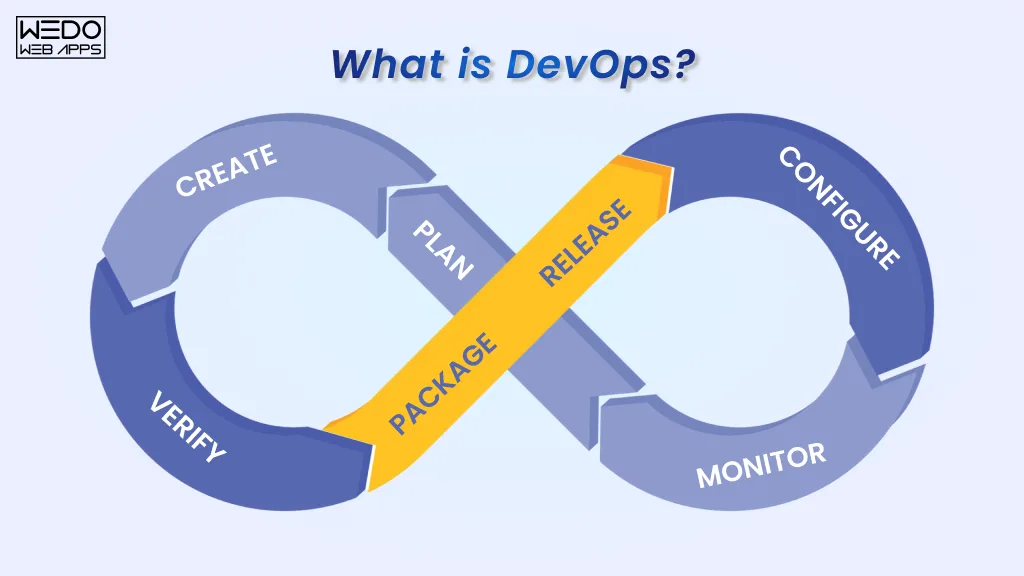
DevOps is a software development and delivery approach that brings development and operations teams together. Instead of working in separate stages, teams collaborate throughout the software lifecycle to build, test, release, and maintain applications more efficiently.
For UK businesses, DevOps creates a structured way to reduce delivery delays, automate repetitive tasks, and respond to changing customer and market requirements.
What Does DevOps Mean?
DevOps combines development and operations. It encourages teams to share responsibility for software quality, performance, security, and reliability.
In a traditional setup, developers may complete an application and hand it over to the operations team for deployment. This separation can create communication gaps, delays, and deployment errors.
With DevOps, teams work together from the beginning. Automation supports repetitive activities, while continuous feedback helps identify and resolve issues earlier.
Example: A UK eCommerce business launching a new checkout feature can use DevOps practices to automate testing, validate code changes, and deploy updates with less manual intervention.
How Does DevOps Work in the Software Development Lifecycle?
DevOps integrates collaboration and automation across key stages of software delivery.
- Planning: Teams define requirements, business goals, and development priorities.
- Development: Developers write and manage code using shared repositories and version control.
- Testing: Automated tests check application functionality, performance, and potential defects.
- Deployment: Approved code moves into production through controlled and repeatable processes.
- Monitoring: Teams track application performance, security signals, and system availability.
- Feedback and improvement: Monitoring data and user feedback guide future updates and improvements.
This continuous cycle helps businesses release improvements regularly instead of relying only on large, infrequent software launches.
What Is the Difference Between DevOps, Agile, and CI/CD?
DevOps, Agile, and CI/CD are connected, but they serve different purposes.
| Approach | Primary focus |
|---|---|
| Agile | Organising development into iterative cycles with regular feedback |
| CI/CD | Automating code integration, testing, and software delivery |
| DevOps | Connecting people, processes, and technology across development and operations |
Agile helps teams adapt to changing requirements. CI/CD supports faster and more consistent delivery through automation. DevOps brings these practices together with operational collaboration, monitoring, security, and shared accountability.
For example, an Agile team may plan a new feature in a sprint, use CI/CD to test and deploy its code, and follow DevOps practices to monitor the feature after release.
Why Is DevOps Important for UK Businesses?
UK businesses are under constant pressure to improve digital experiences, respond to customer expectations, and introduce new products faster. However, disconnected teams, manual processes, and legacy systems can make software delivery slow and difficult to manage.
DevOps helps address these challenges by connecting development, operations, testing, and security throughout the delivery lifecycle.
Supporting Faster Business Adaptation
Customer expectations and market requirements can change quickly. DevOps enables teams to release smaller updates more frequently, helping businesses respond without waiting for lengthy development cycles.
For example, a financial services company could introduce improvements to its customer portal through controlled releases instead of making large changes infrequently.
Improving Operational Efficiency
Manual deployments and repetitive maintenance tasks consume valuable engineering time. Automation helps teams reduce avoidable work and focus on product improvements, innovation, and customer needs.
Businesses can also use performance monitoring and feedback to identify operational problems before they significantly affect users.
Strengthening Digital Transformation
DevOps supports broader digital transformation by creating repeatable processes for developing, deploying, and maintaining software. When combined with a suitable software consulting strategy, it can help businesses align technical improvements with measurable operational goals.
However, DevOps is not simply about adopting more tools. Its value depends on collaboration, clearly defined processes, automation, and continuous improvement.
8 Key Benefits of DevOps for UK Companies
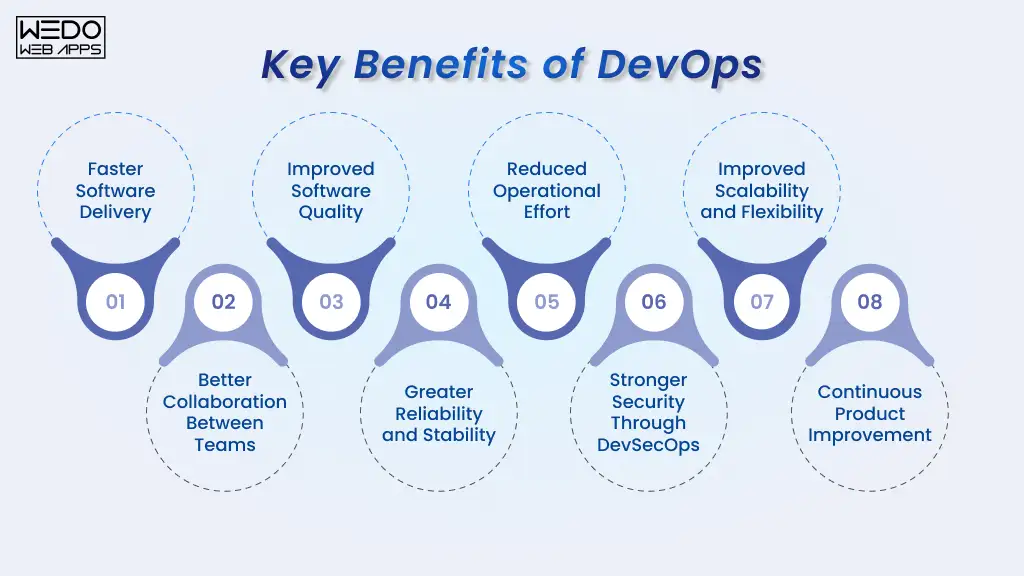
Adopting DevOps can help businesses improve software delivery while creating stronger connections between technical teams and business objectives. The benefits extend beyond faster deployments. When implemented strategically, DevOps can support quality, security, scalability, and long-term operational efficiency.
Here are eight key DevOps benefits for UK companies, with practical examples.
1. Faster Software Delivery
DevOps uses automation and continuous delivery practices to reduce delays between development and deployment. Teams can release updates more frequently without relying on extensive manual processes.
Example: A UK retail business can deploy improvements to its online store faster, helping it respond to seasonal demand and customer feedback.
2. Better Collaboration Between Teams
DevOps encourages developers, operations specialists, testers, and security professionals to share responsibility for delivery outcomes. This reduces communication gaps and makes issue resolution more coordinated.
Example: When an application experiences a performance problem, development and operations teams can investigate it together instead of transferring responsibility between departments.
3. Improved Software Quality
Automated testing helps identify defects earlier in the development lifecycle. Teams can test code changes consistently before they reach production, reducing the risk of avoidable errors.
Example: A healthcare software provider can automate tests for appointment booking workflows before releasing updates to its patient application.
4. Greater Reliability and Stability
Continuous monitoring, automated deployments, and repeatable processes help teams identify problems and maintain more consistent application performance.
Example: A financial services platform can monitor service availability and receive alerts when unusual performance patterns require immediate attention.
5. Reduced Operational Effort
DevOps automation reduces repetitive activities such as manual deployments, environment configuration, and routine testing. This can free technical teams to focus on higher-value work.
The financial impact varies according to the existing infrastructure, toolchain, team structure, and implementation approach.
Example: A growing SaaS company can automate environment setup instead of requiring engineers to configure each development environment manually.
6. Stronger Security Through DevSecOps
DevSecOps integrates security checks into the software delivery lifecycle rather than treating security as a final review. Automated scanning, access controls, and secure development practices can help teams identify risks earlier.
Example: An online payments business can include vulnerability scanning and security checks within its deployment pipeline before releasing application changes.
7. Improved Scalability and Flexibility
DevOps works effectively alongside cloud infrastructure, infrastructure as code, and containerisation. These practices can make it easier to manage changing workloads and support business growth.
Example: An online learning platform can adjust its infrastructure to accommodate increased traffic during examination or enrolment periods.
8. Continuous Product Improvement
DevOps creates feedback loops through monitoring, user insights, and performance data. Teams can use this information to prioritise improvements and address problems after release.
Example: A UK travel booking platform can monitor failed searches and booking errors, then use the findings to improve its customer journey.
The key takeaway: DevOps delivers the greatest value when businesses connect automation with clear goals, measurable performance indicators, and a culture of continuous improvement.
Core DevOps Practices and Tools UK Businesses Should Know
Successful DevOps implementation depends on the right combination of processes, automation, and infrastructure. Your business does not need to adopt every available tool immediately. The technology stack should support your delivery goals, team capabilities, and security requirements.
Here are four core DevOps practices to understand.
1. Continuous Integration and Continuous Delivery (CI/CD)
CI/CD automates code integration, testing, and software delivery. Developers can merge changes regularly, while automated pipelines help validate and release approved updates.
Common tools: GitHub Actions, GitLab CI/CD, Jenkins, and Azure DevOps.
2. Infrastructure as Code (IaC)
Infrastructure as Code allows teams to define and manage infrastructure through configuration files instead of manual setup. This improves consistency and makes environments easier to reproduce.
Common tools: Terraform, AWS CloudFormation, and Ansible.
3. Automated Testing and Monitoring
Automated testing identifies potential defects before deployment. Monitoring and observability tools help teams understand application health, performance, and system behaviour after release.
Common tools: Prometheus, Grafana, Selenium, and Playwright.
4. Containers and Cloud Infrastructure
Containers package applications and their dependencies into portable environments. Cloud platforms provide infrastructure that can be configured and scaled according to business requirements.
Businesses exploring cloud-based DevOps workflows can review suitable cloud computing solutions before selecting their infrastructure approach.
The right combination of tools depends on your application architecture, compliance obligations, existing systems, and operational priorities.
How AI Is Transforming DevOps for UK Businesses
AI is changing how development and operations teams identify problems, automate repetitive tasks, and manage software delivery. For UK businesses, AI-powered DevOps can help teams handle growing application complexity without increasing manual effort at the same pace.
However, AI should support established DevOps processes rather than replace engineering oversight. Businesses still need human validation, security controls, and clear accountability.
1. AI-Assisted Development and Code Reviews
AI tools can help developers generate code suggestions, identify potential defects, and review changes. This can shorten development tasks, but teams should validate AI-generated code for accuracy, security, and maintainability.
2. Intelligent Testing
AI can support test case generation, identify high-risk code changes, and help prioritise testing activities. This allows teams to focus testing efforts where failures could have the greatest business impact.
3. Predictive Monitoring and Anomaly Detection
AI-powered monitoring can analyse application and infrastructure data to identify unusual behaviour. Teams may detect performance degradation or potential incidents earlier, depending on data quality and monitoring configuration.
4. AI-Supported Incident Response
AI can help summarise alerts, identify relationships between system events, and suggest possible troubleshooting steps. Engineers should review recommendations before applying changes, especially in critical production environments.
For businesses exploring AI-enabled workflows, the priority should be measurable outcomes such as shorter resolution times, improved testing coverage, and reduced repetitive work. AI adoption should also account for data protection, access permissions, and the security of development tools.

How to Implement DevOps for UK Businesses
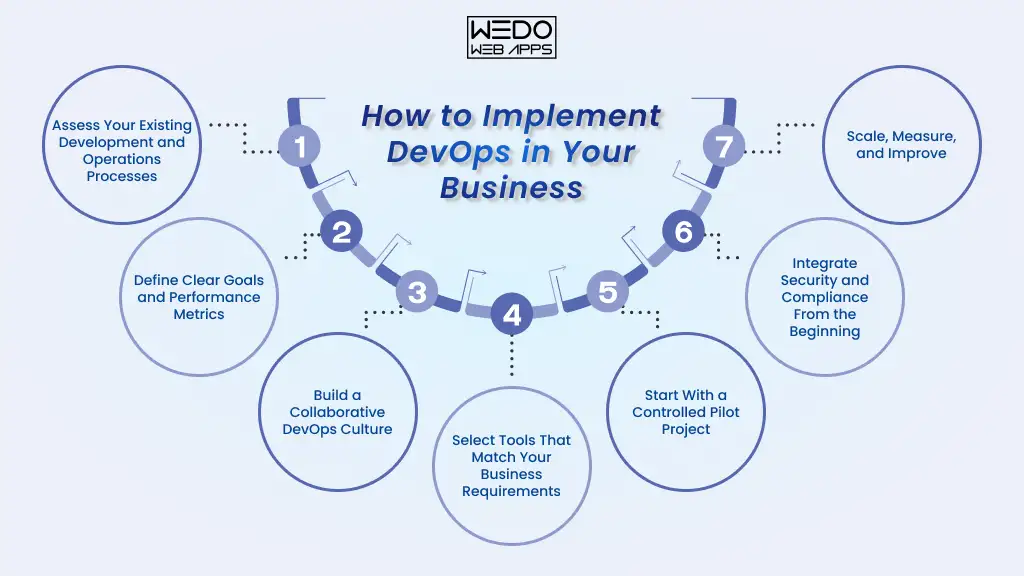
Implementing DevOps requires more than introducing automation tools. Your business needs a clear adoption strategy that connects technical improvements with measurable business outcomes. A phased approach can help your teams manage change while reducing disruption to existing operations.
Follow these steps to plan your DevOps implementation for UK businesses.
1. Assess Your Existing Development and Operations Processes
Review how your teams currently develop, test, deploy, and monitor software. Identify manual tasks, communication gaps, recurring errors, and deployment delays.
What to assess:
- Current software delivery timelines
- Manual testing and deployment activities
- Existing infrastructure and legacy systems
- Security controls and compliance requirements
- Team responsibilities and technical capabilities
This assessment establishes a baseline and helps you identify the areas where DevOps can deliver practical improvements.
2. Define Clear Goals and Performance Metrics
Set objectives before selecting tools or redesigning workflows. Your goals should connect DevOps adoption with business priorities.
Useful metrics may include:
- Deployment frequency
- Lead time for changes
- Deployment failure rate
- Mean time to recovery
- Application availability
- Defect rates after deployment
For example, a business may aim to reduce deployment delays or improve recovery time after production incidents. Establishing a baseline makes progress easier to measure.
3. Build a Collaborative DevOps Culture
DevOps requires collaboration across development, operations, testing, and security teams. Encourage shared ownership instead of measuring each department only against isolated responsibilities.
Regular planning sessions, shared dashboards, and clear escalation processes can improve communication. Leadership should also provide training and allow teams time to adapt to new workflows.
4. Select Tools That Match Your Business Requirements
Choose tools based on your existing technology stack, team expertise, security needs, and budget. Avoid adopting multiple platforms without a clear operational purpose.
Your toolchain may include:
- Version control and collaboration platforms
- CI/CD pipeline tools
- Automated testing frameworks
- Infrastructure as Code solutions
- Monitoring and observability platforms
- Security scanning tools
A DevOps consulting partner can help assess your environment and develop an implementation roadmap aligned with your business objectives.
5. Start With a Controlled Pilot Project
Instead of transforming every application at once, begin with a manageable project. Select an application with clear delivery challenges and a team prepared to participate.
During the pilot, introduce selected practices such as automated testing, continuous integration, and deployment monitoring. Measure the results, document lessons, and address workflow issues before expanding the approach.
6. Integrate Security and Compliance From the Beginning
Security should be part of the development lifecycle rather than a final-stage activity. Review access controls, secrets management, vulnerability scanning, audit requirements, and data protection obligations.
For UK businesses, the appropriate controls will depend on the industry, data handled, contractual requirements, and applicable regulations. DevOps processes should support these obligations without treating compliance as a one-time task.
7. Scale, Measure, and Improve
After validating the pilot, gradually extend DevOps practices to other teams and applications. Review performance metrics regularly and adjust workflows based on operational feedback.
DevOps implementation is an ongoing process. Continuous improvement helps your business maintain delivery quality as applications, infrastructure, and customer expectations evolve.

Common Challenges of DevOps Adoption and How to Overcome Them
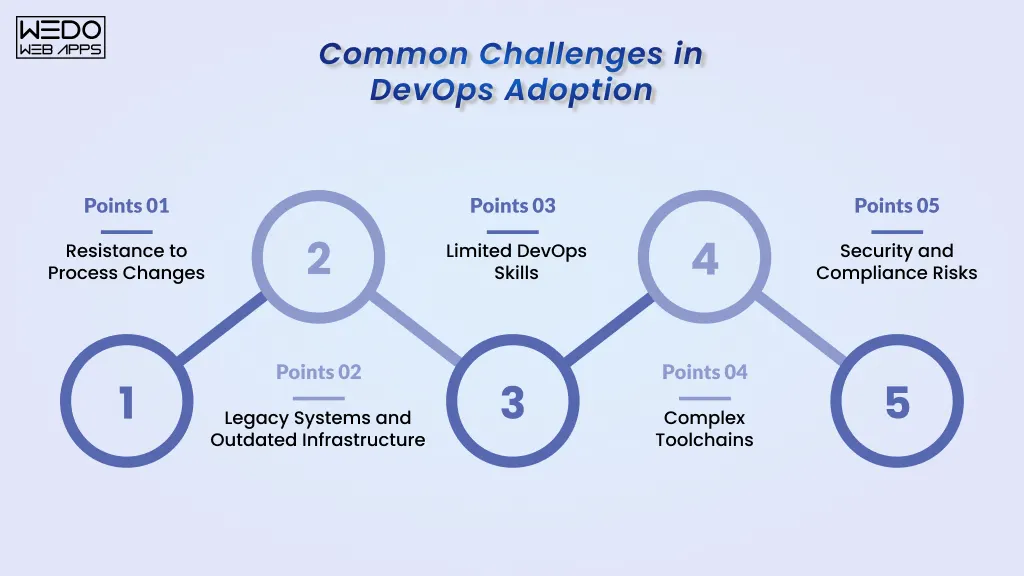
Although DevOps can improve software delivery, adoption may create challenges for businesses with established processes, legacy applications, or limited technical resources. Identifying these barriers early helps you plan a smoother transition.
1. Resistance to Process Changes
Challenge: Employees may be uncomfortable with new responsibilities, automation, or cross-team collaboration.
Solution: Explain the business purpose of DevOps, provide practical training, and introduce changes through manageable pilot projects. Encourage feedback throughout the transition.
2. Legacy Systems and Outdated Infrastructure
Challenge: Older applications may not support modern deployment methods, automated testing, or cloud-native workflows.
Solution: Assess system dependencies before making changes. Modernise components gradually, introduce automation where practical, and avoid disrupting critical business operations.
3. Limited DevOps Skills
Challenge: Your team may lack experience with CI/CD pipelines, infrastructure automation, monitoring, or cloud platforms.
Solution: Identify skill gaps and combine internal training with specialist support when necessary. Create documented processes so knowledge is shared across teams.
4. Complex Toolchains
Challenge: Adopting too many disconnected tools can increase maintenance work, integration issues, and operational confusion.
Solution: Select tools based on specific business requirements. Prioritise interoperability, centralised visibility, and a manageable technology stack.
5. Security and Compliance Risks
Challenge: Faster deployments can introduce security gaps if access controls, vulnerability testing, and approval processes are overlooked.
Solution: Integrate security checks into CI/CD pipelines, manage permissions carefully, and review compliance requirements throughout the software lifecycle.
Key takeaway: Successful DevOps adoption depends on people, processes, and technology working together. A phased strategy helps your business address challenges without treating automation as the only solution.
How Much Does DevOps Implementation Cost in the UK?
The cost of DevOps implementation for UK businesses depends on the size of your organisation, application complexity, existing infrastructure, team capabilities, and level of automation required. There is no fixed cost that applies to every business.
Key Factors That Influence DevOps Costs
- Infrastructure requirements: Cloud services, servers, storage, and networking.
- Tool selection: Licensing, integrations, and maintenance costs.
- Team expertise: Internal training, recruitment, or external consulting support.
- Application complexity: Legacy systems may require additional modernisation work.
- Security and compliance: Testing, monitoring, access controls, and audit requirements.
- Ongoing maintenance: Pipeline management, monitoring, optimisation, and support.
In-House DevOps vs External Support
| Factor | In-house implementation | External DevOps support |
|---|---|---|
| Initial investment | Recruitment, training, and infrastructure | Consulting or project-based fees |
| Technical control | Managed internally | Shared or externally supported |
| Implementation speed | Depends on team availability | May accelerate delivery through specialist expertise |
| Long-term costs | Salaries, tools, and ongoing training | Support fees and internal coordination |
| Best suited for | Businesses with established technical teams | Businesses needing expertise or flexible support |
For an accurate estimate, assess your current environment, implementation goals, and expected ongoing requirements before choosing an approach.
Is DevOps Right for Your UK Business?
DevOps can support businesses that need faster software releases, stronger application reliability, and more efficient development processes. However, its suitability depends on your current challenges, technical environment, and long-term business goals.
Signs Your Business May Benefit From DevOps
Consider exploring DevOps if your business experiences:
- Frequent deployment delays or production errors
- Manual testing and release processes
- Poor communication between development and operations teams
- Difficulty scaling applications during demand spikes
- Limited visibility into application performance
- Repeated security issues during software releases
- Slow response to customer feedback and changing requirements
DevOps can be valuable for startups, SMEs, and larger enterprises, although the implementation approach will differ based on available resources and system complexity.
When Should You Consider DevOps Consulting?
External expertise may be useful when your internal team lacks the experience or capacity to plan and implement DevOps effectively. A suitable consulting partner can assess your current workflows, recommend relevant tools, support automation, and help establish measurable performance goals.
Before selecting a partner, evaluate their experience with your technology stack, security requirements, cloud environment, and business sector. Ask how they will measure results and support your team after implementation.
The objective is not to adopt DevOps because it is popular. It is to build a software delivery process that addresses your specific operational challenges and supports sustainable growth.
Build a More Efficient Software Delivery Process With DevOps
Slow deployments, recurring errors, and disconnected teams can limit your business’s ability to innovate. DevOps helps address these challenges by combining collaboration, automation, continuous testing, and monitoring into a more efficient software delivery process.
For UK businesses, successful DevOps adoption requires a strategy aligned with your technical environment, security requirements, and growth objectives. Whether you are modernising legacy systems or improving existing cloud workflows, a phased implementation can help you achieve sustainable improvements.
Ready to improve your software delivery process?
Partner with experienced professionals to assess your current workflows and develop a DevOps strategy tailored to your business. Explore DevOps Consulting