Introduction
Adding another customer-facing application can expose problems buried in the backend. A mobile app needs the same customer data as the web platform. A partner wants access to selected services. Your CRM needs to exchange data with the product. Then a new integration lands on the roadmap.
Each addition can create another dependency.
For UK businesses scaling digital products, this is where architecture decisions start affecting development speed, integration costs, and the ability to launch new experiences. Teams can spend too much time adapting an existing backend for every new requirement.
API first development UK approaches this problem earlier. The API becomes a planned part of the product architecture, with its contracts, data structures, security, and consumers considered before application development moves too far ahead.
That approach can give businesses a more structured way to connect web applications, mobile products, third-party platforms, and internal systems. But API-first development also introduces decisions around architecture, governance, security, and cost.
So, what does API-first architecture actually involve, and when does it make sense for a UK business or startup? This guide breaks down how the approach works, where it can deliver value, the challenges to consider, and how to decide whether it fits your next digital product.
What is API-First Architecture?
What is API first architecture? It is a development approach where APIs are designed as a core part of the product before the application layers that consume them are built around those interfaces.
The key idea is simple. Teams decide how systems will communicate early in the project. They define the data, operations, responses, authentication requirements, and expected consumer behavior before implementation becomes deeply tied to one application.
That changes how teams plan a digital product.
A web application, mobile app, partner platform, or internal tool can consume the same well-defined API. Development teams can work against an agreed contract rather than repeatedly changing the backend to accommodate every new interface.
API-first vs API-Last Development
The difference becomes clearer when the two approaches are placed side-by-side.
| API-First Development | API-Last Development |
|---|---|
| API requirements are considered early | APIs are often created after application functionality exists |
| API contracts are defined before implementation | API behaviour may develop alongside the application |
| Multiple consumers can be planned from the start | The original application often drives API design |
| Frontend and backend teams can work against agreed contracts | Teams may depend more heavily on each other’s implementation |
| Documentation and governance are considered early | Documentation may be added later |
API-first does not mean building an API and leaving the rest of the product until later. It means treating the API as an important product interface with its own design decisions, documentation, and lifecycle.
What Does an API-First Approach Include?
A well-planned API-first project typically considers:
- API contracts that define how consumers interact with the system
- Data structures that establish consistent request and response formats
- Authentication and authorisation to control access
- Documentation that helps developers understand and use available endpoints
- Versioning to manage future changes without unnecessarily disrupting consumers
- Error handling so applications receive predictable responses
- Testing to verify that the API behaves according to its agreed contract
This planning becomes particularly useful when a business expects its product to serve multiple digital channels.
For example, an eCommerce company might use APIs to connect its website, mobile application, inventory system, payment provider, and fulfillment platform. Each system can communicate through defined interfaces instead of relying on tightly connected application code.
The result is an architecture that can support new consumers without redesigning the entire backend every time the business introduces another digital experience.
How Does API-First Development Work?
API-first development starts with a question that is easy to overlook: who needs to use this API, and what should they be able to do with it?
That question shapes the API before developers begin building the underlying application.
A typical API-first workflow includes the following stages.
1. Identify the API Consumers
Start by mapping every application or system that may need access to the product. These could include:
- Web applications
- Mobile applications
- Internal business tools
- Partner platforms
- Customer portals
- AI applications
- Third-party services
Knowing the consumers early helps teams avoid designing an API around a single interface.
2. Define the API Contract
The team then establishes how consumers will communicate with the system. The contract can define:
- Available endpoints
- Request parameters
- Response structures
- Data types
- Authentication requirements
- Error responses
- Expected behaviours
This gives frontend and backend teams a shared reference before implementation begins.
3. Design and Document the API
API design turns the contract into a structure developers can understand and test.
Teams may use standards such as OpenAPI to document endpoints, parameters, responses, and authentication requirements.
Good documentation also reduces the learning curve when another development team, partner, or internal application needs to consume the API later.
4. Develop Against the Contract
Once the API contract is agreed, different teams can begin their work without waiting for every backend component to be completed.
Frontend developers can build against documented endpoints or mock responses. Backend developers can implement the services behind those endpoints.
This separation can reduce unnecessary dependencies between teams.
5. Test the API Independently
Testing should cover more than whether an endpoint returns a response. Teams need to verify:
- Contract compliance
- Authentication
- Authorisation
- Data Validation
- Error handling
- Performance
- Integration behaviour
Contract testing can also help detect changes that could unexpectedly affect existing consumers.
6. Deploy, Monitor, and Version
An API becomes a long-term product interface once applications depend on it.
That means teams need to monitor usage, identify performance issues, track errors, and manage changes carefully.
Versioning becomes particularly important when different applications depend on different versions of the same API.
This lifecycle is one reason API-first development requires more thought than simply creating endpoints after an application has been built. The API needs to remain understandable, secure, and reliable as the business adds new products, integrations, and consumers.
API-First vs API-Driven vs Microservices: What Is the Difference?
API-first, API-driven development, and microservices often appear together in architecture discussions. They are related, but they describe different things.
Understanding the distinction matters before choosing an architecture for a new product or modernising an existing one.
| Approach | What it describes | Primary focus |
|---|---|---|
| API-first development | A development approach that prioritises API design and contracts early | How APIs are designed and developed |
| API-driven development | An approach where APIs play a central role in connecting applications and services | How systems communicate |
| Microservices architecture | An architecture that divides an application into independently deployable services | How an application is structured |
API-First Development
API-first is primarily about when and how APIs are designed.
The team defines the API contract early and considers its consumers before implementation becomes tightly coupled to a particular application.
A business can follow an API-first approach while still using a traditional monolithic backend.
API-Driven Development
API-driven development puts APIs at the centre of communication between applications, services and systems.
For example, an organisation could use APIs to connect its customer portal with its CRM, payment provider, analytics platform and internal business systems.
The emphasis is on making APIs a dependable connection layer across the technology ecosystem.
Microservices Architecture
Microservices take a different approach.
Instead of organising an application as one large codebase, the system is divided into smaller services that can be developed, deployed, and scaled independently.
Each service may expose APIs, but using microservices is not a requirement for API-first development.
Can You Use API-First Without Microservices?
Yes.
A business can build an API-first monolithic application where a single backend exposes well-designed APIs to multiple consumers.
This can be a practical option for businesses that want the flexibility of API-first development without introducing the operational complexity of managing numerous independent services.
Microservices may become useful as system complexity, team size, or scaling requirements increase. But introducing them simply because a project uses APIs can create unnecessary overhead.
The better approach is to choose the architecture around the product's actual requirements, team capabilities, and expected growth.
Now we move from architecture theory to the business case. This section should answer the question a CTO, founder, or product leader is likely to ask: what does API-first actually change for the business?
What Are the API-Driven Development Benefits for UK Businesses?
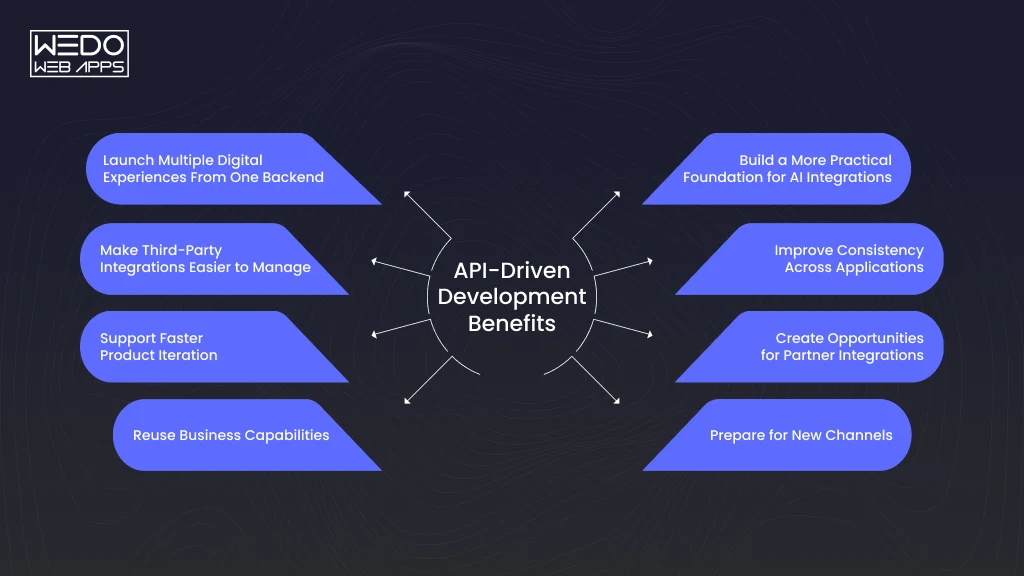
An API architecture becomes valuable when it helps a business connect products, systems, and teams without rebuilding the same functionality repeatedly. For UK businesses expanding their digital operations, that flexibility can affect development timelines, integration work, and future product plans.
Here are the most relevant API driven development benefits to consider.
Launch Multiple Digital Experiences From One Backend
Customers may interact with a business through a website, mobile application, customer portal or another digital channel.
An API-first architecture can allow these interfaces to consume shared backend capabilities.
For example, an online retailer could use APIs to provide product information, customer accounts, stock availability and order tracking across its website and mobile application.
The business can introduce another interface without recreating the underlying business logic from scratch.
Make Third-Party Integrations Easier to Manage
Most modern businesses rely on several external platforms.
A typical technology stack might include:
- CRM software
- Payment services
- Accounting platforms
- Marketing tools
- Shipping providers
- Identity services
- Analytics platforms
APIs provide defined communication points between these systems.
With a planned API architecture, integration requirements can be considered alongside the product instead of becoming a collection of ad hoc connections later.
Support Faster Product Iteration
When frontend applications and backend services communicate through defined APIs, teams have clearer boundaries between their responsibilities.
A mobile team can work with documented API contracts while backend developers build or update the underlying services.
That separation can reduce unnecessary waiting between teams and make parallel development more practical.
Reuse Business Capabilities
Consider a customer profile service.
The same customer information may be required by a website, mobile app, support dashboard and partner portal.
An API can expose the required functionality consistently rather than forcing every application to implement its own version.
This can reduce duplicated business logic and make changes easier to manage.
Prepare for New Channels
Digital products rarely remain limited to their original interface.
A business may later introduce:
- A mobile application
- A partner portal
- A self-service dashboard
- A marketplace integration
- An AI-powered interface
- An internal operations tool
An API-first approach gives those future consumers a defined way to interact with existing services.
That does not guarantee effortless expansion. New consumers still require security reviews, testing and appropriate API design. But the underlying architecture can provide a stronger starting point.
Create Opportunities for Partner Integrations
For SaaS companies, marketplaces and platform businesses, integrations can become part of the product itself.
A well-documented API can allow approved partners or customers to connect their systems to specific business capabilities.
This can support integration-led products without giving external consumers direct access to internal application code.
Improve Consistency Across Applications
When multiple applications use shared APIs, business rules can be managed closer to the service layer.
For example, an order API can apply the same validation and processing rules whether an order comes from a website, mobile application or partner platform.
That consistency becomes increasingly important as a business adds more digital touchpoints.
Build a More Practical Foundation for AI Integrations
AI applications often need controlled access to business data or specific system capabilities.
Well-designed APIs can provide that access through defined interfaces rather than exposing internal systems directly.
For example, an AI assistant could use authorised APIs to retrieve order information or initiate an approved workflow.
However, API-first architecture does not automatically make a business AI-ready. Data quality, permissions, security, system design and governance still need to be addressed.
For UK businesses, that distinction matters. The value of API-first development comes from creating well-defined, reusable, and governed interfaces that support current products while giving future applications a clearer way to connect.

What are the Advantages of an API-First Approach for UK Startups?
Startups rarely know exactly which product direction they will take two years from now. A feature that begins as a web application may later need a mobile experience, customer portal, partner integration, or new revenue channel.
That uncertainty makes early architecture decisions important.
The advantages of API first approach for UK startups become particularly relevant when a product is expected to expand beyond a single application.
Build an MVP Without Locking the Product to One Interface
An MVP needs to prove a business idea quickly. But the first interface should not necessarily dictate how the entire backend is structured.
With API-first development, the startup can define core capabilities through APIs while building the initial product around them.
If the product later needs another interface, the existing API layer can provide a starting point.
Add Mobile Experiences When the Product Gains Traction
A startup may launch with a responsive web application to validate demand.
Once customers adopt the product, a native or cross-platform mobile app may become commercially useful.
If the core functionality already sits behind well-designed APIs, the mobile application can consume those services instead of requiring an entirely separate backend.
Connect SaaS Tools Without Rebuilding the Core Product
Startups often rely on external platforms for payments, CRM, email, analytics, identity, and other functions.
An API-oriented architecture can make these integrations easier to organise and replace when requirements change.
This is particularly useful when a startup is testing different vendors during its early stages.
Give Development Teams Clearer Boundaries
Small teams often have developers handling several parts of the product.
Clearly defined APIs establish boundaries between the frontend, backend, and connected services.
This makes responsibilities easier to divide and lets developers work on different parts of the product with fewer direct dependencies.
Create a Foundation for Product Expansion
A startup might eventually offer:
- Customer-facing applications
- Partner integrations
- Developer APIs
- Mobile products
- Internal dashboards
- AI-powered features
API-first development can provide a common interface for these consumers.
The important point is not to build every possible API from day one. Startups should design around genuine product requirements and expected use cases rather than creating infrastructure for hypothetical demand.
Support Integration-Led Growth
For some startups, integrations are central to acquiring and retaining customers.
A SaaS platform, for example, may become more useful when customers can connect it with their existing CRM, accounting, or operational software.
A well-designed API can make those connections part of the product strategy rather than an afterthought.
When Should a UK Startup Consider API-First?
API-first development deserves stronger consideration when a startup expects:
- Multiple customer-facing applications
- Significant third-party integrations
- A SaaS or platform business model
- Partner or developer access
- Rapid product expansion
- AI or automation features requiring controlled system access
For a small product with one interface, few integrations, and limited growth requirements, a full API-first strategy may introduce more planning than the project needs.
The right question is not whether every startup should use API-first development. It is whether the product’s future consumers and integration requirements justify designing the API layer early.
API-First Use Cases Across UK Industries
The value of API-first development becomes easier to understand when you look at how businesses actually operate. A retailer may need to connect inventory with its storefront. A fintech company may need several services to exchange financial data. A healthcare platform may need different applications to access the same patient-facing services.
The architecture behind those connections matters.
Here are some practical API-first use cases across UK industries:
FinTech and Financial Services
Financial products often depend on multiple systems working together.
APIs can connect banking services, payment platforms, identity providers, financial data services and customer applications.
For example, a fintech platform could expose controlled APIs for account information or transaction data while keeping sensitive internal systems protected behind defined access layers.
Security, authentication, authorisation and auditability need to be considered from the beginning.
Retail and eCommerce
An online retailer may have far more systems behind its storefront than customers ever see.
Product information, inventory, customer accounts, payments, promotions, fulfilment and order tracking may all sit across different services.
An API-first approach can provide a consistent communication layer between these systems.
It can also support multiple customer experiences, such as:
- eCommerce websites
- Mobile shopping applications
- Customer account portals
- Marketplace integrations
- In-store systems
This becomes particularly useful when retailers expand into new sales channels.
Healthcare
Healthcare platforms often need to connect several digital services while handling sensitive information carefully.
An appointment platform, for example, may need to communicate with patient portals, booking systems, notifications and other healthcare applications.
APIs can provide controlled interfaces between these systems.
However, healthcare organisations need to consider data protection, access permissions, audit trails and interoperability requirements alongside API design.
Logistics and Transportation
Logistics businesses manage information across multiple stages of a shipment.
Tracking systems, fleet management, warehouse operations, customer portals and delivery platforms may all need access to different parts of the same data.
APIs can allow these systems to exchange information without requiring every application to understand how the underlying systems work.
A customer portal could retrieve delivery status through an API while an internal operations platform accesses the same underlying service for a different purpose.
SaaS Businesses
SaaS companies are among the clearest use cases for API-first development.
Customers often expect software to work with the tools they already use.
A SaaS platform may need integrations with:
- CRM systems
- Accounting software
- Project management tools
- Communication platforms
- Analytics systems
- Identity providers
A well-designed API can become part of the product itself, allowing customers and approved partners to build integrations around defined capabilities.
Professional Services
Professional services businesses can also benefit from connected digital systems.
A client portal may need information from CRM, document management, billing, and scheduling platforms. Instead of creating separate connections for every interface, APIs can provide defined ways for these systems to exchange information.
For a growing UK business, this can make it easier to add new client-facing features without redesigning every connected system.
Across these industries, the underlying principle remains similar: the API becomes a controlled connection point between business capabilities and the applications that need them.
The exact architecture should still reflect the organisation's systems, security requirements, development capabilities, and expected scale.
What Does a Practical API-First Architecture Look Like?
API-first development needs more than a collection of endpoints. The surrounding architecture determines how securely those APIs expose business capabilities and how reliably applications can consume them.
A typical API-first platform may follow this structure:
Frontend -> API Gateway -> API/Application Layer -> Business Logic -> Databases & Services -> Third-Party Systems
Each layer has a specific role.
API Gateway
The API gateway acts as an entry point for API requests.
It can handle responsibilities such as:
- Request routing
- Authentication
- Rate limiting
- Traffic management
- Logging
- Access policies
For businesses with several APIs and consumers, a gateway can provide a central point for managing traffic and security policies.
API and Application Layer
This layer exposes the capabilities that applications need.
For example, an eCommerce platform might provide APIs for:
- Products
- Customer accounts
- Shopping carts
- Orders
- Payments
- Inventory
The API layer should expose useful business capabilities without unnecessarily revealing internal implementation details.
Authentication and Authorisation
Not every consumer should have access to every API operation.
Authentication establishes who or what is making a request. Authorisation determines what that consumer is permitted to access.
Depending on the application, teams may use approaches such as OAuth 2.0, OpenID Connect, API keys, or token-based authentication.
The right mechanism depends on the type of consumer and the sensitivity of the data involved.
Business Logic Layer
Business rules should remain behind the API rather than being duplicated across every frontend.
For example, an order service might determine whether an order can be cancelled based on its payment status, fulfilment stage and other business rules.
A website and mobile application can then rely on the same underlying logic.
Databases and Internal Services
The API layer communicates with databases and other internal services to retrieve or process information.
The API should control how that information is exposed.
Consumers generally should not need direct access to internal databases.
Third-Party Systems
Many applications depend on external services for payments, messaging, identity, analytics and other functions.
APIs can act as the communication layer between these services and the core application.
A clear integration boundary also makes it easier to monitor external dependencies and replace providers when business requirements change.
Monitoring and Observability
Once multiple applications depend on APIs, visibility becomes essential.
Teams should be able to identify:
- Failed requests
- Slow endpoints
- Unusual traffic
- Authentication failures
- Dependency problems
- Changes in API usage
Logs, metrics and tracing can help developers identify problems before they affect a wider set of consumers.
The goal is not to build the most complicated architecture possible. A smaller UK startup may need only a well-structured application and API layer, while a larger organisation may require gateways, dedicated services, multiple environments and more advanced infrastructure.
API-first architecture should grow with the product rather than forcing unnecessary complexity from day one.
Which Technologies Can Power an API-First Platform?
There is no single technology stack that makes an API-first architecture successful. The right choice depends on the product, expected traffic, integration requirements, development team’s expertise, and long-term maintenance needs.
For a UK business, the technology decision should follow the architecture and business requirements rather than the other way around.
Backend Frameworks
Popular backend options include Node.js, Python, Java, and .NET.
Each can support API-first development, but their strengths differ.
| Technology | Common Strengths | Suitable Use Cases |
|---|---|---|
| NodeJS | Event-driven processing, large ecosystem, real-time capabilities | Web platforms, real-time applications, integration-heavy products |
| Python | Rapid development, strong data and AI ecosystem | Data-driven applications, AI services, automation and APIs |
| Java | Mature ecosystem, enterprise tooling, strong performance | Large enterprise systems and complex backend platforms |
| .NET | Microsoft ecosystem, enterprise capabilities, strong tooling | Business applications and organisations using Microsoft technologies |
The choice should also consider the team’s existing skills. A technically suitable framework can still create unnecessary costs if the business cannot maintain it effectively.
REST APIs
REST remains a common choice for web and mobile applications.
It uses familiar HTTP methods and resource-oriented patterns, making it relatively simple for teams to understand, document, and consume.
REST can be a practical option when applications need predictable access to business resources such as customers, orders, products, or accounts.
GraphQL
GraphQL allows clients to request the specific data they need through a defined schema.
This can be useful when different consumers require different combinations of data.
For example, a mobile application with limited bandwidth may need a smaller response than a desktop web application.
GraphQL can provide flexibility, but it also introduces additional considerations around caching, query complexity, security, and monitoring.
gRPC
gRPC is designed for high-performance communication between services.
It can be particularly useful for internal service-to-service communication where performance and strongly defined contracts are important.
It is less commonly used as the primary interface for public-facing web APIs, where REST or GraphQL may be easier for external consumers to adopt.
OpenAPI and API Documentation
Technology is only one part of API design.
Documentation is equally important when multiple developers, teams, or external partners need to consume an API.
OpenAPI provides a standard way to describe API endpoints, parameters, responses, and authentication requirements.
Good documentation can make onboarding easier and reduce confusion when an API evolves.
API Management and Gateway Technologies
As the number of APIs grows, businesses may need dedicated API management capabilities.
These can support:
- Access control
- Rate limiting
- Analytics
- Traffic management
- API versioning
- Developer portals
- Monitoring
A smaller application may not need a complex API management platform immediately.
The technology stack should remain proportional to the product’s actual requirements.
The strongest API-first architecture is rarely the one with the most tools. It is the one where the API design, backend technology, infrastructure, and governance work together around clear business requirements.
Node.js for API-First Architecture
Node.js is a common choice for teams building API-first applications, particularly when the product needs to handle frequent requests, real-time interactions or several external integrations.
Its event-driven, non-blocking architecture allows Node.js applications to handle many concurrent operations without creating a separate thread for every request. This can make it a practical option for applications where responsiveness and efficient I/O handling are important.
Why Does Node.js Work Well With API-First Development?
Several characteristics make Node.js useful for API-heavy products.
- Strong support for HTTP and web services makes API development straightforward.
- A large npm ecosystem provides libraries for authentication, databases, validation, and integrations.
- JavaScript across the stack can allow teams to use a common language across frontend and backend development.
- Real-time capabilities make it suitable for applications involving live updates, messaging, and notifications.
- Scalable application patterns can support products as API traffic increases.
Node.js can also be useful when a business expects its API layer to connect several external services.
For example, a SaaS platform could use Node.js APIs to connect its customer-facing application with payment services, CRM systems, notification providers, and internal databases.
When Should a Business Consider Node.js?
Node.js can be a strong candidate when the application involves:
- Real-time communication
- High volumes of API requests
- Multiple third-party integrations
- Lightweight and responsive services
- JavaScript-based development teams
- Rapid product development
It is not automatically the right choice for every API-first project.
A business dealing with highly specialised workloads, established enterprise systems or a team with deep expertise in another backend ecosystem may have good reasons to choose Java, Python or .NET instead.
For businesses evaluating Node.js for an API-first architecture approach, the decision should come down to workload, team capability, performance requirements, and the wider technology ecosystem rather than framework popularity alone.
What Role Does Cloud Infrastructure Play in API-First Platforms?
API-first development can run on traditional infrastructure, but cloud services can make it easier to manage changing workloads, distributed applications, and growing numbers of API consumers.
For UK businesses, the right cloud infrastructure for API-first platforms depends on traffic patterns, security requirements, application complexity, and operational capabilities.
API Gateways
Cloud-based API gateways can provide a controlled entry point for API traffic.
They can help with:
- Request routing
- Authentication
- Rate limiting
- Traffic control
- Monitoring
- Access policies
This becomes useful when a platform exposes several APIs to different applications or external consumers.
Containers and Managed Services
Containers can package API applications with their dependencies, making deployments more consistent across environments.
Managed cloud services can also reduce the operational work involved in running databases, messaging systems, caching layers and other supporting components.
The business can choose how much infrastructure it wants its development team to manage directly.
Serverless APIs
Serverless functions can be useful for specific API workloads, particularly when traffic is variable or certain operations run intermittently.
For example, a business might use serverless functions for webhook processing, background tasks or lightweight API operations.
However, serverless is not automatically better. Cold starts, execution limits, observability and vendor dependencies should be considered before choosing this model.
Scaling API Workloads
Cloud platforms can provide infrastructure that scales as API demand changes.
A growing application may need additional compute capacity during peak periods, while a smaller workload may benefit from more modest infrastructure.
Scaling should be based on actual traffic and performance data rather than assumptions about future demand.
Monitoring and Reliability
Cloud infrastructure can provide tools for monitoring API performance, infrastructure health and application errors.
Teams should track metrics such as:
- Response times
- Error rates
- Request volumes
- Resource utilisation
- Dependency failures
These signals help developers identify bottlenecks and investigate issues affecting API consumers.
Does API-First Require Cloud Infrastructure?
No.
An API-first application can run on dedicated servers, private infrastructure, hybrid environments or public cloud platforms.
The important distinction is that API-first describes how the application interfaces are designed, while cloud computing describes where and how the application infrastructure is operated.
For a UK business, combining the two can provide useful flexibility, but the architecture should reflect actual technical and commercial requirements rather than adding cloud services simply because they are available.
What API Security Considerations Should UK Businesses Address?
An API can become a valuable access point to business data and application functionality. That also makes it an important security boundary.
A weakly protected endpoint can expose customer information, allow unauthorised actions or create a route into connected systems. Security therefore needs to be considered during API design, not added as a final development task.
Authentication and Authorisation
Authentication verifies the identity of the API consumer.
Authorisation determines what that consumer is allowed to access or do.
These controls should be designed around the type of consumer. A customer-facing application, internal service, and external partner may require different permissions.
Technologies such as OAuth 2.0 and OpenID Connect can support secure authentication and delegated access where appropriate.
Encrypt Data in Transit
API communication should use secure transport protocols such as HTTPS to protect information while it moves between systems.
For sensitive applications, teams should also consider how data is handled beyond the network connection, including storage, logging, and internal service communication.
Apply Least-Privilege Access
An API consumer should receive only the permissions it actually needs.
For example, a reporting service that only reads sales information should not have permission to modify customer accounts or delete orders.
This reduces the potential impact if credentials are compromised.
Validate Requests and Responses
APIs should validate incoming data before processing it.
Validation can help prevent:
- Unexpected data formats
- Invalid parameters
- Malicious input
- Unauthorised operations
- Application errors caused by malformed requests
Output handling matters too. APIs should expose only the information the consumer needs rather than returning unnecessary internal or sensitive data.
Use Rate Limiting and Abuse Protection
An API may receive legitimate traffic as well as excessive or malicious requests.
Rate limiting can restrict how frequently a consumer can make requests within a defined period.
Additional controls may include traffic monitoring, throttling and automated blocking where appropriate.
These measures can help protect availability and reduce abuse.
Monitor API Activity
Security teams need visibility into how APIs are being used.
Monitoring can help identify:
- Repeated authentication failures
- Unusual request patterns
- Unexpected geographic activity
- Sudden traffic spikes
- Access to sensitive endpoints
- Repeated failed requests
Logs should also be handled carefully so that sensitive credentials or personal information are not unnecessarily exposed.
Consider UK Data Protection Requirements
UK businesses handling personal data need to consider applicable data protection obligations when designing API-based systems.
That means thinking about data access, retention, security controls, processing responsibilities and where information is stored or transferred.
API architecture does not itself make an organisation compliant. Compliance depends on how the wider system is designed, operated and governed.
Test APIs Before Production
Security testing should form part of the API development lifecycle.
Depending on the application, this may include:
- Authentication testing
- Authorisation testing
- Input validation testing
- API penetration testing
- Dependency testing
- Automated security checks
A secure API-first strategy therefore combines strong API design with appropriate access controls, testing, monitoring and ongoing governance.
Why Do API Versioning and Governance Matter as Your Business Grows?
An API may begin with a handful of endpoints and a single application consuming them. As the product grows, more consumers can start depending on those same interfaces.
A change that looks minor to one development team could then break another application.
That is why API versioning and governance need to be considered early, particularly when an API will serve external partners or multiple internal products.
API Versioning
Versioning provides a structured way to introduce changes without unexpectedly disrupting existing consumers.
For example, a business may maintain an existing API version while introducing a newer version with updated response structures or functionality.
Common approaches include:
- URL-based versioning
- Header-based versioning
- Content negotiation
The right approach depends on the API ecosystem and how consumers are managed.
Backward Compatibility
Not every API change requires a new version.
Adding a new optional field may be relatively low risk, while removing an existing field or changing its meaning can break applications that already depend on it.
Teams should therefore assess how each change affects existing consumers before deployment.
API Deprecation
Older API versions eventually need to be retired.
A sensible deprecation process can include:
- Announcing the planned change
- Documenting migration requirements
- Giving consumers sufficient transition time
- Monitoring usage of the older version
- Retiring it once dependencies have moved
This becomes particularly important when external customers or partners consume the API.
API Governance
Governance establishes shared rules for designing and managing APIs.
It can cover:
- Naming conventions
- Authentication standards
- Documentation requirements
- Error formats
- Versioning policies
- Security controls
- Ownership
- Testing standards
Without these rules, a growing API ecosystem can become inconsistent.
One team might use different naming conventions from another. Error responses may vary between services. Authentication approaches can become fragmented.
That inconsistency makes APIs harder to maintain and consume.
API Ownership
Every important API should have clear ownership.
The responsible team should know who maintains it, who approves changes and who handles incidents.
This becomes especially important when APIs support several business-critical applications.
Documentation as Part of Governance
Documentation should evolve alongside the API.
A consumer needs to understand:
- What an endpoint does
- What data it accepts
- What it returns
- Which permissions are required
- What errors can occur
- Which API version they should use
Keeping this information current can reduce integration delays and support requests.
Why Governance Matters for UK Businesses
For a small application, governance may seem like overhead.
For a growing platform, it can prevent technical decisions from becoming inconsistent across teams and products.
The goal is not to create layers of bureaucracy. It is to establish enough shared standards to keep APIs secure, predictable, and maintainable as more consumers depend on them.
What Are the Challenges of API-First Development?
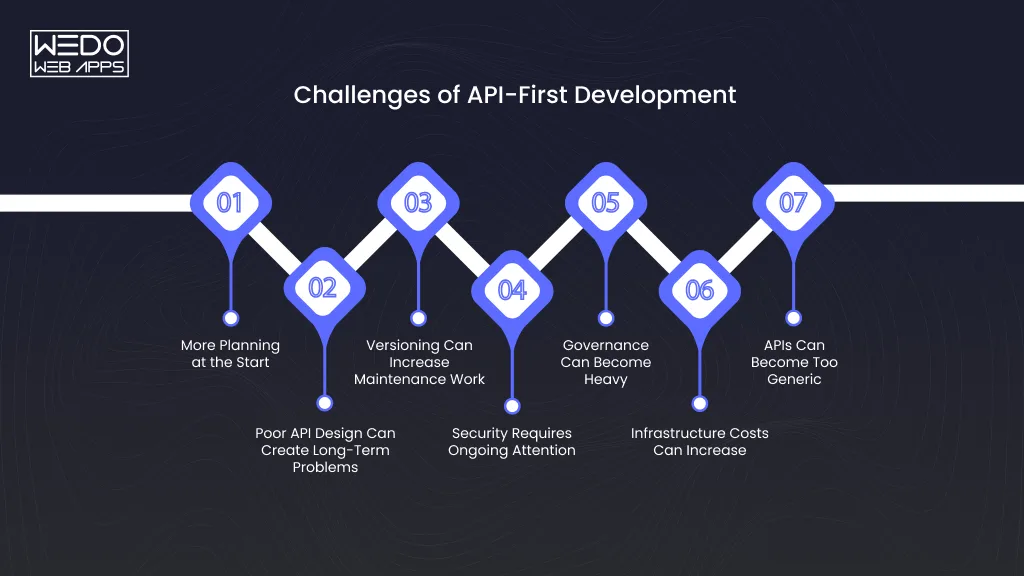
API-first development can give businesses a stronger foundation for connected digital products, but it also introduces additional planning and technical responsibilities.
For a UK business, the main challenge is usually not creating an API. It is designing APIs that remain useful as the product, customer base and integration requirements grow.
More Planning at the Start
API-first development requires teams to think about consumers, data structures, authentication, documentation, and contracts before implementation moves too far ahead.
That planning can add time to the early stages of a project.
For products with well-understood requirements, this can be worthwhile. For an experimental MVP where requirements change every few days, excessive API design can slow down learning.
Poor API Design Can Create Long-Term Problems
An API can technically work while still being difficult to use.
Inconsistent naming, unclear responses, complicated authentication flows or poorly structured resources can create friction for every team that consumes the API.
The cost becomes larger as more applications depend on the same interface.
Versioning Can Increase Maintenance Work
Supporting multiple API versions means maintaining compatibility for different consumers.
An organisation may need to operate an older version while partners and internal applications migrate to a newer one.
Without a clear lifecycle and deprecation policy, old versions can remain active far longer than intended.
Security Requires Ongoing Attention
APIs expose business capabilities and data to applications, users and potentially external partners.
Security therefore needs to cover more than authentication.
Teams must consider authorisation, input validation, rate limiting, access controls, monitoring, secrets management and regular security testing.
A vulnerability in a widely used API can affect several connected applications at once.
Governance Can Become Heavy
As API ecosystems grow, businesses may introduce standards for naming, documentation, testing, approval, and release processes.
These standards can improve consistency, but overly rigid governance can slow development.
The goal should be to establish practical rules that protect security and reliability without creating unnecessary approval steps.
Infrastructure Costs Can Increase
A growing API platform may require API gateways, monitoring tools, logging, security controls, cloud services, and additional environments.
These costs need to be considered alongside development and maintenance.
API-first development itself does not require an expensive cloud architecture. The infrastructure should match actual traffic, reliability requirements, and business needs.
APIs Can Become Too Generic
There is also a risk of designing APIs for hypothetical future requirements.
A team may create complex endpoints because they expect future applications, partners or integrations that may never materialise.
That adds complexity without creating immediate business value.
A better approach is to design APIs around known consumers and credible future requirements, then evolve them as the product gains real usage.
The Key Is Proportionate Architecture
API-first development works best when the architecture reflects the scale and direction of the business.
Next, let’s move into the decision point: when API-first actually makes commercial and technical sense for a UK business, rather than treating it as a default architecture for every project.
When Should a UK Business Choose API-First Development?
API-first development makes the most sense when a business expects its product to serve multiple applications, systems, or external consumers.
A simple website with limited functionality may not need a dedicated API strategy. But once a business starts connecting mobile apps, customer portals, partner platforms, internal systems or third-party services, the value of a well-designed API layer becomes more significant.
Choose API-First When Multiple Applications Share the Same Data
If customers can interact with the business through a website, mobile application and customer portal, those interfaces may need access to the same products, accounts, orders or services.
An API-first architecture can provide a common interface for these applications.
This reduces the need to build separate backend logic for every channel.
Choose It When Integrations Are Part of the Product Strategy
Some businesses depend heavily on integrations with other platforms.
A SaaS company may need connections with accounting software, CRM platforms, payment providers or communication tools.
A marketplace may need APIs for sellers, logistics providers and payment services.
When integrations are central to the product, designing the API layer early can make those connections easier to manage.
Choose It When You Expect Mobile Expansion
A UK business may initially launch with a web application and introduce a mobile product later.
If the core business capabilities are already exposed through well-designed APIs, the mobile application can consume those services rather than requiring a separate backend implementation.
This can make future channel expansion more predictable.
Choose It When Partners Need Controlled Access
Businesses working with partners may need to expose selected capabilities or data without giving direct access to internal systems.
An API provides a controlled boundary for that interaction.
Access permissions, authentication, rate limits and monitoring can be applied to the interface rather than exposing internal infrastructure directly.
Choose It When You Are Building a Platform
API-first development is particularly relevant for businesses creating platforms rather than single-purpose applications.
Examples include:
- SaaS platforms
- Marketplaces
- FinTech products
- Logistics platforms
- Booking systems
- B2B platforms
- Developer-focused products
These products often have several consumers and integration requirements from the beginning.
When API-First May Not Be Necessary
API-first development is not automatically the right choice for every project.
A small internal application with one user interface, limited integrations and stable requirements may not benefit enough to justify extensive API planning and governance.
In these situations, a simpler architecture may be more practical.
The decision should depend on the product roadmap, not the popularity of the architecture.
A Simple Decision Framework
Before choosing API-first development, ask:
| Business requirement | API-first relevance |
|---|---|
| One simple application | May not be necessary |
| Web and mobile applications | Strong consideration |
| Multiple third-party integrations | Strong consideration |
| Partner or developer access | Strong consideration |
| SaaS or platform product | Highly relevant |
| Rapidly expanding digital channels | Highly relevant |
| Small internal tool with limited integrations | Potentially unnecessary |
For UK businesses, the strongest case for API-first development usually appears when multiple consumers need reliable access to shared business capabilities.
The architecture should support the direction of the product without introducing complexity that the business does not yet need.
How Much Does API-First Development Cost in the UK?
The cost of API-first development in the UK depends on the product scope, number of integrations, API complexity, security requirements, technology stack, and development team involved.
There is no useful single price for every API-first project. A small SaaS product with a few core resources requires a very different architecture from a platform connecting mobile apps, enterprise systems, and external partners.
What Affects API-First Development Costs?
Several factors can influence the overall project budget:
| Cost factor | Why it matters |
|---|---|
| API complexity | More business rules and resources require more design and development |
| Number of integrations | Third-party systems increase development and testing requirements |
| Authentication | Advanced access and identity requirements add implementation work |
| Security | Sensitive data requires stronger controls and testing |
| Documentation | External APIs require detailed developer documentation |
| Testing | Contract, integration, security, and performance testing add effort |
| Infrastructure | Gateways, cloud services, monitoring and logging affect running costs |
| Versioning | Supporting multiple API versions increases maintenance requirements |
| Team expertise | Experienced API developers can reduce architectural and implementation risks |
Development Is Only Part of the Cost
Businesses should also consider the ongoing cost of maintaining the API.
New product features may require API changes. Third-party integrations can change. Security requirements can evolve. Older API versions may eventually need to be deprecated.
That means the business should budget for monitoring, maintenance, testing and improvements rather than treating API development as a one-time expense.
How Can Businesses Control API-First Development Costs?
Start with the APIs required by real product requirements.
Avoid designing dozens of endpoints for hypothetical future consumers. Use established standards where appropriate. Automate testing and documentation where possible.
A phased approach can also help.
For example, the first release could expose the core customer, product, and transaction capabilities. Additional partner APIs or advanced integrations can be introduced when there is a clear business requirement.
This keeps the initial architecture focused while leaving room for future growth.
How to Implement an API-First Strategy Without Overengineering
API-first development does not mean building a large API platform before launching the product.
The better approach is to introduce enough structure to support the business while keeping the architecture proportionate to current requirements.
Start With Business Capabilities
Identify what the product actually needs to do.
For an eCommerce platform, this could include:
- Customer accounts
- Product catalogue
- Inventory
- Cart management
- Orders
- Payments
- Delivery
- Notifications
These capabilities provide a more useful starting point than choosing technologies first.
Identify the API Consumers
List the applications and systems that need access to those capabilities.
This could include a website, mobile app, internal dashboard, partner platform, or third-party service.
Understanding the consumers helps determine authentication, response formats, permissions, and performance requirements.
Define a Small Initial API Contract
Create contracts around the functionality required for the first release.
Document:
- Endpoints
- Request parameters
- Response structures
- Authentication
- Error responses
- Data types
- Validation rules
This creates a shared reference for frontend and backend development.
Build for Real Requirements
Avoid creating an elaborate architecture because the product might eventually become a large platform.
Use the simplest architecture that can support the expected requirements.
A modular monolith with a well-designed API can be a sensible starting point. Microservices can be introduced later if operational or scaling requirements justify them.
Automate Testing and Documentation
API documentation should stay aligned with implementation.
Automated contract and integration testing can also reduce the risk of changes breaking existing consumers.
The earlier these practices are introduced, the easier they become to maintain as the API grows.
Monitor Usage After Launch
Once the API is being used, real traffic provides information that assumptions cannot.
Monitor:
- Request volume
- Response times
- Error rates
- Authentication failures
- Frequently used endpoints
- Deprecated API usage
- Third-party dependency failures
This information can guide future architecture decisions.
How to Choose an API-First Development Partner in the UK
The development partner you choose can influence how well the API architecture supports the product over time.
Instead of evaluating a provider only on development rates, look at its approach to architecture, security, testing, and long-term maintenance.
Check Relevant API Experience
Ask whether the development team has built APIs for products with similar requirements.
Experience with SaaS platforms, mobile applications, marketplaces, integrations or partner APIs can be particularly useful when those requirements match your product.
Ask How They Approach API Design
A capable partner should be able to explain how they handle:
- API contracts
- Documentation
- Authentication
- Authorisation
- Error handling
- Versioning
- Testing
- Monitoring
- Deprecation
The conversation should go beyond simply listing technologies.
Review Their Integration Experience
If your product depends on third-party platforms, ask how the team approaches external integrations.
They should understand that an integration is more than connecting two endpoints. It also involves authentication, failure handling, data mapping, retries, monitoring and changes to the external service.
Discuss Security Early
Security should be considered during API design rather than added after development.
Ask how the partner handles access control, sensitive data, request validation, rate limiting, secrets, and security testing.
Evaluate Documentation Practices
Good API documentation helps developers understand how to use the system without repeatedly relying on the original development team.
Ask to see examples of API documentation or understand how API contracts are maintained throughout development.
Consider Long-Term Support
An API can remain part of your product for years.
Discuss how the development partner handles maintenance, upgrades, performance optimisation, security updates, and new API versions after launch.
For businesses searching for a web app development company UK, API architecture should be one of the technical areas discussed during the evaluation process, especially if the product will have multiple digital consumers.

Is API-First Development Right for Your UK Business?
API-first development can be a practical architecture choice when a business expects its digital product to connect multiple applications, systems, partners or services.
The value comes from creating clear and reusable interfaces around business capabilities.
For a growing UK business, that can make it easier to introduce mobile applications, connect third-party platforms, support partner integrations and expand into new digital channels without rebuilding the backend for every new requirement.
But API-first should not become an architectural exercise for its own sake.
A small product with limited integrations may need a simpler approach. A growing SaaS platform, marketplace, FinTech product or connected digital service may have stronger reasons to establish API contracts early.
The right starting point is your product roadmap, not the technology trend.
If your business is planning a new digital product or dealing with complex integrations, an experienced development partner can help assess whether an API-first architecture fits your requirements, budget, and growth plans.