Introduction
Building a SaaS product does not always mean creating a large platform with dozens of features, a big development team, and years of investment. For many UK entrepreneurs, a more focused approach can make more sense. Instead of trying to serve everyone, you can build software that solves one specific problem for a clearly defined group of customers.
That is where micro-SaaS comes in. A micro-SaaS product focuses on a narrow use case, a lean feature set, and a specific customer segment while generating recurring revenue through subscriptions or similar models. This makes the model particularly relevant for entrepreneurs exploring a micro SaaS product UK businesses can adopt without the complexity of a large-scale SaaS platform.
But having a promising idea is only the beginning. You need to determine whether customers actually need it, validate the business model, define the right MVP, select an appropriate technology stack, and build a product that can evolve as your customer base grows.
This guide explains what is micro SaaS, how the model works, where UK entrepreneurs can find viable opportunities, and how to build a micro SaaS product from idea validation through launch and growth.
What is Micro-SaaS?
What is Micro-SaaS Explained in Simple Terms?
Micro-SaaS is a small, focused software-as-a-service product built to solve a specific problem for a defined group of customers. Unlike traditional SaaS platforms that often target broad markets with extensive feature sets, micro-SaaS products deliberately keep their scope narrow.
A micro-SaaS business typically operates with a lean team and relies on recurring revenue from subscriptions. The product may serve a niche such as recruitment, accounting, property management, hospitality, or a specific business workflow.
For example, instead of building an all-in-one property management platform, an entrepreneur could create a SaaS tool that helps UK landlords automate inspection reports and document management.
The key idea is focus. You are not trying to build software for everyone. You are identifying a specific customer problem and creating a product that solves it efficiently.
What Makes a Product Micro-SaaS?
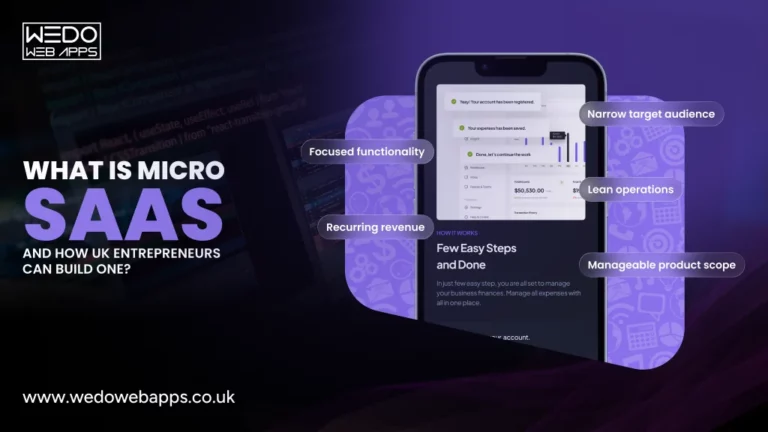
A product generally fits the micro-SaaS model when it has several of these characteristics:
- Narrow target audience:It serves a clearly defined customer segment or niche.
- Focused functionality: It solves one primary problem instead of covering an entire business function.
- Lean operations: A small team can manage product development, support, and day-to-day operations.
- Recurring revenue: Customers typically pay through monthly or annual subscriptions.
- Manageable product scope: The initial product can be developed and improved without the complexity of a large SaaS platform.
However, micro-SaaS does not simply mean “small software.” The defining factor is the combination of a focused customer problem, limited product scope, and a SaaS-based recurring revenue model.
Micro-SaaS vs Traditional SaaS
The biggest difference between micro-SaaS and traditional SaaS is scope. Both can use subscription-based pricing and cloud delivery, but they typically differ in their target audience, product complexity, team size, and growth approach.
| Factor | Micro-SaaS | Traditional SaaS |
|---|---|---|
| Target Audience | Specific niche or customer segment | Broader market |
| Product Scope | Focused on one core problem | Covers multiple workflows or use cases |
| Feature Set | Lean and purpose-built | More extensive |
| Development Team | Usually small and specialised | Often larger and cross-functional |
| Initial Development | Relatively focused | More complex |
| Customer Acquisition | Niche-focused | Multiple acquisition channels |
| Growth Approach | Deepen value within a niche | Expand customers, features, and markets |
| Operations | Leaner | More resources typically required |
This does not mean a micro-SaaS product cannot grow into a larger software business. In fact, a focused product can start by solving one well-defined problem and expand its capabilities as customer needs become clearer.
For a UK entrepreneur, the distinction is useful when deciding how much product to build initially. If your opportunity centres on a specific recurring problem, starting with a tightly scoped product can help you test the concept before committing resources to a broader platform.
Why is Micro-SaaS Attracting UK Entrepreneurs?
The appeal of micro-SaaS comes from its focused business model. Instead of building a large platform before knowing whether customers will pay for it, you can start with a clearly defined problem and a smaller product scope.
For UK entrepreneurs, this approach can create opportunities across specialised industries where existing software is too broad, expensive, or poorly suited to a particular workflow.
Lower Development Complexity
A focused product usually requires fewer features than a large SaaS platform. This can make the initial development process more manageable and allow you to concentrate resources on the functionality customers actually need.
Opportunities in Underserved Niches
UK businesses operate across highly specialised sectors, from property and professional services to hospitality, recruitment, and construction. A recurring workflow within one of these niches can become the foundation for a focused SaaS product.
Recurring Revenue Model
Micro-SaaS products commonly use monthly or annual subscriptions. This creates a recurring revenue structure, provided the product continues delivering enough value for customers to retain their subscriptions.
Easier Customer Feedback
A clearly defined audience makes it easier to identify potential users, conduct customer interviews, and understand how they currently solve the problem. Their feedback can then guide MVP features and future product improvements.
Leaner Business Operations
A micro-SaaS business can often operate with a smaller team than a traditional software company. This can allow founders to remain closely involved in product decisions, customer feedback, and ongoing improvements while the product establishes its market position.
What Makes a Good Micro-SaaS Idea?
Not every niche problem is a viable SaaS opportunity. A strong micro-SaaS idea needs more than an interesting concept. It should address a recurring problem that a specific group of customers already wants to solve.
Before investing in development, evaluate your idea against a few practical questions.
| Validation Question | What You Need to Establish |
|---|---|
| Who has the problem? | A specific customer segment you can clearly reach |
| How frequently does it occur? | A recurring problem rather than an occasional inconvenience |
| How is it solved today? | Existing software, spreadsheets, manual processes, or outsourced work. |
| What does the problem cost? | Lost time, revenue, productivity, or operational efficiency |
| Would customers pay for a solution? | Evidence of willingness to spend, not just interest |
| Can software solve it effectively? | A problem that can realistically be addressed through a digital product |
| Can you reach the target market? | A practical customer acquisition route within your available resources |
Look for Problems, Not Just Ideas
A common mistake is starting with a feature or technology and then searching for customers. A stronger approach is to identify a specific business problem first.
For example, “an AI-powered SaaS platform” is too broad to validate. A tool that automatically prepares inspection reports for independent UK property managers defines the customer, workflow and potential value much more clearly.
Your idea becomes more compelling when customers already rely on inefficient processes, multiple disconnected tools or repetitive manual work. These pain points can provide a clearer foundation for an MVP and a stronger reason for customers to pay.
If you need help assessing technical feasibility, market requirements and MVP scope before development begins, software consulting to validate your idea can help turn an early concept into a more structured product plan.
Micro-SaaS Ideas for UK Market
The UK market has a wide range of specialised businesses with repetitive workflows that can potentially be addressed through focused software. The opportunity is not necessarily to create another general-purpose business platform, but to solve a specific problem for a well-defined customer group.
Here are some micro SaaS ideas for UK market that demonstrate how niche problems can translate into focused products:
| Micro-SaaS Idea | Target Customer | Problem It Could Solve |
|---|---|---|
| Property inspection management | Independent property managers | Organising inspections, reports, photos and follow-ups |
| Quote follow-up software | Trades and service businesses | Tracking unanswered quotes and follow-up activities |
| Recruitment document tracker | Recruitment agencies | Managing candidate documents, expiry dates and outstanding information |
| Accountant client portal | Small accounting firms | Centralising document requests, client communication and submissions |
| Hospitality task manager | Independent hotels and restaurants | Coordinating recurring operational tasks across teams |
| Contractor compliance tracker | Construction businesses | Monitoring certificates, documentation and renewal dates |
| Specialist booking software | Niche service providers | Managing appointments, customer records and reminders |
| Professional services reporting tool | Consultants and agencies | Automating recurring client reports and status updates |
How to Identify Your Own Micro-SaaS Opportunity
You do not need to copy an existing idea to find a viable niche. Look for workflows where businesses repeatedly:
- Use spreadsheets to manage important processes
- Move information between multiple applications
- Send repetitive emails or reminders
- Manually prepare recurring documents
- Track deadlines across disconnected systems
- Spend significant employee time on administrative tasks
The strongest opportunities often emerge when you understand why the existing solution is inadequate, rather than simply identifying that a particular software category exists.
Before choosing an idea, speak with potential customers and determine whether the problem is frequent, costly and important enough to justify a dedicated solution. This evidence should shape your MVP before development begins.
How to Validate a Micro-SaaS Idea Before Building it
A promising idea is not enough to justify development. Before spending money on design and engineering, you need evidence that your target customer experiences the problem, considers existing solutions inadequate and has a reason to pay for something better.
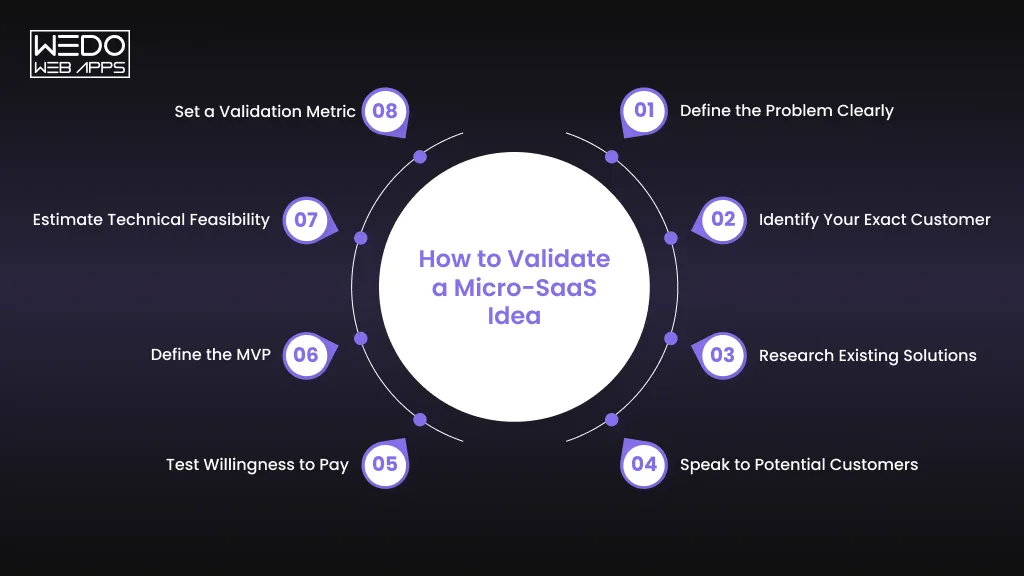
A practical validation process can help you reduce unnecessary development work and define a more focused MVP.
1. Define the Problem Clearly
Describe the problem in one sentence without mentioning your proposed product.
For example, instead of saying “I want to build a property management app,” identify the underlying problem: independent property managers spend too much time preparing inspection reports manually.
2. Identify Your Exact Customer
Avoid targeting broad groups such as “UK businesses” or “small businesses.” Define the people most likely to experience the problem.
Consider their:
- Industry
- Business size
- Job role
- Existing workflow
- Technology usage
- Purchasing authority
3. Research Existing Solutions
Study how potential customers currently solve the problem. Look at competing SaaS products, spreadsheets, manual processes, outsourced services and other workarounds.
The goal is not necessarily to find an untouched market. You need to understand where existing solutions fall short and whether your product can provide meaningful value.
4. Speak to Potential Customers
Customer conversations can reveal problems that keyword research or competitor analysis may miss.
Ask about their current process, time spent, recurring frustrations, existing tools and what they would change. Focus on their actual behavior rather than asking whether they “like” your idea.
5. Test Willingness to Pay
Interest does not automatically translate into demand. Test whether potential customers would consider paying for the solution.
You could use:
- Early-access registrations
- Paid pilots
- Pre-orders
- Prototype demonstrations
- Letters of intent
- Pricing discussions
6. Define the MVP
Once the problem has been validated, identify the smallest version of the product that can solve it effectively.
Separate essential functionality from features that can be introduced later. A narrower MVP allows you to test the core value proposition without unnecessarily increasing development time and cost.
7. Estimate Technical Feasibility
Before development starts, determine whether the product can be built using available technologies, APIs, integrations, and infrastructure.
Consider authentication, data storage, third-party integrations, payments, security, scalability, and ongoing maintenance.
8. Set a Validation Metric
Decide what evidence would convince you that the idea deserves further investment.
For example, you might track the number of qualified users who sign up for an early-access programme, agree to a pilot or convert into paying customers.
The objective of validation is not to prove that your idea is perfect. It is to discover whether a real problem, identifiable customer and viable business opportunity exist before you build the full product.
How to Build a Micro-SaaS Product
Once you have validated the problem and identified your target customers, the next step is turning the idea into a usable product. Knowing how to build a micro SaaS product involves more than writing code. You need to define the right MVP, design a simple user experience, select suitable technology, and prepare the product for secure, reliable operation.
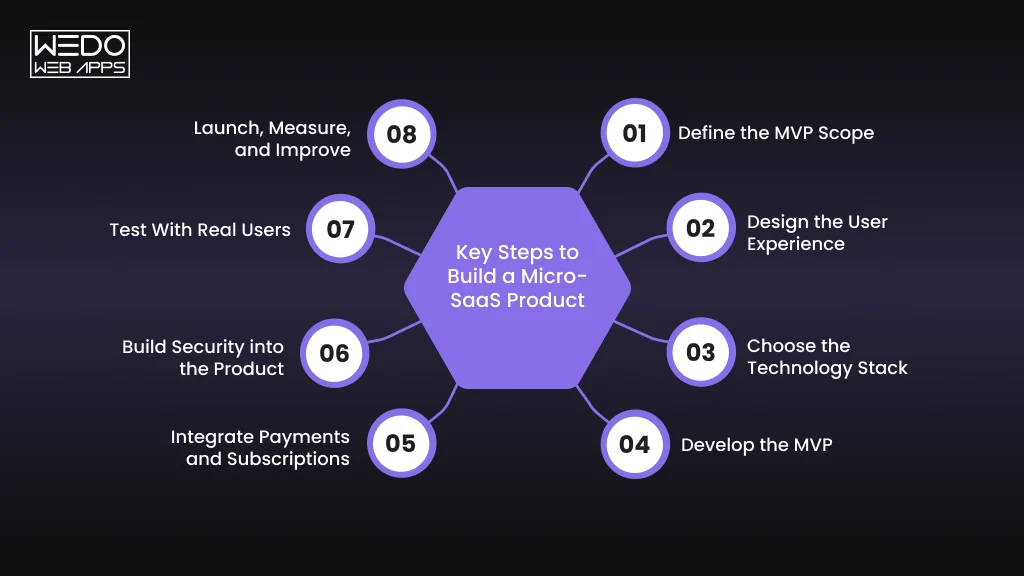
A practical development process can be broken into the following stages:
1. Define the MVP Scope
Start with the smallest feature set that can solve the core customer problem.
Identify:
- The primary user
- The main problem
- The core workflow
- Essential features
- Features that can wait until later
- The outcome you want users to achieve
Avoid adding features simply because competitors offer them. Your MVP should demonstrate the product’s core value as quickly as possible.
2. Design the User Experience
Micro-SaaS products benefit from straightforward experiences. Users should understand what the product does, complete their primary task quickly and know what to do next.
Focus on:
- Simple onboarding
- Clear navigation
- Focused dashboards
- Minimal unnecessary screens
- Responsive design
- Clear calls to action
3. Choose the Technology Stack
Your technology choices should reflect the product’s requirements rather than current development trends.
Consider the requirements for:
- Frontend development
- Backend architecture
- Database management
- APIs and integrations
- Authentication
- Subscription billing
- Analytics
- Hosting and deployment
A suitable stack should support the MVP while leaving enough flexibility for future improvements.
4. Develop the MVP
Build the core functionality in manageable iterations rather than attempting to create the complete product at once.
Development should include regular testing and feedback so technical issues or usability problems can be identified before launch.
5. Integrate Payments and Subscriptions
If the product follows a subscription model, plan billing as part of the product architecture.
Consider:
- Monthly and annual plans
- Free trials, if appropriate
- Payment processing
- Failed payment handling
- Subscription upgrades and cancellations
- Invoices and receipts
6. Build Security into the Product
Security should not be treated as a final-stage addition. Protect user accounts and business data throughout development.
Depending on the product, this may include secure authentication, access controls, encryption, backups, monitoring, and appropriate data retention practices.
For a UK-focused product, you should also consider applicable data protection obligations based on the type of information your SaaS collects and processes.
7. Test With Real Users
Before a wider launch, put the MVP in front of a small group of relevant users.
Observe whether they can complete important tasks, where they encounter friction and which features they actually use. Their feedback can help you prioritise improvements based on real behavior rather than assumptions.
8. Launch, Measure, and Improve
A micro-SaaS product should evolve after launch. Track product usage, customer feedback, conversions, retention and other relevant metrics.
Use these insights to improve the core experience before expanding into additional features or customer segments.
The goal is not to build the largest product possible. It is to build a focused product that solves a real problem, launch it efficiently and improve it using evidence from actual customers.
Choosing the Right Technology for a Micro-SaaS Product
Your technology stack can influence development speed, maintenance, security and how easily your product can handle future growth. For a micro-SaaS product, the goal is not to choose the most advanced technology available. It is to choose technologies that fit your product requirements and can be maintained efficiently.
Frontend
The frontend should make the core workflow simple and responsive. Choose a framework based on the complexity of your interface, performance requirements and development expertise.
For most micro-SaaS products, focus on:
- Fast page loading
- Responsive interfaces
- Accessible components
- Simple navigation
- Reusable UI elements
Backend
The backend handles business logic, authentication, APIs, data processing and integrations. Your choice should depend on expected usage, product complexity and the skills available to maintain it.
A well-structured backend also makes it easier to introduce new functionality without disrupting existing features.
Database
Your database needs to support the type and volume of information your SaaS will manage. Consider data relationships, query requirements, security, backups and expected growth before making a decision.
APIs and Integrations
Many micro-SaaS products become more useful by connecting with tools customers already use. Depending on your product, this could include payment platforms, accounting software, communication tools, calendars or business management systems.
Build integrations around genuine customer requirements rather than adding connections simply to increase the feature list.
Authentication and Payments
User authentication, permissions and subscription management should be considered from the beginning. Your architecture should account for different user roles, secure access, billing status and subscription changes.
Analytics
Product analytics can show how customers actually use your software. Track meaningful events such as onboarding completion, feature usage, conversions and retention rather than collecting data without a clear purpose.
Cloud Infrastructure for Your SaaS
Your cloud infrastructure for your SaaS should support reliable hosting, databases, storage, backups, monitoring and deployment.
You do not necessarily need an elaborate cloud architecture for an MVP. Start with infrastructure that matches your current requirements and can scale as usage increases.
The right approach is to design for future growth without paying for unnecessary complexity today. As your customer base, data volume and product requirements change, you can expand the infrastructure accordingly.
Should You Build a Micro-SaaS Yourself or Hire a Development Team?
Once your idea is validated, you need to decide who will turn it into a working product. Building the MVP yourself can give you direct control, while working with a development team can bring specialised technical expertise and reduce the burden on a non-technical founder.
The right option depends on your technical skills, available time, budget and product complexity.
| Factor | Build it Yourself | Hire a SaaS Development Team |
|---|---|---|
| Technical Skills | You need relevant development expertise | You gain access to specialised developers |
| Initial Control | Direct control over development | Shared through collaboration |
| Development Workload | Managed by the founder or internal team | Handled by the development partner |
| Time Commitment | Can be significant | Founder can focus more on business and customers |
| Technical Planning | Your responsibility | Team can help with architecture and technology choices |
| Scalability Planning | Requires your own expertise | Can be incorporated into the architecture |
| Maintenance | Founder-led or self-managed | Can be supported by the development team |
When Building it Yourself Makes Sense
A founder with strong development experience may be able to create an initial MVP independently, particularly when the product has limited technical complexity.
This approach can work when you:
- Have the required development skills
- Can dedicate sufficient time
- Understand your target customers
- Can manage infrastructure and security
- Are comfortable maintaining the product after launch
When a Development Team Makes More Sense
Working with a SaaS product development team can be useful when you have strong market knowledge but limited technical expertise.
A development team partner can help with:
- Product architecture
- UI/UX design
- Technology selection
- MVP development
- API integrations
- Cloud deployment
- Testing and Security
- Ongoing maintenance
The key is to avoid outsourcing the entire product strategy. You should remain closely involved in customer research, priorities and product decisions while the technical team handles the engineering work.
For founders, this can create a practical division of responsibilities: you understand the customer and business problem, while the development team helps turn that understanding into a reliable product.
How to Launch and Grow a Micro-SaaS Product in the UK
Building the product is only one part of creating a sustainable micro-SaaS business. Once your MVP is ready, you need to reach the right customers, understand how they use the product and improve the experience based on real feedback.
For a UK-focused product, start with a narrow customer segment rather than trying to reach the entire market immediately.
1. Start With a Specific Customer Segment
Choose the customer group that experienced the problem you validated earlier. A focused audience makes your messaging, outreach and product positioning clearer.
2. Create a Focused Landing Page
Your landing page should quickly communicate:
- Who the product is for
- Which problem it solves
- How it works
- What customers can achieve
- How much it costs, where appropriate
- How to start using it
Avoid filling the page with every feature. Lead with the problem and the value of solving it.
3. Build an Early Access List
Before a full launch, collect interested users through your website, industry communities, professional networks or direct outreach.
Early users can provide valuable feedback while helping you identify which customer segments respond most strongly to your proposition.
4. Launch With a Small Customer Group
A controlled launch makes it easier to identify usability problems, technical issues and gaps in your onboarding process.
Instead of immediately pursuing large-scale acquisition, focus on getting your initial customers to successfully use the product and reach its intended outcome.
5. Track Product Usage
Monitor meaningful product metrics such as:
- Sign-up to activation rate
- Feature adoption
- Trial-to-paid conversion
- Monthly recurring revenue
- Customer churn
- Customer acquisition cost
- Customer lifetime value
The specific metrics you need will depend on your business model and customer journey.
6. Improve Retention Before Expanding
Getting users to sign up is only the beginning. If customers do not continue using the product, adding more features or increasing marketing spend will not solve the underlying problem.
Study cancellation reasons, usage patterns and customer feedback. Prioritise improvements that make the core product more useful.
7. Expand Based on Customer Demand
Once the core product has established a clear use case, you can consider additional integrations, features or customer segments.
Expansion should follow evidence from customers rather than a desire to make the product larger.
For a micro-SaaS business, sustainable growth usually comes from becoming highly useful to a defined audience first, then expanding when the product and market provide a clear reason to do so.
How Much Does It Cost to Build a Micro-SaaS Product?
There is no fixed cost for building a micro-SaaS product because the investment depends on what you are building, who will use it and how much technical complexity sits behind the core functionality.
A simple internal workflow tool and a SaaS platform requiring multiple integrations, automated billing and complex data processing can have very different development requirements.
Key Factors That Influence Development Cost
| Cost Factor | What Can Affect the Cost |
|---|---|
| Product complexity | Number and complexity of workflows and features |
| UI/UX design | Custom interfaces, user journeys and responsive design |
| Development team | Team size, expertise and engagement model |
| Integrations | Number and complexity of third-party APIs |
| Authentication | User accounts, permissions and access controls |
| Subscription billing | Plans, trials, invoices and payment management |
| Cloud infrastructure | Hosting, databases, storage, monitoring and backups |
| Security requirements | Data protection, encryption and security testing |
| Testing | Functional, usability, performance and security testing |
| Ongoing maintenance | Bug fixes, updates, monitoring and future improvements |
MVP vs Full Product
One of the most effective ways to control initial investment is to separate the MVP from future product development.
Your MVP should contain only the functionality required to solve the validated customer problem. Features such as advanced reporting, additional integrations, complex automation or multiple pricing tiers can be introduced later if customer demand supports them.
This approach gives you an opportunity to test the product with real users before committing significant resources to features that may not be necessary.
Do Not Choose a Development Approach Based Only on Price
The cheapest development option may not produce the lowest overall cost. Poor architecture, inadequate testing or unsuitable technology choices can create additional expenses when the product needs changes or begins attracting more users.
Instead, assess the development investment against the scope, technical requirements, security needs, expected maintenance and future product direction.
For an accurate estimate, define the MVP requirements first and then have the proposed architecture, integrations and development effort assessed before development begins.
Common Micro-SaaS Mistakes UK Entrepreneurs Should Avoid
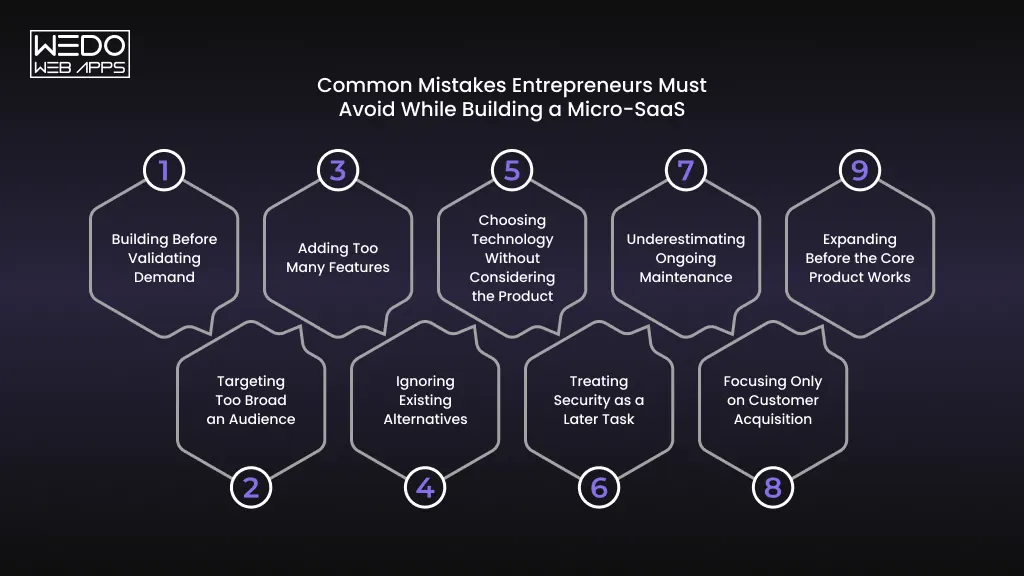
A focused product does not automatically guarantee a successful SaaS business. Many micro-SaaS ideas struggle because founders build too much too early, target an unclear audience or overlook the operational work required after launch.
Avoiding these common mistakes can help you use your development resources more effectively.
Building Before Validating Demand
A polished product cannot compensate for weak market demand. Speak with potential customers and test the problem before committing significant development resources.
Targeting Too Broad an Audience
Trying to serve every UK business can make your messaging, product scope and customer acquisition strategy unclear. Start with a specific audience that has a clearly defined need.
Adding Too Many Features
More features do not necessarily create more value. Unnecessary functionality can increase development costs, complicate the user experience and make your MVP harder to test.
Ignoring Existing Alternatives
Customers may already use another SaaS product, spreadsheet or manual process to solve the problem. Understanding these alternatives helps you identify what your product needs to do differently or better.
Choosing Technology Without Considering the Product
A popular framework or programming language is not automatically the right choice for your SaaS. Consider maintainability, integrations, security, performance and the expertise available to support the product.
Treating Security as a Later Task
User accounts and business data need appropriate protection from the beginning. Security requirements should be considered during architecture, development, testing and deployment.
Underestimating Ongoing Maintenance
Launching the MVP is not the end of development. Your product will require bug fixes, dependency updates, infrastructure monitoring, security improvements and feature enhancements as customer requirements evolve.
Focusing Only on Customer Acquisition
Getting new users is important, but retention matters just as much. If customers do not continue receiving value from the product, increasing acquisition efforts will not address the underlying issue.
Expanding Before the Core Product Works
Adding new markets, integrations or features too early can dilute your development effort. First establish that the core product solves its intended problem consistently, then expand based on customer evidence.
Micro-SaaS vs Traditional SaaS: Which Model Fits Your Business?
The right model depends on the problem you want to solve, the customers you want to serve and the scale you intend to pursue. Micro-SaaS can suit a narrowly defined opportunity, while traditional SaaS may be more appropriate when the product needs broader functionality or serves multiple customer segments.
Use the following questions to assess which direction better matches your business:
| If your priority is... | A model to consider |
|---|---|
| Solving one specific problem | Micro-SaaS |
| Serving a clearly defined niche | Micro-SaaS |
| Testing a focused software concept | Micro-SaaS |
| Starting with a lean product scope | Micro-SaaS |
| Serving multiple customer segments | Traditional SaaS |
| Supporting several related business workflows | Traditional SaaS |
| Building an extensive feature ecosystem | Traditional SaaS |
| Expanding into multiple markets and use cases | Traditional SaaS |
Ask These Questions Before Choosing
Is the problem highly specific?
If your product addresses one recurring problem for a clearly identifiable audience, a micro-SaaS approach may provide a more focused starting point.
Will customers need several connected workflows?
If your product needs extensive functionality across different business processes, a broader SaaS model may be more appropriate.
Can you prove the core value with a small MVP?
If a limited feature set can deliver the primary customer outcome, you may not need to build a large platform initially.
Do you have a clear expansion path?
Consider whether additional features, integrations or customer segments could naturally follow once the core product gains traction.
Ultimately, the distinction is less about the size of the software and more about how narrowly you define the problem, audience and initial product scope. A micro-SaaS product can also evolve over time as customer requirements and business opportunities become clearer.
Final Takeaway
Micro-SaaS is not about building less software simply for the sake of keeping a product small. It is about solving a specific problem for a clearly defined audience with a focused product.
For UK entrepreneurs, the opportunity starts with identifying an underserved or inefficient workflow. From there, the process becomes more practical:
Problem -> Niche -> Validation -> MVP -> Development -> Launch -> Feedback -> Growth
The most important step is to validate the opportunity before investing heavily in development. Once you have evidence of a genuine customer problem, you can define the MVP, choose suitable technology, plan your cloud infrastructure and build a product around the features that matter most.
As your customer base grows, you can use real usage data and feedback to decide which features, integrations or markets are worth pursuing.
If you have a validated idea but need technical expertise to take it from concept to launch, working with an experienced SaaS product development team can help you plan the architecture, build the MVP and establish a foundation for future growth.