Introduction
Your teams may be spending hours processing documents, answering repetitive customer queries, and managing routine workflows that leave little time for strategic work. At the same time, rising operational costs and growing customer expectations are pushing UK businesses to find more efficient ways to operate.
Generative AI is attracting attention. The real challenge is identifying where it can deliver meaningful business results.
Generative AI use cases for UK companies now extend across customer support, document processing, software development, internal knowledge management, and business automation. However, choosing a use case requires more than following an emerging technology trend. You need to understand the potential returns, implementation requirements, and risks involved.
So, how are UK businesses using generative AI in practical business environments? Which applications can improve efficiency? And how can you measure generative AI ROI for UK business before investing further?
This guide explores practical GenAI applications for UK companies, including GenAI for document processing UK, along with the benefits, implementation considerations, and strategies for measuring business value.
What is Generative AI and How are UK Businesses Using it?
Generative AI uses machine learning models to create new content based on the information and instructions they receive. It can generate text, summarise reports, interpret documents, write code, and support conversations.
For businesses, the practical value lies in connecting these capabilities to existing processes. Instead of asking employees to complete every repetitive task manually, you can use Gen AI to assist with research, content creation, customer support, and internal operations.
Recent UK government research shows that businesses are using AI primarily for creative and content creation, administrative support, data analysis, and automation. However, adoption and integration levels vary by business size and industry.
How UK Businesses are Applying Generative AI
| Business Area | Practical Application | Example |
|---|---|---|
| Customer Service | AI-assisted responses and support chatbots | A retail company uses GenAI to answer common delivery and return questions. |
| Document Processing | Extracting, summarising, and classifying information | An insurance team reviews policy documents faster with AI-assisted extraction. |
| Internal Knowledge | Searching company information through conversational interfaces | Employees ask an AI assistant about internal policies instead of searching multiple files. |
| Software Development | Code suggestions, documentation, and debugging support | Developers use AI to draft test cases and explain unfamiliar code. |
The approach you choose should depend on the task, the quality of your data, and the level of human oversight required. A simple AI assistant may be enough for internal questions. More complex workflows may require LLMs, retrieval-augmented generation (RAG), document intelligence, or integrations with your existing business systems.
The goal is not to introduce AI into every department. It is to identify processes where GenAI can reduce manual effort, improve response times, or help your team work with information more effectively.
10 Generative AI Use Cases for UK Companies
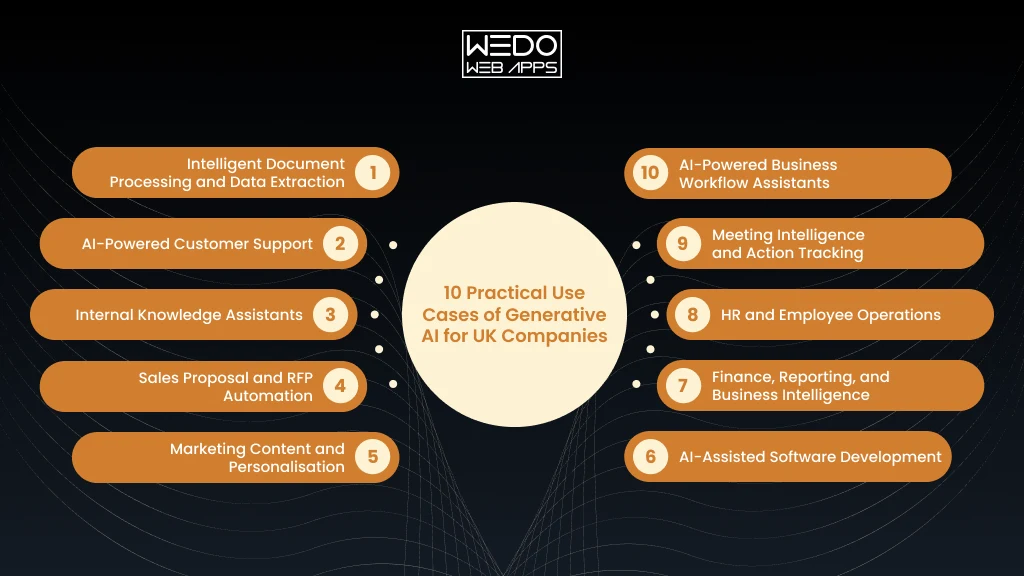
The most valuable generative AI use cases for UK companies are connected to specific business challenges. Whether you want to reduce administrative work, improve customer experiences, or help employees access information faster, the right application depends on your operational priorities.
Here are practical ways businesses can apply GenAI across different functions.
1. Intelligent Document Processing and Data Extraction
Processing invoices, contracts, claims, reports, and compliance documents manually can consume significant employee time. It can also increase the risk of missed information and inconsistent data entry.
Generative AI can help your team extract relevant details, summarise lengthy documents, classify content, and identify missing information.
Example: A UK insurance company can use AI to review claim documents, extract policy details, and flag cases that require human assessment.
With GenAI for document processing UK workflows, businesses can combine LLMs, document intelligence, and human review controls. This allows AI to handle routine processing while employees focus on exceptions and decisions that require judgement.
2. AI-Powered Customer Support
Customer support teams often handle the same questions about orders, account access, refunds, and service availability. GenAI can assist agents by generating relevant responses and retrieving information from approved business resources.
Example: An eCommerce company can use an AI support assistant to draft responses about delivery updates and return policies. A human agent can review the response before sending it when the situation requires additional care.
For more complex support systems, businesses can use RAG-based AI applications to retrieve information from internal knowledge bases and reduce reliance on unsupported model responses.
3. Internal Knowledge Assistants
Your employees may spend considerable time searching through company policies, project documents, product information, and internal guidelines. As your organisation grows, finding the right information becomes more difficult.
A generative AI knowledge assistant can help employees locate relevant information through natural language questions. With LLMs and retrieval-augmented generation (RAG), the assistant can retrieve information from approved internal sources and provide contextual responses.
Example: An employee asks, “What is our process for approving supplier invoices?” The AI assistant retrieves the relevant company policy and summarises the required steps.
This can reduce repetitive questions directed to HR, finance, and operations teams. However, access permissions and source validation should be built into the system to help protect sensitive business information.
4. Sales Proposal and RFP Automation
Preparing proposals and responding to requests for proposals (RFPs) often involves reviewing requirements, collecting internal information, and adapting responses for each prospect.
Generative AI can support this process by helping your sales team:
- Summarise RFP requirements.
- Identify mandatory response criteria.
- Draft proposal sections using approved content.
- Retrieve relevant case studies and service information.
- Highlight missing details for review.
Example: A technology services company can use GenAI to create an initial proposal draft based on a prospect’s requirements and previously approved project information.
AI can reduce preparation time, but commercial terms, pricing, commitments, and technical claims should remain subject to human approval.
5. Marketing Content and Personalisation
Marketing teams need to produce relevant content across websites, email campaigns, social media, and advertising channels. Creating and adapting this content manually can take considerable time, especially when campaigns target different customer segments.
Generative AI can help your team develop content drafts, adapt messaging, summarise customer feedback, and personalise communications based on approved customer data.
Example: A UK eCommerce business can use GenAI to create different email variations for first-time buyers, returning customers, and customers who abandoned their carts.
Potential applications include:
- Product descriptions and campaign copy
- Personalised email content
- Social media content variations
- Customer feedback summaries
- Content repurposing across marketing channels
GenAI can accelerate content production, but your team should review factual claims, brand messaging, and customer data usage before publication. Personalisation should support relevant customer experiences without compromising privacy or trust.
6. AI-Assisted Software Development
Development teams often spend substantial time writing repetitive code, preparing documentation, reviewing changes, and identifying bugs. As applications become more complex, these tasks can slow delivery and increase development effort.
Generative AI can support developers throughout the software development lifecycle. It can suggest code, explain unfamiliar functions, generate test cases, and help identify potential issues.
Example: A UK software company can use an AI coding assistant to generate initial unit tests for a new feature. Developers then review and refine the tests before integrating them into the application.
Common applications include:
- Code generation and completion
- Test case creation
- Code documentation
- Debugging assistance
- Legacy code explanation
- Development workflow support
AI-generated code still requires human review. Your team should validate security, performance, maintainability, and compatibility before deploying changes to production.
7. Finance, Reporting, and Business Intelligence
Finance teams work with large volumes of financial statements, expense records, management reports, and performance data. Preparing summaries and gathering information from different sources can delay important business decisions.
Generative AI can support financial reporting by summarising approved data, explaining performance changes, and helping employees prepare routine reports. When connected to reliable business intelligence systems, it can make complex information easier to understand.
Example: A UK retail business can use an AI assistant to summarise monthly sales performance, highlight changes in operating costs, and prepare questions for the finance team to investigate.
Practical applications include:
- Management report summaries
- Financial document analysis
- Variance explanation
- Natural language queries for business data
- Drafting routine financial updates
AI-generated insights should be checked against trusted financial systems. Sensitive financial information also requires appropriate access controls, validation, and human oversight before it informs important business decisions.
8. HR and Employee Operations
HR teams manage recurring requests involving leave policies, onboarding, employee benefits, and internal documentation. Responding to these questions manually can create unnecessary administrative work.
Generative AI can help employees find relevant information and assist HR teams with routine communication. An AI assistant connected to approved HR resources can provide answers based on company policies and procedures.
Example: A UK company can introduce an internal HR assistant that explains its annual leave policy, shares onboarding instructions, and directs employees to the appropriate forms.
Practical applications include:
- Employee self-service assistants
- Onboarding content and checklists
- Job description drafting
- HR policy summaries
- Internal communication support
Your HR team should review AI-generated responses for accuracy and fairness. Access controls are also essential when the system handles personal employee information.
9. Meeting Intelligence and Action Tracking
Meetings generate valuable information, but important decisions and follow-up tasks can easily get lost in lengthy discussions. Your teams may also spend additional time preparing meeting notes and distributing action items.
Generative AI can transcribe conversations, summarise key points, identify decisions, and draft follow-up tasks. When integrated with collaboration or project management tools, it can help move discussions into actionable workflows.
Example: A UK consulting firm can use an AI meeting assistant to summarise a client discussion, identify assigned responsibilities, and prepare a follow-up email for review.
Useful applications include:
- Meeting summaries and transcripts
- Action item identification
- Decision tracking
- Follow-up email drafting
- Project update preparation
Before deploying meeting intelligence tools, define clear consent, recording, and data retention practices. Human review remains important when meeting summaries influence client commitments or business decisions.
10. AI-Powered Business Workflow Assistants
Many business processes involve multiple steps, systems, and approvals. Employees may need to review incoming requests, update records, prepare responses, and notify the right teams. These repetitive activities can create delays across departments.
Generative AI can assist with workflow coordination by interpreting requests, preparing outputs, and triggering actions through connected business systems. For more advanced processes, AI agents can help manage multi-step tasks within clearly defined permissions.
Example: A UK logistics company can use an AI workflow assistant to review incoming delivery requests, extract essential details, prepare an entry for its operations system, and route exceptions to an employee.
Potential applications include:
- Processing internal service requests
- Routing customer enquiries
- Preparing procurement documentation
- Updating CRM records
- Coordinating approval workflows
AI agents should operate within defined boundaries. Your business needs access controls, approval checkpoints, activity logs, and fallback procedures before allowing AI to perform actions across critical systems.
Businesses looking to connect GenAI with existing platforms can explore generative AI development services to build solutions around their specific operational requirements.
GenAI for Document Processing in UK Businesses
Document-heavy processes are often a practical starting point for generative AI use cases for UK companies. Finance, insurance, healthcare, legal, and professional services teams regularly work with contracts, invoices, claims, reports, and compliance records.
Manually reviewing these documents can delay decisions and increase the effort required to find important information. GenAI can help your team process documents faster while keeping employees involved in tasks that require judgment.
What Can Generative AI Do With Business Documents?
Generative AI can support several stages of document processing:
- Information extraction: Identify names, dates, amounts, clauses, and other relevant details.
- Document summarisation: Convert lengthy reports or contracts into concise summaries.
- Classification: Organise documents according to type, department, or business purpose.
- Question answering: Help employees find specific information within approved documents.
- Anomaly identification: Flag missing information or inconsistencies for further review.
For example, a UK financial services company can use document intelligence to extract information from submitted forms. An LLM can then summarise the content and route incomplete applications to the appropriate employee.
How LLMs and RAG Improve Document Workflows
Different document tasks require different technical approaches. An LLM can generate summaries and interpret extracted information. RAG can help an AI system retrieve relevant content from a trusted document repository before generating a response.
This combination can be useful when employees need answers grounded in company policies, contracts, or operational records.
However, AI should not automatically approve every extracted result. Your workflow should include validation rules, confidence checks, and human review for sensitive or high-impact decisions.
Complex document workflows may require custom LLM development services to connect language models with trusted business data and retrieval systems.
How to Measure Generative AI ROI for UK Businesses
Investing in generative AI does not automatically translate into business growth. You need to establish what the technology is expected to improve and how you will measure that improvement.
A successful AI project might reduce document processing time, lower support costs, improve employee productivity, or help your team respond to customers faster. The right measurement depends on the use case.
Which Metrics Should You Track?
Your ROI framework should connect AI activity to measurable business outcomes. Useful metrics include:
| Metric | What it helps you measure |
|---|---|
| Processing time | How much faster employees complete a task |
| Cost per task | Whether AI reduces operational expenditure |
| Automation rate | The percentage of tasks completed without manual intervention |
| Error rate | Whether accuracy improves or declines |
| Employee adoption | How frequently teams use the AI solution |
| Customer response time | Whether service becomes faster |
| Revenue impact | Whether AI contributes to additional sales or retention |
For example, if your team spends 15 minutes processing one document and AI reduces the average time to 5 minutes, you can calculate the time saved across your monthly document volume. Include implementation, maintenance, training, and usage costs before assessing the overall return.
A Practical Approach to Measuring GenAI ROI
A useful process involves four steps:
- Establish a baseline: Record the current cost, time, accuracy, and workload.
- Define measurable targets: Set realistic goals for the selected AI use case.
- Track performance after implementation: Compare results against the original baseline.
- Review total costs: Include development, integration, AI usage, maintenance, and employee training.
UK businesses are increasingly focusing on cost visibility and measurable value as AI adoption expands. KPMG reported in July 2026 that 31% of UK business leaders identified limited understanding of AI usage costs as a deployment challenge.
An effective AI adoption strategy can help your business prioritise use cases, define success metrics, and assess implementation feasibility.
How UK Businesses Can Implement Generative AI Successfully
Choosing the right generative AI use cases for UK companies is only the beginning. Your business also needs a practical implementation strategy that connects AI capabilities with existing workflows, reliable data, and measurable objectives.
A focused rollout helps you identify what works before committing significant resources to a wider deployment.
1. Identify a Specific Business Problem
Start with a process that creates measurable friction. This could be slow document reviews, repetitive customer enquiries, or time-consuming internal reporting.
Example: Instead of introducing an AI assistant across every department, begin with invoice processing in your finance team. This gives you a defined workflow and clear performance metrics.
2. Review Data Readiness and Security
Your AI solution needs access to relevant and reliable information. Before implementation, review:
- Data quality and availability
- Access permissions
- Sensitive information handling
- Integration requirements
- Data retention and governance
For UK organisations, privacy and security requirements should be considered during solution design rather than after deployment.
3. Select the Right AI Architecture
Not every use case requires a custom-built AI system. Your technical approach should match the complexity of the workflow.
| Business requirement | Possible approach |
|---|---|
| Content drafting | Existing generative AI tool |
| Internal knowledge search | LLM with RAG |
| Document extraction | Document intelligence with validation |
| Multi-step workflow | AI agent with defined permissions |
| Complex business platform | Custom AI integration |
4. Run a Focused Pilot
Start with a limited group of users and define success criteria before launch. Track time savings, accuracy, adoption, and operational costs.
Once the pilot delivers consistent results, you can refine the workflow and assess whether scaling is justified.
Risks and Considerations When Adopting Generative AI in the UK
Generative AI can improve business operations, but implementation without appropriate safeguards can introduce new risks. Your organisation needs to consider how AI handles information, produces outputs, and interacts with existing systems.
The following considerations can help you build a more controlled adoption strategy.
Data Privacy and GDPR Compliance
AI systems may process customer information, employee records, contracts, or financial data. Using sensitive information without appropriate safeguards can create privacy and compliance concerns.
Practical solution: Define what data the AI system can access. Apply appropriate access controls, minimise unnecessary data collection, and review how information is stored and processed.
Inaccurate or Unreliable Outputs
Generative AI can produce responses that sound convincing but contain incorrect information. This can create problems when outputs influence financial decisions, customer communication, or operational processes.
Practical solution: Use trusted data sources, validation rules, and human approval for high-impact tasks. Test the system with realistic business scenarios before deployment.
Security and Unauthorised Access
An AI assistant connected to internal systems may expose sensitive information if permissions are poorly configured. Prompt injection and unsafe system integrations can also create security risks.
Practical solution: Apply role-based access controls, monitor system activity, restrict tool permissions, and conduct security testing before allowing AI to perform business actions.
Lack of Human Oversight
Not every task should be fully automated. Decisions involving legal obligations, employee matters, financial approvals, or customer disputes may require human judgement.
Practical solution: Introduce human-in-the-loop controls. Let AI handle suitable routine tasks while employees review exceptions and approve sensitive outcomes.
Your AI strategy should balance efficiency with accountability. The objective is to create a system your teams can use confidently while maintaining appropriate oversight.
How Much Does It Cost to Implement Generative AI for a UK Business?
The cost of implementing generative AI depends on what you want the system to achieve. A basic AI assistant may require limited configuration, while a custom solution connected to your internal platforms can involve more development and ongoing maintenance.
Before setting a budget, you need to understand the technical requirements, expected usage, and business outcomes.
Factors That Influence Generative AI Implementation Costs
| Cost Factor | Why it Matters |
|---|---|
| AI model selection | Different models have varying usage costs and capabilities. |
| Data Preparation | Cleaning, organising, and structuring business data requires resources. |
| Custom development | Complex workflows and tailored features increase development effort. |
| System integration | Connecting AI with CRM, ERP, document management, or other platforms adds complexity. |
| Security and compliance | Sensitive business data may require additional controls and testing. |
| Ongoing maintenance | Monitoring, updates, support, and optimisation create recurring costs. |
For example, a company introducing an internal knowledge assistant may need document processing, RAG, access controls, and integration with existing systems. A simple content-generation workflow may require a much smaller technical setup.
Off-the-Shelf Tools vs Custom AI Solutions
Off-the-shelf AI tools can help your team test a use case quickly with limited initial development. However, they may offer fewer options for custom workflows, advanced integrations, or organisation-specific controls.
Custom generative AI solutions provide greater flexibility when your business needs specialised functionality, internal data connections, or more detailed governance. They also require careful planning for development and long-term operating costs.
Your decision should be based on the complexity of the problem, data sensitivity, expected usage, and measurable business value rather than the initial software price alone.
The Future of Generative AI for UK Companies
Generative AI is moving beyond standalone content-generation tools. Businesses are exploring how AI can support connected workflows, provide contextual insights, and assist employees with more complex tasks.
The next stage of adoption will depend on how effectively organisations combine AI capabilities with reliable data, existing systems, and clear operational controls.
From AI Assistants to AI Agents
AI assistants typically respond to questions or support individual tasks. AI agents can handle multiple steps within a defined workflow, such as retrieving information, preparing an output, and requesting approval.
Example: A procurement agent could review a purchase request, check relevant policy requirements, prepare documentation, and route the request to an authorised employee.
Agent-based systems still require clear permissions and monitoring. Greater autonomy should be introduced gradually, based on the sensitivity and complexity of the task.
More Contextual and Connected AI
Future generative AI use cases for UK companies will increasingly involve systems that can work with business-specific information and existing applications.
Potential developments include:
- AI assistants connected to enterprise knowledge bases
- Context-aware customer service systems
- Automated workflows across business applications
- AI-supported analysis of operational data
- Personalised employee productivity tools
Businesses that focus on practical use cases, measurable outcomes, and responsible implementation can build a stronger foundation for scaling AI as their needs evolve.
Conclusion
Generative AI is becoming a practical opportunity for UK businesses looking to improve efficiency, reduce repetitive work, and deliver better customer experiences. From document processing and internal knowledge assistants to workflow automation, its applications extend across multiple business functions.
The right approach starts with a clear business problem. You need to evaluate the available data, select a suitable AI architecture, and define measurable outcomes before scaling implementation.
Understanding generative AI ROI for UK business is equally important. Track improvements in processing time, operational costs, accuracy, and employee productivity to determine whether your investment is delivering meaningful value.
Whether you are exploring GenAI for document processing UK workflows or planning a broader AI transformation strategy, the next step is to identify the use cases that align with your organisation’s priorities and technical readiness.